
C
cloudshine-sync
September 24, 202614 min read

cloudshine-sync
India’s procurement and supply chain landscape is being rewritten by digital transformation, and the professionals driving that shift usually sit inside one system: SAP. If you have ever wondered how buyers, warehouse managers, and inventory planners keep global supply chains running without chaos, the answer is often SAP Materials Management, or SAP MM. Building a career in SAP MM is one of the most practical ways to move from a functional, process-heavy role into a well-paid, technology-driven consulting path. Whether you are a fresh graduate trying to pick a direction, a procurement executive tired of manual purchase orders, or a warehouse professional who wants to work with enterprise systems instead of spreadsheets, this guide walks you through exactly how to start a career in SAP MM, step by step, from your first day of learning to your first job offer.
SAP MM, short for SAP Materials Management, is a core module of SAP ERP and SAP S/4HANA. It manages the entire procurement and inventory lifecycle, from raising a purchase requisition to receiving goods, verifying invoices, and maintaining accurate stock records. In simple terms, SAP MM is the digital backbone that connects a company’s buyers, warehouses, suppliers, and finance teams inside one integrated system.
For procurement, purchasing, inventory, and logistics professionals, SAP MM is often the natural entry point into the SAP ecosystem because it maps directly onto processes they already understand. Core functions of SAP MM include:
SAP’s mainstream maintenance deadline for its legacy ECC systems is 2027, and the shift to SAP S/4HANA is accelerating fast. Industry research shows that fifty-nine percent of SAP customers are now fully or partially live on S/4HANA, up thirteen percentage points from 2024, while more than sixty percent of ECC customers still have not migrated. That backlog is exactly why demand for skilled SAP MM professionals is rising. Every migration project needs consultants who can configure procurement and inventory processes, test them, and support them after go-live, which keeps SAP MM jobs consistently open across implementation partners, global capability centres, and end-user companies.
A career in SAP MM does not lock you into a single job title. The same core knowledge opens doors into functional consulting, techno-functional roles, S/4HANA procurement specialisation, support and application maintenance roles, and eventually solution architecture. Companies hire SAP MM professionals across implementation partners as well as directly into manufacturing, retail, pharma, and FMCG companies that run SAP internally. This breadth means you can start in a support role and gradually move into higher-paying, higher-responsibility positions without switching domains.
Materials management is not specific to one sector. Manufacturing plants use SAP MM to manage raw material procurement and production planning integration. Retail and FMCG companies use it to control multi-location inventory. Pharma and healthcare companies rely on it for batch-managed, compliance-heavy material tracking. Oil and gas, utilities, and engineering firms use it for high-value asset and spare parts procurement. Because nearly every large enterprise runs some version of SAP, SAP MM career opportunities exist across almost every industry, not just IT services.
Unlike many entry-level roles that plateau quickly, SAP MM offers a visible growth ladder. A fresher typically starts as a support or associate consultant, moves into an implementation consultant role within two to three years, and can progress into a senior consultant, solution architect, or programme manager role over a longer horizon. Many professionals also pick up complementary modules such as SAP SD, SAP WM/EWM, or SAP Ariba, which increases both their market value and the range of projects they can lead.
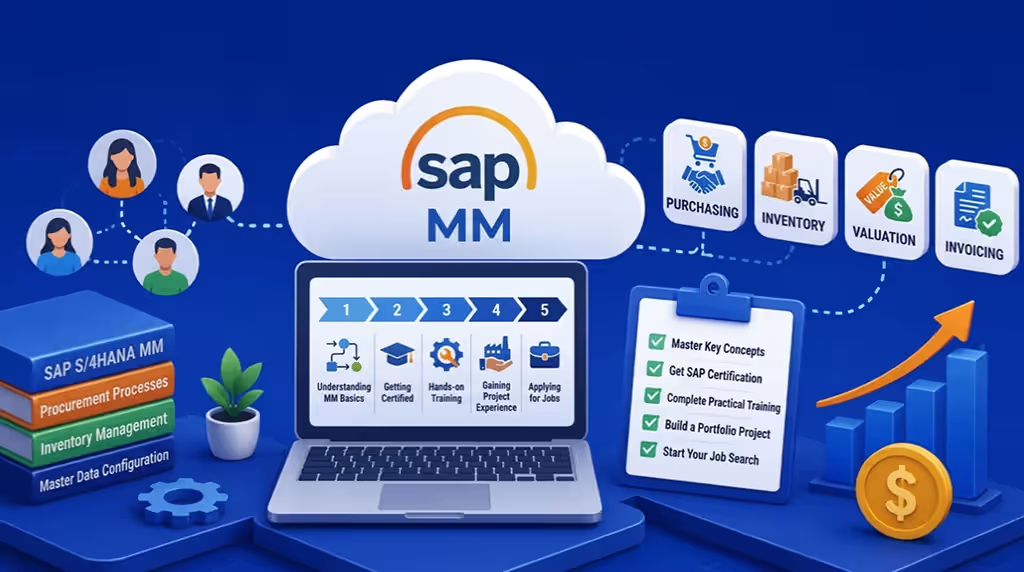
Here is a practical, twelve-step roadmap to help you move from zero SAP knowledge to a job-ready career in SAP MM.
Before you touch the SAP system, get comfortable with the business process SAP MM digitises: procurement and supply chain management. Understand how purchase requisitions turn into purchase orders, how goods receipt and invoice verification work together, and why accurate inventory data matters for production and sales. If you already work in procurement, purchasing, or warehouse operations, you already have this foundation. If you are a fresh graduate, spend a week or two reading about procurement cycles, vendor management, and basic inventory concepts before you start SAP-specific learning. This context makes every SAP MM concept easier to absorb because you are mapping software to a process you already understand, not memorising screens.
Once the business process is clear, start with structured SAP MM fundamentals. This includes SAP navigation, organisational structure (client, company code, plant, storage location, purchasing organisation), and the basic transaction codes used in day-to-day procurement and inventory work. Most learners find it faster to follow a guided course rather than piecing together tutorials, since SAP’s configuration screens and terminology can be overwhelming without context. If you are looking for SAP MM training online, prioritise programmes that give you hands-on access to a live SAP system rather than only slide-based theory, since SAP MM is a hands-on, transaction-heavy module.
SAP MM is built around a set of interconnected processes. Once the fundamentals are clear, go deeper into each of the following areas, ideally practising every transaction inside a real SAP system rather than just reading about it:
Do not try to master everything in isolation. Practise a complete procure-to-pay cycle end to end so you can see how these pieces connect in a real project.
As you gain confidence, decide which direction fits your background and interests best. Common specialisations include:
There is no wrong choice here. Most professionals start in a support or functional consultant role and specialise further once they have real project experience.
Certifications and courses matter, but hiring managers ultimately look for practical skill. Focus on building genuine hands-on competence in SAP system navigation, procurement configuration, purchase order processing, inventory transactions, material master maintenance, supplier management, invoice verification, pricing procedures, and account determination. Beyond the module itself, learn how SAP MM integrates with other modules, since most real projects require you to understand upstream and downstream impacts. Reporting and troubleshooting are equally important: being able to pull the right reports, read error logs, and diagnose why a posting failed is often what separates a support consultant from someone who has only memorised transaction codes.
The single biggest factor in how fast you become job-ready is the quality of your training. Look for a programme that offers real-time project scenarios, access to a live SAP practice instance, trainers who are practising consultants rather than only academic instructors, and support that continues after the course ends. Cloudshine’s SAP MM training programme is built around exactly this approach: working professionals as trainers, hands-on practice access, and placement assistance once you complete the course.
If you are comparing options, ask providers directly how many hours of live system access you get and whether the curriculum has been updated for SAP S/4HANA. And if you are researching SAP MM course fees in Hyderabad or exploring SAP MM course in Bangalore, ask providers these same three questions before enrolling anywhere, regardless of the city.
Both formats can work well. The table below compares them across the factors that matter most for a working professional or a fresh graduate.
| Aspect | Online SAP MM Training | Classroom SAP MM Training |
| Flexibility | High. Learn around a job or other commitments | Fixed schedule, requires physical attendance |
| Cost | Generally lower, no commute or relocation cost | Often higher due to infrastructure and travel |
| Peer interaction | Limited unless the batch is live and interactive | Stronger in-person networking and doubt-solving |
| Hands-on practice | Depends on the remote system access provided | Often easier to get supervised, in-person practice |
| Best suited for | Working professionals and remote learners | Freshers who want structured, in-person guidance |
| Availability | Accessible from anywhere, including smaller cities | Limited to cities with training centres |
Certification is not mandatory to get hired, but it does help you stand out, especially as a fresher with no prior project experience. As of 2026, SAP has largely moved to a subscription-based Certification Hub model, and a typical SAP S/4HANA MM associate certification bundle costs roughly $270 to $600 depending on the plan, translating to approximately ₹24,000 to ₹55,000 when training is included. Always choose the SAP S/4HANA MM certification path rather than the older ECC-based one, since employers increasingly list S/4HANA skills as a requirement, and SAP itself is winding down ECC support ahead of its 2027 deadline.
If you do not have live project experience yet, build a portfolio of practice scenarios: a complete procure-to-pay cycle, a stock transfer process, and an invoice verification exercise with a deliberate mismatch, along with a short write-up of how you resolved it. Many training programmes, including ours, include real-time project simulations for exactly this reason. A portfolio like this gives you concrete talking points in interviews instead of generic textbook answers, and it shows recruiters you can actually operate inside the system, not just describe it.
Structure your resume around SAP MM specific keywords and outcomes rather than generic descriptions. Mention the SAP version you trained on (ideally S/4HANA), the specific processes you practised, any certification, and any project or simulation experience. If you are transitioning from procurement, purchasing, or warehouse operations, explicitly connect your prior domain experience to the SAP processes you now know. Recruiters searching for SAP MM jobs candidates often filter resumes by these exact keywords, so precision matters more than length.
SAP MM interviews typically test three things: your understanding of the business process, your familiarity with SAP configuration and transactions, and your ability to explain integration points with other modules. Be ready to walk through a full procure-to-pay cycle from memory, explain common error scenarios such as invoice mismatches, and discuss how MM connects with FI, SD, and PP. Practising with mock interviews or a peer group before the real thing significantly improves confidence and clarity of answers.
Once you are certified and interview-ready, apply broadly: support roles, implementation partner roles, and direct end-user openings, rather than waiting only for your ideal title. Many strong SAP MM careers start with a support or associate consultant role that builds real project experience within six to twelve months. If you trained with a provider that offers placement assistance, use it actively rather than relying only on job portals. Cloudshine’s placement support connects learners with hiring partners actively looking to fill SAP MM jobs across implementation and support roles.
Once you are established in the field, your SAP MM career can branch in several directions depending on your interests and strengths.
The core role, responsible for configuring, testing, and supporting procurement and inventory processes for a client or internal SAP landscape. Most professionals spend their first several years here before specialising further.
Focuses specifically on S/4HANA’s simplified procurement stack, Fiori apps, and central procurement scenarios. This is currently one of the fastest-growing specialisations given the industry-wide S/4HANA migration push.
Manages tickets, minor enhancements, and day-to-day issues on a live system. A common and realistic entry point for freshers, offering steady project experience.
Sits closer to the business side, combining SAP configuration knowledge with sourcing strategy, vendor negotiation, and procurement policy. Suited to professionals who enjoy the business and process side as much as the system side.
Works across MM, SD, PP, FI/CO, and WM/EWM to ensure processes flow correctly between modules. This role typically requires several years of MM experience plus exposure to at least one other module.
A senior, high-responsibility role designing the end-to-end procurement and inventory architecture for large or multi-country SAP implementations. Usually reached after seven to ten years of progressively senior MM project experience.
If you are currently in procurement, purchasing, warehouse operations, or a non-SAP IT role, structured SAP MM training can be the fastest way to move into a better-paying, more stable career in SAP MM without starting from zero.
Salary expectations vary widely by experience, city, and specialisation. The table below gives a realistic 2027 outlook based on current 2026 market data and the growth expected as S/4HANA adoption accelerates ahead of SAP’s 2027 deadline.
| Role / Level | Experience | Typical Annual Salary (India) | Typical Annual Salary (US) |
| Fresher / Associate Consultant | 0-2 years | ₹4-7 LPA | $55,000-$70,000 |
| SAP MM Consultant | 2-5 years | ₹7-12 LPA | $75,000-$95,000 |
| Senior SAP MM Consultant | 5-10 years | ₹16-22 LPA | $95,000-$130,000 |
| SAP S/4HANA Procurement Consultant | 5+ years | ₹18-25 LPA | $100,000-$140,000 |
| SAP MM Solution Architect | 10+ years | ₹25 LPA and above | $150,000-$200,000+ |
Bangalore, Hyderabad, Mumbai, and Delhi NCR continue to pay a premium over the national average, largely driven by global capability centre and implementation partner hiring. Location matters less than it used to for remote-friendly support roles, but city-based project roles still command ten to twenty percent higher pay in these hubs. As more ECC customers approach SAP’s 2027 deadline, expect SAP MM jobs tied to S/4HANA migration and procurement specifically to command a growing premium over generic ECC-only experience.
Starting a career in SAP MM is not about memorising transaction codes. It is about combining a real understanding of procurement and supply chain with structured, hands-on SAP training. Whether you are a fresh graduate exploring your first serious career direction or a procurement, purchasing, or supply chain professional ready to move into consulting, the twelve-step path above gives you a realistic, proven route from beginner to job-ready.
If you are ready to stop researching and start building real project experience, explore Cloudshine’s SAP MM and S/4HANA Procurement training programmes. With working-professional trainers, hands-on practice access, and placement assistance, we help you turn a plan into an actual SAP MM career, not just another course certificate.
Still weighing your options? Read our related guide on how to choose the right SAP module for your career before you commit to MM specifically.
SAP MM is the SAP module that manages procurement, inventory, and material data. It matters to procurement professionals because it digitises purchase orders, vendor management, and stock control, making it the standard system most large enterprises use to run day-to-day buying and inventory operations.n