
C
cloudshine-sync
August 14, 20269 min read

cloudshine-sync
Reading about Oracle Fusion is not the same as configuring it. Concepts like chart of accounts, absence plans, or supply planning only make sense once you have clicked through the actual screens, and that is exactly why so many learners go looking for an Oracle Fusion Instance for practice before they commit to a course or an exam.
Oracle Fusion Cloud ERP now runs in more than 10,000 organisations worldwide, and the platform posted 22% revenue growth in fiscal 2025 alone, according to Oracle’s own reporting. The global ERP software market is projected to reach $106.22 billion in 2026, growing at a 13% compound annual growth rate, with cloud deployments accounting for over 70% of all new implementations. Behind those numbers sits a simple hiring reality: recruiters want consultants who can demonstrate configurations, not just recite theory.
The challenge is that Oracle does not provide free production access to the public, and most companies restrict system access to employees working on live projects. This guide walks through every realistic way to get hands-on time in a Fusion environment, from free trial resources to dedicated paid instances, so you can pick the option that actually moves your career forward.
Reading documentation teaches you what a screen is supposed to do. Working inside a live environment teaches you what actually happens when you save a configuration, run a process, or hit a validation error. This difference is what separates candidates who can talk about Fusion from candidates who can operate it.
Instance access also directly supports Oracle Fusion certification preparation, since most implementation exams test scenario-based questions that assume you have configured the relevant setup screens yourself, not just watched a demo video.
Beyond exams, practice environments let you simulate real project work such as running a payroll cycle, testing a procure-to-pay flow, or building an OTBI report. That simulated project experience becomes the evidence you show recruiters when they ask, quite reasonably, what you have actually built.
A well-provisioned Fusion environment lets you work across every major pillar of the application suite, rather than on a single isolated module.
Practising across these areas mirrors how an actual implementation project moves from setup to configuration to reporting, which is exactly the kind of end-to-end exposure that hiring managers screen for.
Here’s how the typical learning journey progresses once you have reliable practice access: (Design – Flowchart)
| 1. Training (Learn concepts) | 2. Practice (Oracle Fusion instance) | 3. Certification (Prove your skills) | 4. Job Readiness (Land the role) |
Not every Fusion environment serves the same purpose. Understanding the differences helps you avoid paying for the wrong type of access.
A Sandbox is an isolated testing space where changes do not affect live data. It is the safest place to experiment, break things, and rebuild configurations without worrying about damaging a production system. Most training providers give learners Sandbox-Style access precisely because mistakes here carry no real business risk.
Production Environments run a company’s actual live business operations. Learners are almost never given direct access to a real production instance, both for data security and because an incorrect configuration could disrupt genuine payroll runs or financial transactions. Instead, training providers replicate production-like conditions inside a controlled instance.
Institutes and Oracle partners often provision dedicated Training Instances that mimic real project structures across HCM, SCM, Financials, and PPM. These environments are built specifically to support learners preparing for Oracle Fusion certification exams and are usually available for a defined rental period rather than indefinitely.
| Aspect | Sandbox | Production | Training Instance |
| Purpose | Safe experimentation | Live business operations | Structured learning & practice |
| Data Risk | None, isolated | High, real data | None, isolated |
| Access for Learners | Sometimes available | Almost never | Commonly provided by institutes |
| Modules Covered | Depends on setup | All, live | HCM, SCM, FIN, PPM typically |
| Typical Duration | Project-based | Ongoing | 1 to 6 months, rental-based |
Technically, you can study for the exam using recorded videos and slides alone, but most learners struggle with scenario-based questions if they have never touched a live screen. Online-only training platforms rarely bundle a genuine Oracle Fusion Instance for practice, which is the single biggest limitation of the cheapest course options.
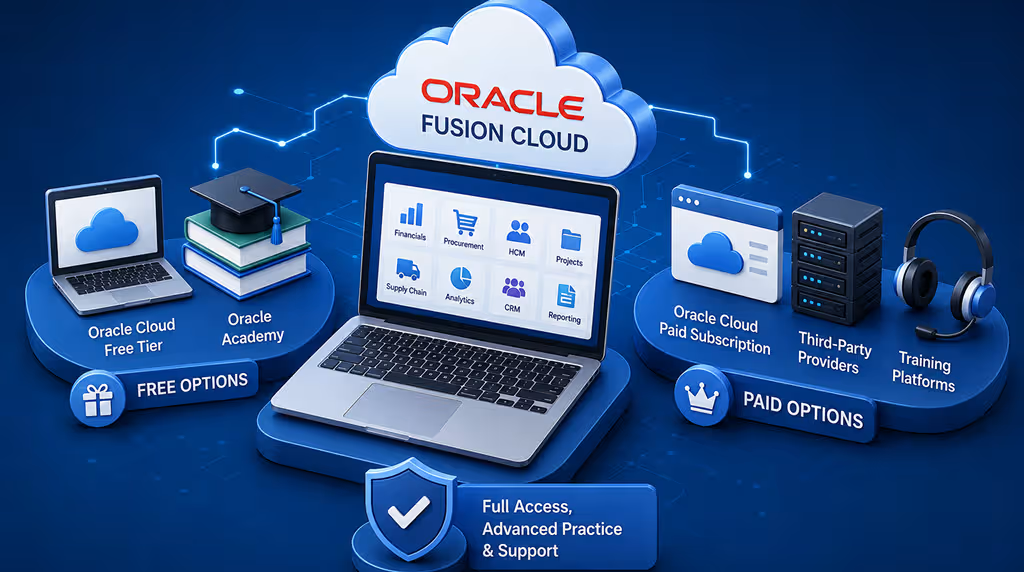
Oracle occasionally offers limited trial access and guided learning labs through its official MyLearn platform, as well as free foundational courses that cover platform navigation. These resources are useful for orientation, but trial windows are short and usually restricted to a narrow set of screens rather than a full implementation-style environment.
Online communities, forums, and some open study groups occasionally share access to shared lab environments or walkthrough recordings. These can help beginners get a feel for the interface, though shared community access is inconsistent and rarely available long enough for serious certification preparation.
Important Note: An important note to keep in mind. Free options are useful for orientation, but they typically offer short access windows, limited modules, shared logins, and no support for real-world project scenarios. Treat them as a starting point, not a substitute for dedicated practice time.
The most reliable route is through a training provider that includes dedicated instance access as part of the course or sells standalone access for learners who have already completed training elsewhere. CloudShine, for example, offers a private Oracle Fusion Instance for practice covering SCM, Financials, HCM, PPM, and EPM, with three months of access typically included in the course fee.
Most reputable institutes bundle live instance hours directly into their course structure rather than treating it as an add-on. CloudShine’s model, delivered through its Oracle Fusion Instance Access program, follows a roughly 60:24 instructor-to-lab ratio, meaning every batch of classroom hours is paired with dedicated practice time in a private or public cloud instance.
Enterprises upskilling internal teams often negotiate dedicated corporate lab environments that mirror their own configuration standards. These setups are more expensive and typically reserved for organisations that train multiple employees at once rather than for individual learners.
Self-paced programs give you instant access on your own schedule but offer little troubleshooting support when something breaks. Instructor-led programs cost more but pair your practice time with a mentor who can explain errors as they occur, considerably shortening the path to Oracle Fusion certification readiness.
| Criteria | Free Options | Paid Options |
| Access Duration | Days to a few weeks | 1 to 6+ months, extendable |
| Module Coverage | Limited, often single module | HCM, SCM, FIN, PPM, EPM |
| Support | Minimal or community-based | Mentor and instructor support |
| Certification Readiness | Partial, needs supplementing | Structured, exam-aligned |
| Best For | Early orientation and exploration | Serious learners and job seekers |
Compare what you get per month of access rather than the headline price alone. A cheaper plan with only two weeks of access can end up costing more per usable hour than a slightly pricier plan that includes three months.
Confirm upfront whether the environment includes the specific modules you plan to specialise in. An instance limited to one module will not help you build the cross-functional understanding that many implementation roles expect.
Ask whether you get private access or a shared public instance, since shared environments can run more slowly and occasionally reset your work when other learners are active at the same time.
Instance access alone is not enough without a structured exercise guide to back it up. Look for providers that pair access with real business scenarios, such as procure-to-pay or hire-to-retire simulations, rather than open access with no direction.
If your goal is to pass an official exam, check whether the environment configuration steps map directly to the current Oracle Fusion certification blueprints, since Oracle periodically updates exam objectives and screen layouts.
Many free trials expire within days, leaving learners with too little time to complete a full end-to-end scenario before their access disappears.
Free resources often unlock only a narrow slice of functionality, which prevents learners from understanding how HCM, SCM, and Financials data actually connect in a real implementation.
Clicking through empty setup screens without a business context rarely builds real skill. Learners need guided exercises that simulate actual project tasks, not just unstructured exploration.
Shared or trial environments sometimes get reset without warning, wiping out configuration work that took hours to build. Dedicated, paid instances generally avoid this problem since the environment is assigned to you alone.
Start with free orientation resources to confirm you enjoy the platform, then move to a paid training instance once you are ready for structured, module-wide practice.
If you are upskilling while employed, prioritise instructor-led access with flexible timing so you can practice around your existing work schedule without losing troubleshooting support.
Focus on scenario-heavy practice across the specific module you specialise in, along with reporting tools like OTBI, since functional interviews frequently ask for configuration walkthroughs.
Technical learners need access that includes integration tools, FBDI data loads, and BI Publisher report building, not just basic navigation through setup screens.
If your primary goal is passing an exam, choose an environment explicitly aligned to current Oracle Fusion certification blueprints, and pair it with practice questions so you can validate readiness before booking the actual test.
Want dedicated, private Fusion Instance access without waiting for a corporate project? CloudShine, a trusted name in Oracle training in Bangalore, provides live SCM, HCM, Financials, and PPM instances, along with structured coursework.
Call or WhatsApp +91-7587123123 or email inquiry@cloudshinepro.com to check current batch and Instance availability.
Free resources are a reasonable place to start, but they were never designed to carry you all the way to job readiness. Their short trial windows and restricted modules make them useful only for early orientation, not for serious exam or career preparation.
If you are serious about becoming implementation-ready, a dedicated Oracle Fusion Instance for practice, paired with structured exercises, is what actually closes the gap between watching a demo and configuring a real business process. Explore CloudShine’s Oracle Fusion Instance Access options and take your practice from theoretical to interview-ready.
Oracle occasionally offers limited trial access and orientation labs through its official MyLearn platform. These are useful for beginners exploring the interface, but access windows are short and module availability is limited.