
C
cloudshine-sync
September 29, 202611 min read

cloudshine-sync
Organizations are sprinting away from clunky legacy ERP systems toward Oracle Cloud applications, and that shift has created a genuine talent gap. Freshers and working professionals are all eyeing Oracle certifications right now, and honestly, for good reason. A certification doesn’t just teach you Oracle, it validates that knowledge in a way recruiters instantly recognize, without them having to take your word for it.
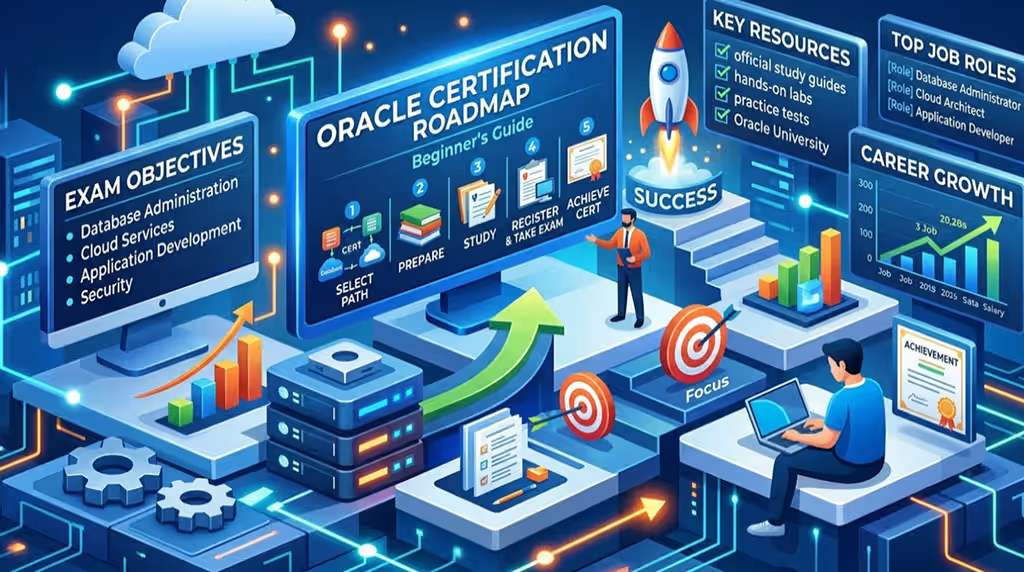
If you are wondering how to get oracle certified without wasting months guessing your way through it, this guide is your complete roadmap for beginners. From choosing the right certification, building real skills, prepping for the exam, and actually landing that first Oracle role afterward, this guide highlights the actual sequence that works.
An Oracle certification is an official credential from Oracle that validates your knowledge and hands-on skills in a specific Oracle technology or Cloud application, HCM, Financials, SCM, or a technical domain like Integration Cloud. Think of it as documented proof that you can actually configure, implement, or support that domain, not just talk about it in an interview.
Unlike a generic online course completion badge, an Oracle certification exam is proctored, standardized, and periodically updated by Oracle itself. This is exactly why employers treat it as a meaningful signal rather than just another line on a resume.
Oracle Cloud adoption is accelerating, and businesses genuinely need professionals who understand both the ERP logic and the cloud-native tools running it.
Across all four groups, certification supports the same outcomes like career growth, better job opportunities, and eligibility for international projects that specifically require verified Oracle Cloud expertise.
It’s also worth noting that many implementation partners and consulting firms now list a relevant certification as a baseline requirement for functional consultant roles, so skipping this step can genuinely narrow your options later.
Before picking a certification, get honest about where you want to end up: ERP consulting, HCM consulting, Finance consulting, SCM consulting, cloud infrastructure, technical development, or integration. Your educational background and any prior work experience should genuinely steer this choice, not whichever certification is trending this month.
Tip: Think about the last time you enjoyed solving a work problem, was it a spreadsheet puzzle, a people-process issue, or a system that just wouldn’t connect properly? That instinct usually points toward finance, HR/SCM, or technical paths respectively. There is no wrong answer here, only a better starting fit for your natural strengths.
Here’s a quick map of who fits where:
If more than one of these genuinely appeals to you, that is fine too. Plenty of successful consultants eventually add a second module once they are established in their first.
Most functional certifications don’t demand prior Oracle experience, though relevant domain knowledge (accounting for Financials, HR for HCM) genuinely helps. Requirements differ by certification, so always double-check the specific prerequisites before committing.
Before you start studying, get clear on exam objectives, topics covered, question format, duration, passing score, and the registration process. Details change, so always verify the latest information directly on Oracle University’s official certification page rather than relying on outdated blog posts.
It is genuinely worth doing this before you buy a single training course. Knowing the exam blueprint upfront helps you judge whether a training program actually covers what you will be tested on, rather than a slightly different and older version of the syllabus.
Build a genuine foundation first with Oracle Cloud concepts, Fusion applications, ERP fundamentals, cloud architecture, business processes, and module-specific concepts. Understanding why something works matters far more than memorizing screen sequences, since exam scenarios often test applied logic, not rote recall.
Beginners who skip this step often hit a wall later. They can follow a configuration tutorial step-by-step but can’t troubleshoot when something looks slightly different in a real business scenario.
Structured training genuinely simplifies this entire journey. Look for instructor-led sessions, hands-on labs, live demonstrations, practical assignments, mentor support, mock tests, and real-world business scenarios, not just recorded slides. Quality oracle fusion training online programs bundle most of this into one structured track.
A good litmus test when comparing providers is to ask to see a sample of the actual sandbox environment or a recorded snippet of a live class. Marketing copy tends to look identical across providers; the actual teaching quality rarely does.
Theory alone won’t cut it. Practice inside real Oracle Cloud environments and sandbox instances, working through configuration exercises, business scenarios, reporting, integrations, and testing. This is genuinely where confidence gets built.
If your training provider does not offer live instance access, that is a meaningful gap worth asking about before you enroll. Watching someone else click through screens is a poor substitute for doing it yourself and occasionally breaking things. Always consider getting hands-on practice with Oracle cloud as a priority while making a choice.
Structure your preparation in stages. Start with fundamentals, core module concepts, advanced topics, hands-on practice, revision, then mock tests. Consistent daily study practice is better than cramming for retention. Besides this, always allocate extra time to whatever topic keeps tripping you up.
Even 45 focused minutes a day, tracked honestly in a simple spreadsheet, tends to outperform an occasional weekend marathon session. This is mostly because spaced repetition genuinely helps concepts stick in long-term memory rather than fading by exam week.
Stick to Oracle’s own documentation, official learning resources, structured training materials, practice exercises, mock tests, and genuine instructor guidance. Outdated dumps or unreliable third-party PDFs waste time and can teach you concepts that no longer match the current exam.
If a resource feels too good to be true, promising guaranteed pass with predictable questions, avoid replying to it. Using it can actually violate Oracle’s certification agreement, putting your credential at risk down the line.
Mock tests reveal your actual readiness, not just your confidence level. They sharpen time management, question interpretation, and topic identification. After every practice test, actually analyze what you got wrong; that’s where the real learning happens, not in the score itself.
Track your scores across multiple attempts too. A single high score can be luck; a consistent upward trend across three or four mock tests is a genuinely reliable signal that you’re ready.
Once you are genuinely ready, confirm the right certification, check current exam requirements, set up your Oracle account, choose your exam delivery option, schedule the test, and review any technical or ID requirements beforehand. Always verify current exam details before booking, since Oracle updates these periodically.
Give yourself a buffer of a few extra days beyond your actual decided date too; last-minute technical hiccups with online proctoring are common enough that a little slack genuinely reduces exam-day stress.
On exam day read every question carefully, manage your time so no single question eats your clock, avoid overthinking straightforward questions, review answers if the format allows, and stay calm. Understanding concepts beats memorized answers every single time, especially on scenario-based questions.
If you hit a genuinely confusing question, flag it and move on rather than freezing. You can always circle back with a clearer head once the easier questions have built some momentum and confidence.
Passing the exam is genuinely just the beginning. Once you know how to get oracle certificate after exam formalities are sorted, build mock implementation projects, work through case studies and business scenarios, practice configuration and support scenarios, and start developing an actual portfolio. Employers consistently favor candidates who can apply certification knowledge. Even two or three well-documented mock projects can make a huge difference.
Clearly list your certification, module specialization, functional and technical skills, projects, internships, training, business-process knowledge, and relevant tools. Using accurate Oracle-specific keywords genuinely improves visibility when your resume passes through an Applicant Tracking System before a human ever sees it.
Avoid burying your certification in a small “Certifications” section at the bottom either. Mentioning it in your summary line at the top ensures it’s one of the first things both the ATS and the recruiter actually notice.
Certification preparation and interview preparation are different games. Practice functional questions, technical questions, scenario-based questions, business-process questions, implementation lifecycle questions, and troubleshooting questions. Interviewers often test how you would handle a messy real situation than working on textbook definitions.
Mock interviews with a mentor or peer, even an informal one over a video call, genuinely expose gaps that silent, solo revision never will.
Search job portals, LinkedIn, Oracle partner organizations, IT consulting firms, ERP implementation companies, recruitment agencies, and campus recruitment drives. Broaden your search beyond just “Oracle Consultant”, roles like Oracle Cloud Analyst, ERP Support Analyst, Junior Functional Consultant, and Business Analyst are genuinely great entry points too.
Set up job alerts for several of these titles simultaneously rather than checking manually every few days. The right opening often gets buried quickly under dozens of newer postings.
A certification opens the door for opportunities, but recruiters are quietly screening for a broader mix of skills. Here is what consistently comes up:
Once you are certified, the job titles you can genuinely target expand considerably. Consider this your realistic starting shortlist, not an exhaustive ceiling for profiles like:
All these choices are genuinely realistic first roles for certified beginners.
Oracle Cloud migration, digital transformation, and cloud ERP adoption show no signs of slowing down. Also, AI-powered enterprise applications and automation are actively reshaping how consultants work day to day.
Add growing global consulting opportunities, remote and hybrid roles, and international project exposure. Oracle certification looks less like a one-time achievement and more like an ongoing career investment that rewards continuous learning. Consultants who stay current by learning new Oracle Cloud updates tend to be the ones trusted with the more interesting, higher-visibility projects, and eventually, the better rates too.
These tips are helpful to clearly understand how to get oracle certificate.
From choosing your certification to passing the exam and landing that first role, this journey rewards patience and consistency far more than shortcuts. Remember that certification is genuinely a starting point to get familiar with fundamentals, hands-on practice, real projects, a sharp resume, and interview readiness; all this matters just as much as the exam itself. Pick a path aligned with your background and goals, and keep learning as Oracle Cloud, AI, and automation keep evolving.
This is exactly where CloudShine can support your roadmap. Whether you are exploring Oracle Fusion HCM training, Oracle Fusion Financials training, or Oracle Fusion SCM training, CloudShine provides access to experienced and Oracle-certified trainers. You also get real sandbox access and structured oracle fusion certification preparation along with a genuine placement support.
Learners exploring oracle fusion training in Hyderabad and across India have built real, job-ready skills through CloudShine’s hands-on, project-based approach. With Cloudshine getting Oracle certified isn’t the achievement but building a career around it is.
Yes, absolutely. Professionals from finance, HR, procurement, and other business backgrounds regularly transition into Oracle Fusion roles through functional certifications, no coding background required.