
C
cloudshine-sync
September 29, 202612 min read

cloudshine-sync
Organisations everywhere are moving finance, HR and supply chain operations onto Oracle Fusion Cloud applications, creating a steady stream of functional consulting openings across every module. Whether you are a fresher, an experienced professional switching modules, or an EBS consultant moving to Fusion, clearing an oracle functional consultant interview in 2026 takes more than screen navigation. Panels probe how well you understand your specific module, since expectations differ across HCM, Financials, SCM, Procurement and Manufacturing, and they look for a blend of functional knowledge, business-process understanding, hands-on exposure and clear communication.
This guide walks through a module-aware roadmap covering fundamentals, business processes, configuration, resume building, certification and mock interviews.
An Oracle Functional Consultant bridges business requirements and the Oracle Fusion Cloud application. They gather requirements from finance, HR, supply chain or procurement teams, translate them into system configuration, run testing cycles, and support end users through go-live. Unlike a technical consultant, who writes integrations, reports and code, a functional consultant works inside the application itself, configuring setups and business rules so the software matches how the organisation operates.
Oracle’s own fiscal 2026 results show Fusion Cloud ERP revenue growing double digits year over year, and Oracle has stated that more than 10,000 organisations run Fusion Cloud ERP applications worldwide, a figure that keeps climbing as companies retire legacy ERP, EBS and PeopleSoft systems. That migration wave is why recruiters are actively screening interview questions for oracle functional consultant candidates across every module.
The following fifteen steps take you from fundamentals to interview day. Work through them in order if you are early in your prep, or jump to the sections most relevant to your timeline.
Before module-specific prep, get comfortable with the Oracle Fusion Cloud architecture and ecosystem as a whole. Be able to explain what Oracle Cloud applications do, walk through core ERP and HCM concepts in plain language, describe the implementation lifecycle at a high level, and state clearly how Oracle Fusion differs from Oracle EBS. Interviewers often open with one of these to gauge your base before going deeper.
Interview preparation should never be generic. A recruiter hiring for HCM will probe entirely different territory than one hiring for Procurement, so identify your target module early and go deep there rather than spreading yourself thin across all five.
Candidates targeting HR-facing roles typically strengthen this module through CloudShine’s Oracle Fusion HCM Training, which pairs Core HR and workforce structures with hands-on sandbox practice.
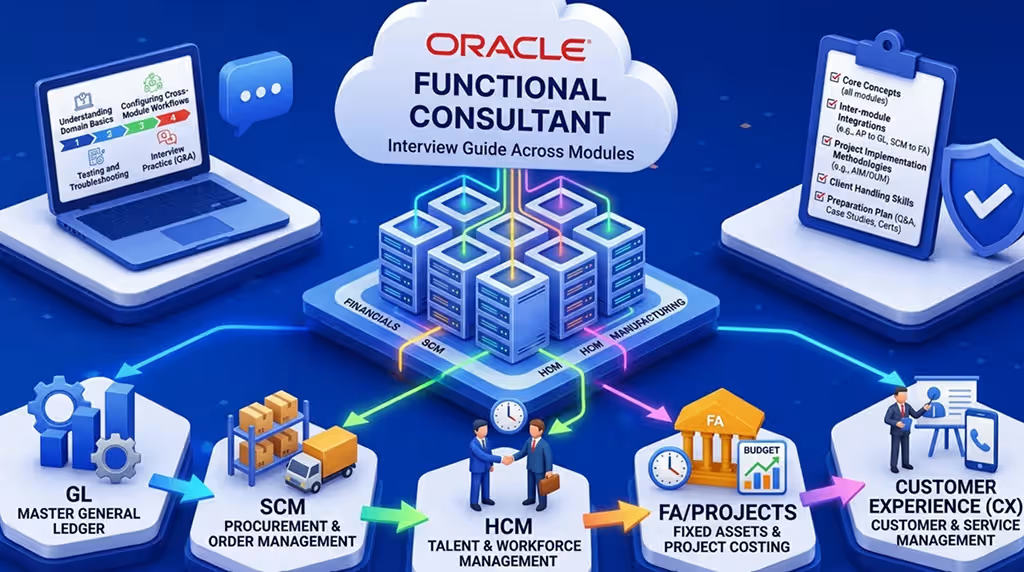
Financials interviews cover General Ledger, Payables, Receivables, Fixed Assets and reporting, which is exactly where most interview questions for oracle finance functional consultant roles concentrate. SCM interviews centre on Inventory, Order Management, Supply Chain Planning and Logistics. Procurement focuses on Purchasing, Supplier Management, purchase orders and approval hierarchies. Manufacturing tests work definitions, work orders and production management, and how it integrates with Inventory.
Functional consultants are hired for business-process judgement, not just screen knowledge. Understand the complete flow tied to your module, how Oracle modules hand off to one another, and practice explaining that flow with a real or mock business example rather than textbook definitions.
Once fundamentals and business processes are solid, move into structured question practice. Most panels mix basic, intermediate and advanced questions, so separate definition-based questions from scenario-based ones early, since each needs a different style of answer. Practice explaining concepts in your own words rather than memorising scripts, since interviewers can tell the difference quickly.
Use the table below as a quick-reference map of what each module’s panel typically probes before you build out full answers of your own.
| Module | What Interviewers Cover |
|---|---|
| Oracle Fusion HCM | Enterprise structures, business units, jobs and positions, worker types, security, absence, compensation |
| Oracle Fusion Financials | Chart of accounts, ledgers, Payables, Receivables, General Ledger, asset accounting, period close |
| Oracle Fusion SCM | Inventory organisations, items, inventory transactions, order management, supply planning |
| Oracle Fusion Procurement | Requisitions, purchase orders, suppliers, sourcing, approval workflows |
| Oracle Fusion Manufacturing | Work definitions, work orders, plants, production processes, material requirements |
Notice how heavily the Financials row leans on ledgers, Payables and Receivables. That is the same territory covered by most interview questions for oracle finance functional consultant panels, so Financials candidates should treat period close and reconciliation scenarios as must-know material rather than a nice-to-have.
Scenario-based questions are one of the biggest differentiators in a modern oracle functional consultant interview, since they reveal how you think under pressure. Structure every answer using problem, analysis, solution, result, and keep it concrete.
| Scenario Type | What to Prepare |
|---|---|
| Requirement changes | Re-scoping configuration without breaking existing setups |
| Configuration issues | Root-cause steps before proposing a fix |
| Approval failures | Tracing and correcting a broken approval hierarchy |
| Data problems | Validating and cleaning data before a load |
| Integration issues | When to escalate versus resolve it yourself |
| Access or testing failures | Isolating a security role or test-script issue |
Configuration questions test whether you can translate a business requirement into an actual Oracle setup, not just describe the screen. For each configuration you have worked on, be ready to explain what was configured, why, which requirement it solved, and how it was tested. Avoid presenting purely theoretical knowledge with no practical example attached.
Almost every panel expects you to walk through the major stages of an Oracle Fusion implementation and explain where a functional consultant sits at each one.
Keep one example ready of what you personally contributed at two or three of these stages, live project or mock implementation.
You are not expected to code, but basic technical awareness makes you more credible. Get comfortable with SQL, APIs, web services, integrations, data migration and reporting fundamentals, and be able to say plainly when an issue belongs with you versus an oracle fusion technical consultant.
Practical experience separates shortlisted candidates from the rest, since it lets you answer scenario questions with a real example instead of a guess. If live implementation experience is not available yet, build it through structured mock projects instead.
Align your resume line by line with the job description instead of sending a generic version everywhere. Recruiters and ATS systems both scan for precise Oracle keywords, so keep them accurate and specific.
Oracle certification demonstrates structured, verified knowledge and helps establish credibility with a panel that has never worked with you before. It rarely closes an offer alone, though, so treat it as one part of your profile, backed by practical knowledge and project experience.
Explore CloudShine’s Certification track alongside your module course to prepare for the exam and the interview together.
Communication is not a soft add-on for a functional consultant, it is core to the job, since you translate between business stakeholders and the system. Panels test this directly through how clearly you explain concepts in the interview itself.
Functional and scenario rounds are usually followed by an HR or behavioural round, and candidates who ace the technical portion sometimes lose the offer here simply from under-preparing for it.
Mock interviews are the single highest-leverage step in this roadmap, since they surface gaps that self-study never reveals. Practice with a mentor or training provider, simulate technical, functional, scenario and HR rounds separately, and record your answers so you can review them honestly and close whatever weak area gets exposed.
Join a CloudShine mock-interview batch before your next Oracle Fusion interview
Once you know your target module, revisit its core topic list one more time in the final week before the interview.
CloudShine’s Oracle Fusion Financials Training, Oracle Fusion SCM Training, Oracle Fusion Procurement Training and Oracle Fusion Manufacturing Training programs map directly to this breakdown.
Preparing thoroughly for an oracle functional consultant interview opens roles across consulting firms, implementation partners and enterprises, spanning IT services, banking, manufacturing, healthcare, retail and logistics.
Fresher salary in Oracle functional consulting depends heavily on module, certification, technical skills, project exposure, location and interview performance, so treat any single number as a starting reference rather than a guarantee. Industry salary trackers such as Glassdoor and training-industry surveys commonly report HCM and SCM freshers with training and certification but no live-project experience starting in the roughly 4.5 to 7 lakh per annum range in India, with mid-level consultants across modules typically reported in the 8 to 16 lakh per annum band within two to three years, and experienced Financials consultants often quoted at 10 to 20 lakh per annum.
These figures come from self-reported salary data and vary by source, city and employer, so use them to gauge direction rather than as a fixed benchmark. What consistently moves candidates up these ranges faster, across every source, is strong functional knowledge, practical experience and relevant certification, which is exactly why the preparation in this guide matters beyond just clearing the interview.
Before walking into the interview, candidates should be able to verify all of the following:
Clearing an oracle functional consultant interview in 2026 comes down to combining module-specific expertise with business-process knowledge, practical experience and clear communication, not any one of those alone. Certification strengthens your profile best when it sits alongside hands-on projects and real configuration examples you can defend under questioning. Whether you are preparing for HCM, Financials, SCM, Procurement or Manufacturing, practising scenario-based questions and running structured mock interviews will do more for your confidence than passive reading. Oracle Fusion and AI capabilities keep evolving every quarter, so treat this preparation as a continuous habit rather than a one-time sprint.
Start your Oracle Fusion interview prep with CloudShine’s instructor-led and self-paced courses
Most panels mix definition questions (enterprise structures, ledgers, workforce structures) with scenario questions on configuration, approvals and testing. Expect at least one question on implementation lifecycle stages and one on how your module integrates with others.