
C
cloudshine-sync
August 11, 202611 min read

cloudshine-sync
If you have been quietly wondering whether now is the right time to learn Workday HCM, here is your answer: yes, and 2026 might just be the best year to start. Organisations across the globe are racing to modernise their HR systems, and Workday sits right at the centre of that shift. Whether you are eyeing a career switch, a fresh start after graduation or simply a more future-proof skill set, structured Workday HCM training genuinely opens doors that were not there five years ago.
The opportunity is not just theoretical either. Consulting firms, global enterprises, and implementation partners are actively hiring certified Workday professionals, and salaries reflect that demand. This is not one of those trends that is easily forgotten tomorrow. HR technology has become genuinely mission-critical to how businesses run, which means the people who understand these systems are becoming just as essential as the systems themselves.
This guide walks you through exactly what Workday HCM is, who it suits, what you will learn, what you can realistically earn and how to choose training that actually leads to a job rather than just a certificate on your wall. Grab your cup of tea, settle in and let us work through this properly.
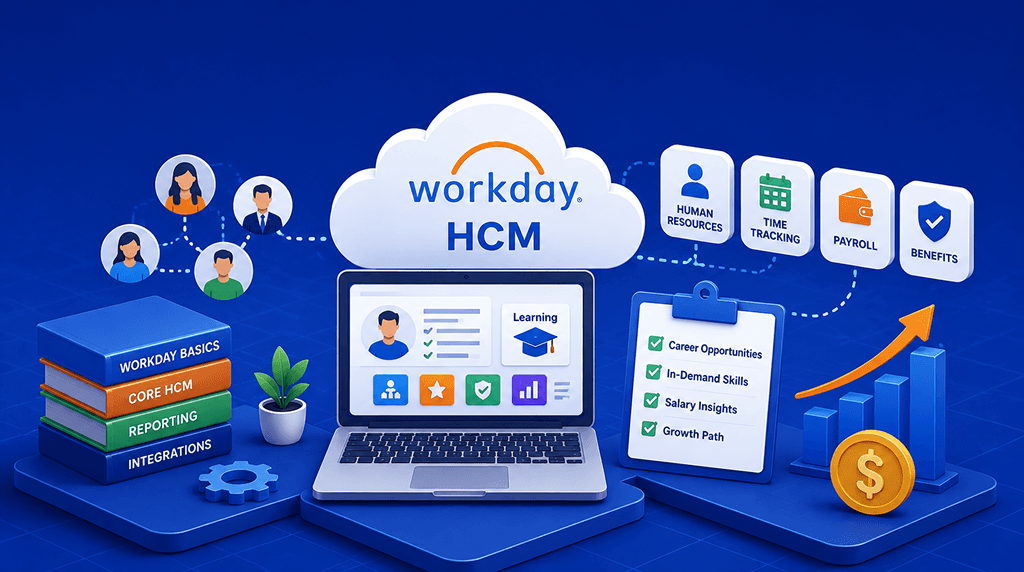
Workday HCM is a cloud-based Human Capital Management platform that brings together core HR, recruiting, talent management, payroll, and workforce analytics into one unified system. Unlike older, on-premise HR software, Workday was built entirely for the cloud from day one, which means it updates twice a year, feels genuinely modern to use, and scales easily as organisations grow.
At its core, Workday HCM helps businesses manage the entire employee lifecycle. From hiring and onboarding through to performance, compensation, and eventually offboarding, every process is within a single connected system rather than a patchwork of disconnected tools. This is precisely why organisations like Netflix, Airbus, and Dell rely on it to run HR operations across multiple countries and time zones.
What makes Workday genuinely different from older enterprise systems is how it was designed from the ground up. Rather than bolting cloud capabilities onto legacy architecture; Workday’s founders built the platform natively for the cloud. This means that updates roll out smoothly twice a year without the disruptive, months-long upgrade cycles that plagued older on-premise HR systems.
For businesses, that translates into fewer IT headaches. For professionals learning the platform, it means the skills you build today stay relevant, since the underlying architecture is not going anywhere.
Digital HR transformation is not slowing down; it is accelerating. Businesses that once managed HR through spreadsheets and legacy systems are now under real pressure to modernise. Employees expect the same intuitive, mobile-friendly experience from HR software that they get from consumer apps. Nobody wants to file a leave request through a clunky, decade-old portal when they can approve it from their phone in seconds.
That pressure translates directly into hiring demand.
This is the growth that consulting firms and enterprises alike are responding to with expanded Workday teams.
This growth is not evenly spread either. It is concentrated heavily in sectors undergoing rapid digital transformation, such as technology, financial services, healthcare and professional services in particular. These are the work sectors where workforce complexity makes a unified HR platform genuinely essential rather than a nice-to-have.
Put simply, businesses need people who can implement, configure, and optimise Workday systems, and right now, supply has not caught up with demand. That gap is exactly where a well-trained, certified professional can step in, and honestly, the earlier you start building that skill set, the more of this growth window you get to benefit from.
If you already understand HR processes such as recruitment, payroll, or performance management, Workday HCM training lets you translate that domain knowledge into a genuinely lucrative technical skill set. Since you already understand the performance factors behind the workflows, your existing HR expertise becomes a real advantage rather than something you need to unlearn.
Graduates with no prior HR or IT experience can absolutely build a career here too. Workday’s intuitive interface makes it a genuinely approachable entry point into enterprise software; provided your training programme includes proper hands-on practice rather than theory alone. Many successful consultants started with zero enterprise software experience and built their entire career from a single and well-structured course.
If you have worked with SAP, Oracle, or other ERP systems before, much of the underlying logic, business processes, security roles, and reporting will feel familiar. You will likely progress through Workday HCM training and placement programmes faster than complete beginners. Also, your existing understanding of enterprise data structures gives you a genuine head start.
Developers and system administrators bring a genuine advantage when it comes to integrations, technical configuration and troubleshooting. These are the areas that increasingly separate average consultants from truly sought-after ones. If you already understand APIs, data mapping or system architecture, moving into Workday’s integration layer often feels like a natural extension of skills you already have.
A genuinely good workday HCM course covers all five areas with real, hands-on configuration practice, not just slides and theory. CloudShine’s Workday HCM Training programme is built around exactly this kind of practical, project-based learning.
Once certified, a Workday HCM skill set can take you in several genuinely rewarding directions.
Many professionals move fluidly between these roles over time and several eventually expand into adjacent ecosystems like Oracle Fusion HCM, particularly at organisations running both platforms in parallel during transitions or acquisitions.
It is genuinely common to see consultants start as generalist HCM Consultants before specialising in integrations or reporting once they discover which part of the platform they enjoy most.
Compensation varies meaningfully by experience, certification, and location, but both markets offer strong earning potential for certified professionals.
| Experience Level | India (Annual, INR) | United States (Annual, USD) |
| Entry-Level (0-2 years) | ₹7,15,000 approx. | USD 93,000 to 100,000 approx. |
| Mid-Level (3-6 years) | ₹11,25,000 approx. | USD 127,995 approx. |
| Senior/Lead (7+ years) | ₹17,31,750 to 22,70,000 | USD 165,242 to 206,749 |
Management consulting firms tend to pay the highest premiums in both markets. Thus; a certification paired with genuine implementation experience at a consulting firm can meaningfully accelerate your earning trajectory.
Demand spans both global implementation partners and the enterprises adopting Workday internally. Major consulting and technology firms, including Deloitte, Accenture, Wipro, IBM, TCS, Fujitsu, PwC, KPMG, Mercer, EY, and Capgemini, regularly hire Workday HCM consultants for client implementation projects.
Beyond these consulting giants, mid-size Workday implementation partners and enterprises undergoing their own internal HR digital transformation also maintain steady hiring pipelines throughout the year.
It is worth noting that hiring patterns differ slightly between consulting firms and end-user enterprises. Consulting firms tend to move faster; often hiring in bursts around new project wins and generally offer broader exposure across multiple clients and industries early in your career.
Enterprises hiring internally, on the other hand, tend to offer more stability and deeper, long-term involvement in a single organisation’s systems, which some professionals genuinely prefer once they have built enough foundational experience.
If you are based in South India and searching for workday training in Hyderabad, it is worth knowing that the city has become a genuine hub for enterprise software talent. It ensures a strong concentration of consulting firms and IT companies actively hiring Workday-skilled professionals locally and for remote-first roles.
Hyderabad’s growing cluster of global capability centres has only accelerated this demand further, making it a genuinely strategic location to build your Workday career from.
Look for instructors with real, hands-on implementation experience; not just presentation skills. Someone who has actually configured Workday for live clients will teach you things no textbook covers, the small workarounds, common pitfalls and practical shortcuts that only come from genuine project experience.
Theory alone will not prepare you for real client work. Prioritise programmes offering live sandbox access and genuine project-based assignments over recorded video libraries. Employers can usually tell within the first interview whether a candidate has actually configured Workday themselves or simply watched someone else do it.
A structured path toward official Workday certification, including mock exams and guided preparation, makes a measurable difference to how confidently and quickly you clear it. A workday HCM certification earned through properly guided preparation tends to stick far better than one crammed for at the last minute.
Perhaps the most important factor of all! Genuine workday HCM training and placement support, including resume building, mock interviews, and direct employer connections, is what actually converts a certificate into a job offer.
Before enrolling anywhere, ask specifically what placement support looks like in practice and not just whether it exists on paper. A vague promise of placement assistance means very little without concrete details on how many learners actually landed roles, and how quickly.
AI is not replacing Workday consultants; it is reshaping what they focus on. Workday’s own Illuminate initiative has introduced AI Agents designed to automate routine HR tasks, flag anomalies in payroll data, and surface predictive workforce insights automatically. This helps in reducing the manual, repetitive work that once consumed so much consultant time.
For professionals, this means the value is shifting toward configuring, governing, and fine-tuning these AI-driven workflows rather than simply setting up static business processes. Consultants who understand how to work alongside AI Agents, rather than seeing them as a threat, are positioning themselves for the roles that will matter most over the next few years.
Think of it less as AI taking over your job and more as AI taking over the repetitive parts of it. This helps in freeing you up to focus on the strategic configuration and problem solving that genuinely requires human judgment.
This is exactly why forward-looking training programmes are beginning to weave AI-readiness into their curriculum rather than treating it as an afterthought. Consultants entering the field today have a real opportunity to build AI-literacy alongside their core Workday skills from the very start.
They have the right support and direction to avoid retrofitting that knowledge onto an established career later, which tends to be a slower, more disruptive process.
Workday HCM training is not just another certification to add to your CV; it is a genuinely strategic career move in 2026. Demand is strong, salaries are competitive in both India and the US, and the range of career paths, from HCM Consultant to Integration Consultant.
This means there is genuinely a fit for HR professionals, freshers, ERP specialists, and IT professionals alike. Very few enterprise technology skills offer this combination of accessibility, strong demand, and genuine long-term career runway.
The difference between a certificate that sits unused and one that actually changes your career often comes down to the quality of your training. It is worth genuinely comparing a handful of programmes before you commit, looking closely at trainer background, project depth and above all, real placement outcomes rather than marketing promises.
CloudShine’s Workday HCM Training programme combines hands-on projects, experienced trainers, and genuine placement support to help you move from learner to job-ready consultant. You can also explore our Workday HCM Certification guide and Workday HCM Tutorial for a deeper look before enrolling.
Ready to take the next step? Explore our blog for more career guidance, or reach out today to start your Workday HCM journey.
Workday HCM is a cloud-based platform that manages the entire employee lifecycle, from hiring to payroll to analytics. It matters because businesses increasingly need connected, modern HR systems rather than fragmented legacy tools. This enables better workforce planning, data-driven decisions, improved employee experiences, and greater operational efficiency.