
C
cloudshine-sync
August 11, 202614 min read

cloudshine-sync
The global ERP software market is set to cross $106 billion in 2026, with cloud deployments now accounting for nearly four in five new implementations. That is why recruiters are flooded with openings for Oracle-skilled finance talent, and why a strong grip on oracle fusion financials interview questions now separates shortlisted candidates from the rest.
This guide covers fifty real fusion financials interview questions across General Ledger, Payables, Receivables, Fixed Assets, Cash Management, and a scenario-based round, answered the way you would say them in a panel interview. Let’s get you interview-ready.
Want hands-on Oracle Fusion Financials experience before your interview? Explore CloudShine’s Oracle Fusion Financials Training.
A quick map of the fifty questions by category, so you can jump to the module you are weakest in.
| Category | Questions | Key Topics |
| Basic Concepts | 10 (Q1-Q10) | Ledgers, chart of accounts, business units, legal entities |
| General Ledger | 10 (Q11-Q20) | Journals, approval workflows, intercompany, period close |
| Accounts Payable | 8 (Q21-Q28) | Invoice types, three-way matching, payments, holds |
| Accounts Receivable | 7 (Q29-Q35) | AutoInvoice, receipts, credit memos, revenue recognition |
| Fixed Assets | 5 (Q36-Q40) | Depreciation, retirement, transfers |
| Cash & Expense Management | 5 (Q41-Q45) | Bank reconciliation, expense audit, cash forecasting |
| Scenario-Based | 5 (Q46-Q50) | Troubleshooting, optimisation, reporting efficiency |
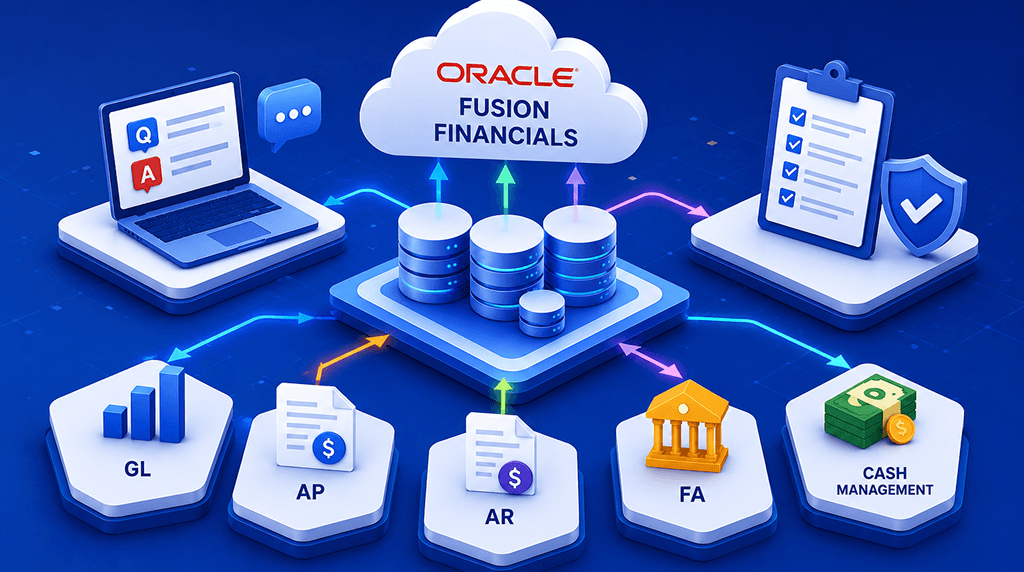
Oracle Fusion Financials is the finance and accounting product family within Oracle Fusion Cloud Applications, Oracle’s cloud-based ERP suite. It replaces the finance modules of on-premises systems like Oracle E-Business Suite with a browser-based, continuously updated platform. Organisations use it to record transactions, close their books, manage supplier and customer accounts, track assets, and generate real-time financial reports from a single data model. Core capabilities include:
Every subledger ultimately posts into the General Ledger, so interviewers almost always start with GL-related oracle fusion financials interview questions before module-specific rounds.
Oracle’s extended support timelines are pushing enterprises off legacy systems like E-Business Suite and PeopleSoft, creating a real demand-supply gap for talent that knows the cloud platform, not just the legacy one. Hundreds of Oracle Fusion Financials roles are open in India at any given time, and functional consultants typically earn ₹10 to ₹20 lakhs per annum depending on experience and certification.
Explore CloudShine’s Oracle Fusion Financials Training for live instance access before your next interview.
Build job-ready Oracle Fusion Financials skills with live projects and expert-led training.
Oracle Fusion Financials is Oracle’s cloud-based financial management suite within Oracle Fusion Cloud Applications. It covers General Ledger, Payables, Receivables, Fixed Assets, and Cash Management on a single, continuously updated platform. Built on Oracle Cloud Infrastructure, it replaces on-premises systems like EBS with real-time reporting, automated workflows, and embedded AI-driven controls.
The core modules are General Ledger, Accounts Payable, Accounts Receivable, Fixed Assets, Cash Management, and Expenses, supported by Subledger Accounting. Many implementations also include Revenue Management, Advanced Collections, and Project Portfolio Management depending on business scope. Together they cover the full record-to-report and procure-to-pay cycles.
Oracle EBS is an on-premises or hosted application requiring manual patching and upgrades, whereas Oracle Fusion Financials is a true SaaS product with quarterly Oracle-managed updates. Fusion also uses a modern Redwood interface, embedded AI features, and a simplified data model compared to EBS’s more rigid architecture.
Benefits include real-time financial visibility, automated period close, multi-currency and multi-ledger support, embedded AI for invoice matching and anomaly detection, reduced IT overhead since Oracle manages infrastructure, and self-service reporting through OTBI and BI Publisher, all of which lower total cost of ownership compared to legacy systems.
A Ledger is the structure that records accounting transactions for a specific chart of accounts, accounting calendar, currency, and accounting method combination. Every journal entry ultimately posts to a ledger, which forms the basis for trial balances, financial statements, and consolidated reporting.
A Chart of Accounts (COA) is the segmented structure used to classify and record every financial transaction, typically including segments like company, cost centre, account, and department. In Oracle Fusion, the COA is built using a flexible structure that supports multiple hierarchies for reporting.
An Accounting Calendar defines the accounting periods, such as monthly or 4-4-5 periods, used to record and close transactions within a ledger. It controls period statuses like open, closed, or permanently closed, ensuring transactions are recorded in the correct fiscal period.
A Business Unit is an organisational entity that processes transactions on behalf of one or more legal entities, such as a specific procurement or sales operation. It groups related transaction data and reporting for functions like Payables, Receivables, and Procurement, independent of the legal entity structure.
A Legal Entity represents a registered company recognised under a specific country’s law, responsible for its own statutory and tax obligations. In Oracle Fusion, transactions trace back to a legal entity to support compliance, intercompany accounting, and statutory financial reporting.
A Primary Ledger is the main accounting ledger used to record an organisation’s day-to-day transactions, aligned to a specific chart of accounts, calendar, currency, and accounting method. Secondary and reporting currency ledgers can be attached to it for additional reporting or compliance.
General Ledger is the central module where all subledger transactions ultimately post as journal entries. It maintains the chart of accounts, ledgers, and accounting calendars, and produces trial balances and consolidated reports.
Journals record debits and credits against specific account combinations. They can be entered manually, imported from subledgers via Subledger Accounting, or generated through recurring or allocation rules, then posted to update account balances.
Journal approval workflows route manually entered or above-threshold journals to designated approvers before posting, based on rules configured in the workflow engine, ensuring no journal updates the ledger without appropriate sign-off.
Journal Import brings accounting entries into General Ledger from external systems, spreadsheets, or subledgers using a standard interface. It validates data against the chart of accounts and calendar before creating postable journal batches.
AutoPost is a scheduled process that automatically posts eligible journal batches meeting defined criteria, such as source, category, or ledger, without manual intervention, speeding up period-end processing of routine journals.
Intercompany Accounting automates recording transactions between two legal entities within the same organisation, generating balanced intercompany receivable and payable entries automatically, so balances reconcile correctly during consolidation.
A Secondary Ledger is an additional ledger attached to a primary ledger, recording the same transactions using a different chart of accounts, currency, or accounting method, typically to satisfy standards like IFRS alongside local GAAP.
Subledger Accounting is the rules-based engine converting transactions from Payables, Receivables, Fixed Assets, and other subledgers into detailed accounting entries before they post to General Ledger, without touching source transactions.
A Reporting Currency is an additional currency maintained alongside a ledger’s primary currency to support statutory or management reporting in a different currency, such as reporting in USD for an INR subsidiary.
Period-end closing involves completing subledger transactions, running Subledger Accounting to post journals, reconciling intercompany balances, reviewing trial balances, and closing subledger and GL periods once reconciliations are confirmed accurate.
Accounts Payable manages the procure-to-pay cycle, covering supplier invoice capture, validation, approval, and payment processing. It integrates with Procurement for purchase orders and General Ledger through Subledger Accounting to record liabilities.
Common types include Standard invoices for goods or services, Credit Memos for supplier credits, Debit Memos for adjustments owed by the supplier, Prepayment invoices for advances, and Mixed invoices combining debit and credit lines.
Invoice Validation checks an invoice against tolerances, matching rules, budgetary controls, and tax setup before it can be accounted or paid. Invoices that fail are placed on hold until the issue is resolved.
Three-Way Matching compares the purchase order, the goods or services receipt, and the supplier invoice to confirm quantities and amounts align before payment is approved, preventing overpayment for undelivered goods.
Supplier payments are processed by selecting eligible invoices, grouping them into a Payment Process Request, and generating payment files through a chosen method, such as electronic transfer or cheque, updating invoice and cash accounts.
A Payment Process Request is the mechanism used to select, group, and build payments for approved supplier invoices based on criteria like due date or payment method, before generating the payment file for disbursement.
Holds are system-applied or manual restrictions that prevent an invoice from being paid until resolved, commonly triggered by price or quantity mismatches, missing purchase orders, or tax discrepancies. They must be released before payment.
Supplier records are managed through the Supplier Portal and Supplier Model, covering profiles, addresses, banking details, tax registrations, and payment terms. Onboarding workflows validate new suppliers before they can be paid.
Accounts Receivable manages the order-to-cash cycle, covering customer invoicing, receipt application, credit memos, and collections. It integrates with Order Management and General Ledger to track what customers owe.
AutoInvoice imports transaction data from upstream systems, such as Order Management or third-party billing systems, and converts it into AR invoices, credit memos, or debit memos after validating the data.
Customer invoices are created manually in the Receivables work area, imported through AutoInvoice from upstream systems, or generated via recurring billing schedules, then completed and posted to update customer balances.
Receipt Management covers recording customer payments, whether received manually, via lockbox files, or through electronic formats, and applying them against open invoices. Unapplied receipts can be matched later.
A Credit Memo is a document issued to reduce a customer’s outstanding balance, typically for returns, billing errors, or agreed discounts. It can be applied against a specific invoice or left on account.
Revenue is recognised using the Revenue Management module, which applies the five-step model from standards like ASC 606 and IFRS 15, allocating transaction price across performance obligations as they are satisfied.
Customer Account Management covers maintaining customer profiles, credit limits, payment terms, and billing hierarchies. It supports collections strategies by giving a consolidated view of a customer’s transaction history.
Oracle Fusion Fixed Assets tracks the full lifecycle of capital assets, from addition and capitalisation through depreciation, transfers, and retirement, integrating with Payables for acquisition and General Ledger for accounting entries.
Common methods include Straight-Line, where cost spreads evenly over useful life, and Declining Balance, which front-loads depreciation. Oracle Fusion also supports units-of-production and flat-rate methods per asset category.
Depreciation is calculated automatically each period based on the asset’s cost, salvage value, useful life, and assigned method. The depreciation program generates journal entries posting to General Ledger through Subledger Accounting.
Asset retirement is removing an asset from active use, through sale, disposal, or write-off. Oracle Fusion calculates any gain or loss by comparing sale proceeds to the asset’s net book value.
Asset transfers move an asset between locations, cost centres, or employee assignments, updating ownership and depreciation allocation without affecting original cost or accumulated depreciation, unless a category change also occurs.
Cash Management provides visibility and control over an organisation’s bank accounts and cash positions, supporting bank statement processing, reconciliation, and forecasting alongside Payables and Receivables activity.
Bank Reconciliation matches transactions recorded in the system, such as payments and receipts, against bank statement lines to confirm they agree, using automatic matching rules alongside manual review for exceptions.
Employee expenses are managed through the Expenses module, where employees submit reports, attach receipts, and route them through approval workflows. Approved expenses flow into Payables and post to General Ledger.
Expense Audit reviews submitted expense reports against policy rules, flagging violations such as missing receipts, duplicate claims, or amounts exceeding limits, before reimbursement is approved and processed.
Cash Forecasting projects future cash inflows and outflows using data from Payables, Receivables, and bank balances, helping treasury teams anticipate liquidity needs and plan borrowing or investment decisions.
I would first check the journal’s status and any error messages, confirm the accounting period is open, verify the account combination is valid and enabled, and review Subledger Accounting rules if the journal originated from a subledger, before correcting and reposting.
I would review the specific hold reason, whether it is a matching, tax, or budgetary hold, compare the invoice against the purchase order and receipt, coordinate with the supplier or requester if data is incorrect, and release the hold once resolved.
I would identify unposted or on-hold transactions in subledgers, reconcile intercompany balances, review suspense or unallocated accounts, and work with module owners to clear exceptions before closing, documenting adjustments for audit purposes.
I would increase touchless processing by tightening three-way matching tolerances, using OCR-based invoice imaging for supplier bills, setting up AutoPost for validated invoices, and monitoring hold trends to fix recurring root causes with requesters or suppliers.
I would standardise recurring reports using OTBI or BI Publisher templates, automate data validation before period close, reduce manual reconciliations through Subledger Accounting rules, and build dashboards giving stakeholders self-service access to real-time data.
Certification does not guarantee an offer, but it changes the shape of an interview. A recognised credential, such as an Oracle Fusion Financials GL Implementation Professional badge, signals structured, verified knowledge, so interviewers spend less time on basic definitions. Compare exam paths on CloudShine’s Oracle Fusion certification roadmap.
Earn industry-relevant Oracle Fusion Financials skills that employers look for
Oracle Fusion Financials interviews reward preparation that goes beyond memorised definitions. The strongest candidates can explain how GL, AP, AR, and Fixed Assets connect to one business process. Use the fifty oracle fusion financials interview questions above as your practice framework, but do not stop at reading. Configure a ledger or process a supplier invoice in a sandbox if you can. CloudShine’s Oracle Fusion Financials Training pairs live instance access with mock interviews and placement support, so your next round of fusion financials interview questions feels like a formality. See also CloudShine’s Workday Finance Interview Questions guide for related accounting concepts from another platform’s perspective.
Yes, freshers can succeed by building a portfolio of lab exercises, such as configuring a chart of accounts, processing a full AP cycle, and running a depreciation schedule in a training instance. Interviewers value demonstrable hands-on practice from structured oracle fusion financials interview questions preparation over prior project experience, especially for entry-level functional roles.