Direct answer: If you need a job-ready, hands-on route choose a vendor bootcamp that provides live Fusion tenants and placement support; if you need vendor authority and formal certification opt for Oracle University; self‑paced courses are best when you need specific skills on a tight budget. This oracle fusion technical training guide cuts through options and shows which path works for Pivoters, Aspirants and Enterprises.
Quick credibility: at CloudShine we’ve trained 500+ consultants, provide live Fusion instances for labs, and run a placement cell—I’ll use that vendor‑bootcamp model as the practical example throughout this guide.
Pick your path: official vs bootcamp vs self‑paced
Direct takeaway: Match the training path to your career stage, timeline and ROI needs—there’s no single “best” route.
Who each path fits: Pivoters (experienced EBS or ERP professionals switching to Fusion), Aspirants (recent grads or career starters), Enterprise buyers (teams needing consistent upskilling), and Specialists (integration or developer-focused engineers). Your persona determines whether you prioritize certification, hands‑on labs, or flexibility. If you want a deeper look at consultant responsibilities, see The Role of an Oracle Fusion Consultant in Successful ERP Implementation, CloudShine.
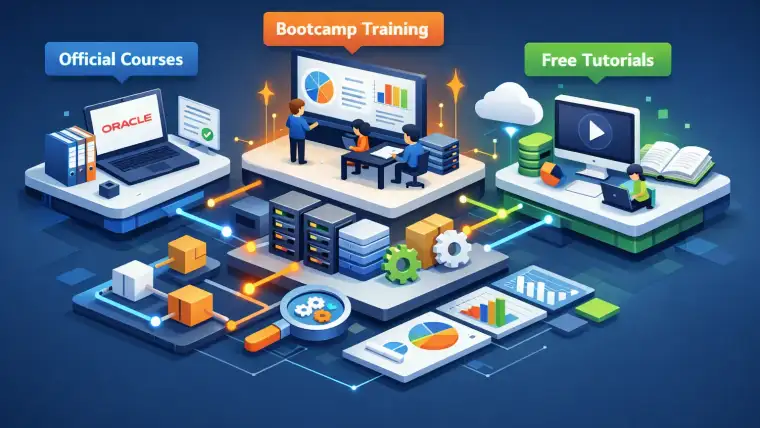
What each path delivers: Oracle University grants official certification authority and the most direct route to badges employers recognize. Vendor bootcamps focus on speed and practice—live tenants, scenario projects and placement prep. Self‑paced courses offer low cost and modular learning for targeted technical skills.
- Decision checklist — before you choose, ask: How many hours/week can I commit? What’s my budget? Do recruiters require certification? Do I need live tenant experience? How quickly must I be job-ready?
Example: a mid‑career EBS consultant who needs to land Fusion consulting gigs fast will generally do better in an intensive bootcamp with live instances and placement coaching than by only buying an Oracle University course and sitting exams.
Actionable takeaway: Decide in three steps—identify your persona, list two non‑negotiable skills (e.g., OIC + OTBI), then choose the provider type that guarantees those outcomes.
Compare costs, timelines and delivery formats
Direct takeaway: Expect exam fees to be fixed (about $245) while course delivery ranges from low‑cost self‑study to high‑value, placement‑oriented bootcamps that often exceed $1,200.
Price ranges: Oracle University exams typically cost ~$245. Self‑paced video courses run $50–$500. Short instructor‑led modules often fall in the $400–$1,200 range; intensive placement bootcamps with live tenants and mock interviews are usually >$1,200.
Timelines: Self‑study can take weeks to months; short instructor‑led classes are days to weeks; immersive bootcamps with placement run 4–12 weeks. Exams are generally ~90 minutes with ~50–58 questions.
ROI example: an Implementation Specialist salary band may increase by $10–30k after moving from legacy EBS to Fusion consulting. If a bootcamp costs $2k, a conservative $15k uplift pays back in under two months on first promotion or new role.
What to verify before you pay: confirm live tenant access hours, total lab hours, trainer experience (years and project background), placement support scope, and refund/guarantee terms. For an authoritative breakdown on certification pricing and what to expect, review what it costs to get Oracle certified.
- Vendor checklist: live tenant availability; minimum lab hours; trainer CVs and real project experience; placement cell services and success metrics; clear refund/guarantee language.
Actionable takeaway: Use the 5‑point checklist above to compare providers side‑by‑side before committing funds.
Core technical skills and which courses teach them
Direct takeaway: Master these core skills—OIC for integrations; OTBI and BI Publisher for reporting; FBDI for data loads; REST/SOAP APIs and ADF/customization—and you’ll be interview‑ready.
OIC (Oracle Integration Cloud): look for OIC modules or integration tracks in vendor bootcamps and Oracle’s integration courses. Practicals should include adapters, mapping, orchestration and error handling.
OTBI & BI Publisher: choose courses with hands‑on report labs. Ideal sessions let you build dashboards and author BI Publisher templates from live data.
FBDI/Data migration: prioritized in migration modules. Good training provides FBDI templates, CSV staging practice and end‑to‑end import runs into a tenant.
Integrations/APIs & customizations: developer tracks covering REST/SOAP, ADF/JDeveloper, Redwood UI and, for advanced work, Oracle AI Agent Studio. Training should combine dev tools with Fusion configuration context. For security-focused guidance relevant to customization and integration work, read Optimizing Oracle Fusion Security: Best Practices for Consultants.
Sample lab projects to build your portfolio: build an OIC invoice sync to a backend accounting system; create an OTBI executive dashboard for AR aging; deploy a BI Publisher invoice template; perform an FBDI employee data migration with reconciliation notes.
Proving skills in interviews: show a tenant walkthrough, export report PDFs, include command‑by‑command migration logs and a short video demo. Employers value repeatable evidence over memorized answers.
Actionable takeaway: Choose two core skills and one capstone project to complete within 90 days and list them prominently on your resume. If your focus includes supply chain modules, our training path Master Oracle Fusion SCM Training Quickly: Your Path to Success outlines SCM-specific labs and projects.
Certification roadmap employers respect
Direct takeaway: Start with Process Essentials, then target a module Implementation Professional (ERP/SCM/HCM) and add Integration/Developer certs for technical differentiation.
Suggested sequence: foundation (Process Essentials) in 0–1 month; module Implementation Professional prep in 2–4 months; integration/developer certs after 6 months once you’ve had labs and a capstone project.
Practical exam notes: plan for ~90 minutes per exam, ~$245 each, and keep delta exams in mind for yearly updates. Preparation must include hands‑on practice, not only reading materials.
Which certs employers value: Implementation Professional tracks for consultants; Integration/Developer certs (OIC, AI Agent Studio) for technical hires. These map to titles like Implementation Consultant, Integration Specialist and can materially shift compensation expectations. For details on specific Implementation Professional tracks, review the Oracle Fusion Implementation Professional track.
Study strategy: combine Oracle MyLearn theory, vendor bootcamp labs, and practice exams. Maintain a practice tenant where you repeat tasks you’ll be asked about in interviews.
Actionable takeaway: Use a 6‑month plan—month 1 foundations, months 2–4 module prep with labs, month 5 exam attempts, month 6 start an integration cert—book exams at least two weeks ahead to fix a deadline. For official certification paths and exam scheduling, see Oracle certification paths.
A 30/90‑day learning plan: weekly milestones and portfolio deliverables
Direct takeaway: Use the first 30 days to gain practical competency and the 90‑day plan to produce demonstrable work for interviews.
30‑day sprint (weeks 1–4): Week 1—complete Process Essentials and set up your practice tenant; Week 2—learn OIC basics and implement a simple integration; Week 3—build an OTBI mini-report and a BI Publisher template; Week 4—perform an FBDI sample load and prepare your capstone demo.
90‑day summary: Month 1 foundations and reporting; Month 2 integrations and data migration depth; Month 3 module configuration, mock interviews and scheduling certification attempts.
Time guidance: weekdays 1–2 hours or weekend blocks of 4–8 hours; aim for a 60:24 training:lab ratio—60 hours of guided instruction balanced with 24+ lab hours where possible.
- Deliverables checklist for hiring: capstone project summary (one‑page); demo video/screenshots with steps; an integration design document (2–3 pages); OTBI dashboard PDF or shared report link.
Interview readiness: complete three mock interviews, do one technical walkthrough with a mentor, and update LinkedIn and your resume with explicit project bullets and artifact links.
Actionable takeaway: Block time in your calendar for the first 30 days now, and commit to the deliverables checklist as your interview portfolio.
Where to enroll: provider shortlist, selection checklist, next steps
Direct takeaway: Oracle University for official certification, self‑paced platforms for low‑cost topic learning, and a practical vendor like CloudShine when you need live instances, mentorship and placement support.
Provider comparisons: Oracle University provides the official curriculum and exam paths; Udemy and other self‑paced platforms fit targeted skill gaps at low cost; CloudShine emphasizes 100% practical labs, live Fusion tenants, 60:24 lab rule, trainers with 15+ years’ experience and a placement cell that runs mock interviews and resume coaching—ideal for Pivoters and Aspirants who need job readiness. For a short primer on choosing a training program before you enroll, read Oracle Fusion Training: Things to Know Before You Learn, CloudShine.
Three-step next actions: choose the path that matches your persona; verify the vendor using the 5‑point checklist above; enroll and schedule your first 30‑day sprint and exam window.
FAQs
Q: How long before I can apply to Fusion technical roles?
A: With focused, hands‑on training you can be interview‑ready in 30–90 days depending on prior experience; intensive bootcamps compress hands‑on exposure and placement prep.
Q: How much does a Fusion certification cost?
A: Expect ~$245 per standard Oracle exam; training costs range from $50–$500 for self‑study to $400–$1,200 for short courses and higher for full placement bootcamps. For an official source on training and certification pricing, see Oracle’s certification information and the Oracle University cost overview linked above.
Q: Which cert should a developer aim for?
A: Start with Process Essentials, then move to Integration/Developer credentials (OIC, AI Agent Studio) after completing practical integration projects.
Q: Do bootcamps guarantee jobs?
A: Some offer placement assistance or guarantees—read terms carefully. What matters most is proven hands‑on experience, mock interviews and employer introductions.
Q: Does CloudShine provide live Fusion instances and placement support?
A: Yes—CloudShine’s model centers on live Oracle Fusion instances, project labs, mentor guidance and a placement cell that provides mock interviews and resume help. Confirm current batch details before enrolling.
Final takeaway: Choose the path that matches your timeline—if you need to show skills quickly, pick a practical bootcamp with live tenants and a placement cell; if you want official badges, layer Oracle University certs on top of hands‑on labs. Block the first 30 days on your calendar today and build a one‑page capstone that proves you can do the work recruiters care about.