
csp@admin
The demand for Oracle Fusion HCM professionals has quietly become one of the most consistent hiring stories in India’s enterprise technology sector. There are currently over 1,700 active Oracle HCM openings in India as of July 2026, with the HCM software market expected to grow at an 11.84% CAGR and reach USD 3.68 billion by 2031.
Organisations across IT services, BFSI, healthcare, manufacturing, and consulting are actively replacing legacy HR systems with cloud-based platforms and Oracle Fusion HCM is the platform leading that transition for many of them.
If you have been considering whether to invest time in learning Oracle Fusion HCM modules, the market is giving you a very clear answer. The question now is not whether to learn it; but, it is how to learn it properly, in the right sequence, without wasting months on the wrong path.
This guide gives you exactly that: a practical, step-by-step roadmap through fusion HCM modules, from fundamentals to certification readiness.
What Is Oracle Fusion HCM?
Oracle Fusion HCM (Human Capital Management) is Oracle’s flagship cloud-based HR platform, built to smoothly manage the entire employee lifecycle, from recruitment and onboarding through to payroll, talent management, learning, and workforce analytics.
Unlike legacy systems such as Oracle EBS (E-Business Suite), which required significant on-premise infrastructure, Oracle Fusion HCM operates entirely in the cloud, receives continuous updates and integrates natively with Oracle’s broader ERP ecosystem, including Financials, SCM and Procurement.
The platform covers an extensive range of fusion HCM modules: Core HR, Absence Management, Time and Labour, Talent Management, Oracle Recruiting Cloud, Learning Cloud, Payroll and Reporting/Analytics. Mastering these modules opens doors to meaningful consulting and implementation roles.
Why Should You Learn Oracle Fusion HCM in 2026?
1. The Demand Is Real and Growing
The average Oracle HCM Cloud Consultant salary in India sits at ₹8.6 LPA, with experienced professionals earning between ₹16–27 LPA. For senior consultants and solution architects, packages of ₹40 LPA and above are documented at major implementation firms; including TCS, Infosys, Genpact and Oracle’s own partner network.
2. AI and Automation Are Increasing Consultant Value
Oracle Fusion HCM is not standing still. Oracle’s AI-powered features, including Journeys (personalised employee guidance), Digital Assistant (conversational HR), and Predictive Workforce Analytics, mean that Oracle Cloud HCM consultants who understand these capabilities are increasingly valued for more than functional configuration. Organisations want consultants who can design AI-supported HR workflows, not just implement standard processes.
3. Certification Adds Credibility
Oracle offers recognised certification tracks for Oracle Fusion HCM modules, including the Oracle HCM Cloud Implementation Professional certification. Certified consultants consistently report faster shortlisting and higher interview conversion rates, particularly in GCC environments and large Oracle partner firms.
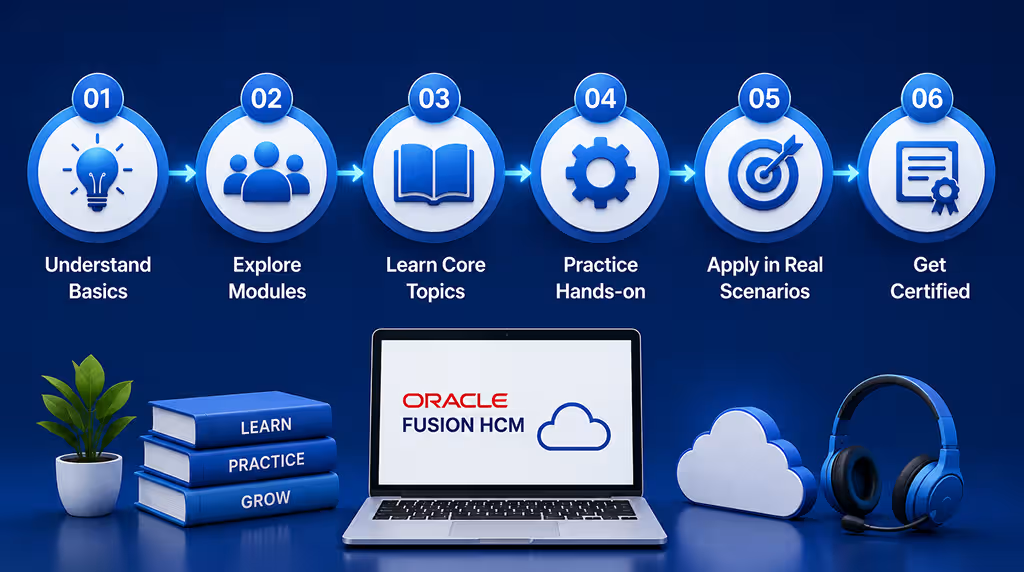
Step-by-Step Learning Roadmap for Oracle Fusion HCM
Step 1: Understand Oracle Cloud and HCM Fundamentals
Before touching any specific module, spend time understanding Oracle Cloud architecture; how the application is structured, how navigation works, and what differentiates Oracle Fusion from legacy systems like EBS. Understand the distinction between ERP (enterprise resource planning) and HCM and familiarise yourself with key Oracle Cloud concepts: tenants, environments, sandboxes and the difference between implementation and production instances.
This foundation prevents the confusion that trips up many learners when they jump straight into configuration without context.
Step 2: Learn Core HR (Global Human Resources)
Core HR is the engine room of Oracle Fusion HCM. Every other module depends on it; which is why experienced consultants consistently say: master Core HR first or struggle with everything else later.
Key concepts to cover:
- Enterprise Structure: Legal entities, business units and reference data sets
- Workforce Structures: Departments, locations, grades and job families
- Jobs and Positions: The critical distinction between job-based and position-based HR models
- Worker Lifecycle: Hire to termination, transfers, promotions and global assignments
- Person Management: Managing personal, employment, and assignment records
Understanding why enterprise structure decisions affect downstream configuration, such as payroll processing, security and reporting, is what separates a functional learner from someone who can actually implement.
Step 3: Learn Workforce Structures and Security
Security in Oracle Fusion HCM is not an afterthought; it shapes everything. Learn how data roles, abstract roles and security profiles interact to control what users can see and do. Understand:
- Person Security Profiles: Who can access whose records
- HCM Data Roles: Combining a job role with a security profile
- User Management: Provisioning, role assignment, and role hierarchy
Misconfigured security is one of the most common implementation errors. Getting comfortable with this early saves significant rework later.
Step 4: Learn Workforce Management Modules
This step covers the operational workforce modules that HR and operations teams use daily:
- Absence Management: Absence types, accrual plans, qualification plans and absence entries
- Time and Labour: Time entry, time cards, approval workflows and payroll integration
- Workforce Scheduling: Resource planning and schedule management
These modules interact closely with payroll, so understanding their data flow is essential before moving into payroll configuration.
Step 5: Learn Talent Management Modules
Talent Management covers the performance and development side of HCM – the modules that organisations use to grow and retain their people:
- Goal Management: Setting, tracking, and aligning employee goals
- Performance Management: Review periods, check-ins, evaluation scales and document types
- Career Development: Development goals, career paths and manager discussions
- Succession Planning: Talent pools, succession plans and readiness ratings
- Talent Review: Talent calibration meetings and nine-box assessments
These are high-visibility modules for HR teams and are frequently discussed in implementation projects with global organisations.
Step 6: Learn Oracle Recruiting Cloud (ORC)
Oracle Recruiting Cloud covers the full hiring lifecycle:
- Job Requisitions: Creating, approving and managing open positions
- Candidate Management: Application tracking, pipeline management and interview scheduling
- Offers: Offer letter generation, approval workflows, and candidate communication
- Hiring: Converting accepted offers into new hires within Core HR
ORC integrates tightly with Core HR, which is why the sequence matters — configuring ORC without a solid Core HR foundation creates gaps that are hard to diagnose.
Step 7: Learn Oracle Learning Cloud
Oracle Learning enables organisations to assign, track and report on employee learning:
- Learning Catalog: Courses, offerings and specialisations
- Learning Assignments: Automatic and manual assignment rules
- Certifications: Completion tracking and expiration management
- Compliance Training: Mandatory training workflows
Understanding how learning integrates with Talent Management, particularly career development and performance, adds significant value to your consultant profile.
Step 8: Learn Oracle Payroll Basics
Payroll is technically complex and varies by country legislation; but a functional understanding of payroll concepts is essential even for non-payroll consultants because it affects element configuration, absence accruals and time data.
Cover:
- Payroll Elements: Earnings, deductions, information elements and element classifications
- Payroll Flow: The sequence from payroll calculation through validation and costing to archiving
- Balance Management: Understanding how balances feed into reports and statutory filings
- Payroll Reporting: Standard reports, prepayments and payment methods
Note that payroll rules, element eligibility, and legislative requirements differ significantly between India, the UAE, the UK, and the US. This makes sure you study the legislation relevant to your target market.
Step 9: Learn Reports and Analytics
Reporting skills dramatically improve a consultant’s usefulness on live projects:
- OTBI (Oracle Transactional Business Intelligence): Ad hoc reporting across HCM subject areas
- BI Publisher: Formatted document and data extract reports
- HCM Extracts: Data extracts for payroll, benefits and third-party integrations
- Dashboards and Infolets: Self-service analytics for managers and HR teams
Consultants who can build and troubleshoot reports independently save significant time on implementation projects and are valued highly during support and post-go-live phases.
Step 10: Practice with a Live Oracle Fusion Instance
Reading about Oracle Fusion HCM modules and practising in a live environment are entirely different experiences. Live instance access allows you to:
- Configure enterprise structures, security profiles, and absence plans
- Process transactions end-to-end and follow approval workflows
- Troubleshoot configuration issues in a real environment
- Build reports and validate outputs
CloudShine offers Oracle Fusion instance access specifically for learners who want to practise in a real Oracle Cloud environment; an important differentiator when most self-study approaches rely entirely on theory.
Ready to practise in a live Oracle environment? Explore CloudShine’s Oracle Fusion instance access and start building real hands-on experience today.
Step 11: Work on Real-Time Projects
Implementation project experience is what hiring managers actually test in interviews. Common project activities include:
- Requirement Gathering (RG): Capturing business requirements through workshops
- Configuration and Build: Setting up modules in a project environment
- System Integration Testing (SIT): Validating configuration against test scripts
- Data Migration: Loading worker, assignment and historical data using HDL/FBDI
- User Acceptance Testing (UAT): Supporting business users through testing cycles
- Go-Live Support: Monitoring production, resolving issues and stabilising the system
CloudShine’s Oracle Fusion HCM Training includes real-time project-based assignments that mirror actual implementation activities, giving learners documented experience to discuss during interviews.
Step 12: Prepare for Oracle Fusion HCM Certification
Oracle’s HCM Cloud certification validates implementation knowledge across Core HR, security and the functional modules you have studied. Preparation strategies include:
- Working through Oracle’s official documentation and learning paths on Oracle University
- Practising with mock exam questions covering configuration scenarios
- Reviewing hands-on labs to reinforce practical knowledge
- Studying implementation scenarios that reflect real-world decision-making
Step 13: Prepare for Oracle Fusion HCM Interviews
Interview preparation for Oracle Cloud HCM consultant roles typically covers:
- Functional questions on Core HR, security and module configuration
- Scenario-based questions: “How would you configure leave plans for a global organisation?”
- Configuration walkthroughs: demonstrating steps in a test environment
- Real-time implementation discussions: describing a project you contributed to
- Resume preparation: accurately representing your module experience and project scope
Recommended Oracle Fusion HCM Learning Sequence
| Stage | Learning Area | Priority |
| Foundation | Oracle Cloud Basics, Core HR | Essential first |
| Structure | Workforce Structures, Security | Before any module |
| Operations | Absence Management, Time and Labour | Mid-stage |
| People | Talent Management, Recruiting, Learning | Mid-to-advanced |
| Finance | Payroll (basics) | Advanced |
| Analytics | OTBI, BI Publisher, HCM Extracts | Parallel with modules |
| Integration | HDL/FBDI, Basic Integration Overview | Advanced |
| Delivery | Real-Time Projects, Certification | Final stage |
Following this sequence ensures each area of learning reinforces what came before it. Core HR configurations affect security profiles. Security affects what users can see in Talent Management. Talent Management connects to Learning. Learning connects to Compliance. The system is a chain and learning it as one makes each step easier.
Online Training vs Classroom Training
| Feature | Online Training | Classroom Training |
| Flexibility | High; learn at your own pace | Fixed schedule |
| Access | Global, 24/7 | Local, time-bound |
| Live Instance | Yes (with quality providers) | Varies |
| Mentor Support | Chat, live sessions, recordings | In-person |
| Cost | Generally lower | Generally higher |
| Placement Assistance | Available (with specialist providers) | Varies |
| Recorded Sessions | Yes, review anytime | Rarely available |
| Real-Time Projects | Included by specialist providers | Variable |
For most working professionals and career switchers, Oracle Fusion HCM training online offers a better combination of flexibility, cost, and access to live environments. CloudShine’s online Oracle Fusion HCM training programme covers all thirteen steps above with instructor-led sessions, recorded access, live instance practice, and placement referrals to MNC companies.
If your organisation needs to upskill an entire team, CloudShine’s corporate training programme for Oracle Fusion HCM offers structured delivery across batches; with customised content mapping and dedicated mentorship.
For those also exploring related platforms, CloudShine’s Workday HCM training covers the comparable Workday modules for professionals who want cross-platform versatility. It is a useful complement for consultants operating in mixed-platform environments where Workday HCM corporate training programs are also in demand.
How AI Is Changing Oracle Fusion HCM Careers?
Oracle’s investment in embedded AI within Oracle Fusion HCM modules is accelerating. Key developments consultants should understand:
- Oracle Digital Assistant: Conversational HR that allows employees and managers to perform actions (raise a leave request, check a payslip) via natural language
- Journeys: AI-personalised employee experience workflows that adapt to individual worker events (new hire, promotion, relocation)
- Predictive Workforce Analytics: Predictive attrition models, flight risk indicators and hiring forecasts built into HCM dashboards
- AI-Powered Talent Review: Automated talent assessments and succession plan recommendations
Consultants who understand how to configure and leverage these features, not just the traditional functional modules, will increasingly stand apart. The combination of HCM functional expertise with AI workflow design is where the premium salaries are moving.
Conclusion
Learning Oracle Fusion HCM is not a linear process; you cannot rush. It has a clear logical sequence: Core HR first, security next, then operational modules, then talent and recruiting, then reporting, then projects and certification. Each stage reinforces the one before it.
The consultants who build careers in this space are not those who cut corners on Core HR to jump to Talent Management. They are the ones who understood the full system, practised in live environments and brought real project experience into every interview.
Take the next step today. CloudShine’s Oracle Fusion HCM Training gives you instructor-led sessions, live Oracle instance access, real-time project exposure, and placement support; everything you need to move from learner to employed consultant. Book your free demo session today.
Frequently Asked Questions
Oracle Fusion HCM is Oracle's cloud-based HR platform covering the full employee lifecycle, from hiring through payroll, performance, and learning. It is suited to HR professionals, payroll executives, IT consultants, MBA graduates, and anyone targeting cloud HCM implementation roles at large enterprises or Oracle partner firms.