
C
csp@admin
October 1, 202612 min read

csp@admin
Oracle Fusion Cloud skills have quietly become one of the hottest things on the wishlist of recruiters in 2026. Companies are retiring legacy ERP systems faster than ever and someone has to actually run the shiny new cloud version. Thus, the demand for Oracle Fusion Cloud skills is at its peak.
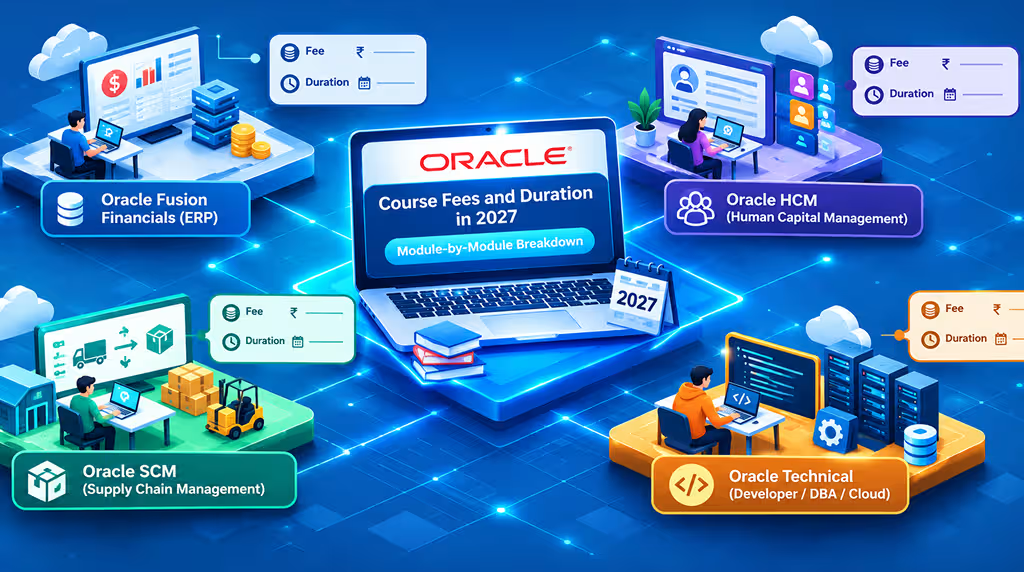
Before you sign up for any course, understanding Oracle course fees and duration genuinely matters. Pricing and timelines vary significantly depending on the module you pick, the training format, your experience level, included certification preparation and how much hands-on project access you actually get.
In this guide, we will break things down module by module, so you walk away with a genuinely useful comparison of fees, duration, learning scope, and career relevance without any guesswork.
Oracle Fusion Cloud is Oracle’s suite of cloud-based enterprise applications that run core business functions, HR, finance, supply chain, procurement, and more, all from a single unified platform rather than a patchwork of disconnected systems. Major application areas include HCM (Human Capital Management), ERP (Enterprise Resource Planning), SCM (Supply Chain Management), Procurement and Financials.
Organizations are adopting it because it genuinely reduces IT overhead, improves reporting accuracy and scales more easily than on-premise legacy systems. This is exactly why demand for skilled Oracle Fusion professionals keeps increasing across various sectors like BFSI, manufacturing, healthcare and IT services.
What makes this shift particularly interesting for job seekers is timing. Plenty of experienced professionals still only know the existing on-premises version of Oracle Applications. This means that the pool of genuinely cloud-ready talent has not caught up with employer demand yet. That gap is exactly where a well-chosen certification, paired with real hands-on practice, tends to pay off fastest.
A handful of factors genuinely decide the price and duration of the oracle course. It includes the module itself, the training provider’s reputation, whether it’s self-paced or instructor-led, whether certification prep and project-based training are bundled in, and whether placement support is included. The traditional theory-based course may cost less than a live and mentor-supported program, but the results may not be what you expected.
Duration follows a similar logic. Beginner-friendly overview courses might run for an average of 20-30 hours. A genuinely implementation-ready and certification-focused program typically runs closer to an average of 60 hours of core instruction combined with additional lab or sandbox practice.
Here’s a general comparison to help you with the budget and duration plan (treat these as indicative ranges, not fixed pricing):
| Oracle Module | Typical Duration | Typical Fee Range (INR) |
| HCM | 50–65 hours | ₹35,000 – ₹55,000 |
| Financials | 50–65 hours | ₹35,000 – ₹55,000 |
| SCM | 55–70 hours | ₹38,000 – ₹60,000 |
| Procurement | 35–50 hours | ₹35,000 – ₹40,000 |
| Manufacturing | 35–50 hours | ₹35,000 – ₹40,000 |
| Integration Cloud | 40–55 hours | ₹35,000 – ₹45,000 |
| ERP (Full Suite) | 70–100+ hours | ₹35,000 – ₹75,000 |
Note: These are broad market estimates meant to help you plan a budget, not a live price list. The actual figures shift based on batch, add-ons and provider. Always confirm current numbers directly with your chosen training provider before enrolling.
One distinction that often confuses people is that the training fees and Oracle certification exam costs are two entirely separate things. Your training fee covers the learning itself, while the official Oracle certification exam fee is billed separately by Oracle University. The exam fee is typically around $245 USD per attempt for most Associate and Professional-level exams, regardless of which training provider you learned from.
Tip: Do not pick a course based purely on the lowest sticker price. Compare curriculum depth, real hands-on practice and instructor experience first, price second. A low-priced course that leaves you unable to configure a real business scenario isn’t actually worth it.
Oracle Fusion HCM covers Core HR, Payroll, Recruiting, Compensation, Benefits, and Talent Management, essentially everything that touches an employee’s journey. It is a natural fit for HR professionals and IT folks aiming for HCM consulting.
Most instructor-led Oracle Fusion training online for cloud HCM programs run around an average of 60 hours of core sessions. It is often paired with additional hours of lab practice. Fees typically land in the ₹35,000-₹55,000 range depending on format and add-ons.
How long does it take to complete Oracle Fusion HCM Cloud training? For most working professionals, the duration is around 6-10 weeks part-time, though full-time learners can compress this significantly. As for salary, Oracle Fusion functional consultants in India, HCM included, commonly see figures broadly comparable to the ₹8-25 LPA range. The range is reported for Oracle Fusion consultants overall and can scale with experience and specialization.
Oracle Financials Cloud is the natural next step for finance professionals, covering General Ledger, Accounts Payable, Accounts Receivable, Fixed Assets and Cash Management, alongside Accounting Hub and Revenue Management.
Training typically runs around 60 hours and fees generally sit between ₹35,000 and ₹55,000. If you already understand accounting and financial reporting, expect a noticeably smoother learning experience than someone starting from zero.
Curious about Oracle Finance course duration and fees? The honest answer is that its budget is similar to HCM, since both are core functional modules with comparable depth.
How does instructor-led training improve Oracle Fusion Financials certification outcomes? Live sessions let you ask practical questions in real time for hands-on experience. This matters enormously in Financials as even small configuration errors in the reports can become hard to self-diagnose from a traditional theory program.
Oracle SCM Cloud covers Inventory, Order Management, Product Management and Supply Chain Planning. The course is appealing to professionals who enjoy untangling operational puzzles like demand forecasting and order fulfillment.
Programs generally run for an average of 55-70 hours with fees between ₹38,000 and ₹60,000. The oracle fusion SCM training online formats have become especially popular for working professionals since supply chain disruptions pushed companies to modernize their logistics infrastructure at speed.
It is also worth knowing that some SCM programs include extended sandbox access even after the course ends, along with placement referrals to dozens of partner companies. With the support of Oracle Fusion training with placement Bangalore, Oracle Fusion SCM consultants in India can reasonably expect somewhere in the ₹8-25 LPA range depending on experience.
Oracle Procurement Cloud focuses on purchasing, supplier management, and sourcing workflows. These are essentially the systems that ensure a company buys the right things, from the right suppliers, at the right price.
Courses typically run for an average of 35-50 hours, with fees between ₹35,000 and ₹40,000. It is a strong fit for procurement and vendor-management professionals or SCM learners looking to round out their skill set with a closely related specialization.
Oracle Manufacturing Cloud covers production management, work definitions, and work orders. These are essentially the digital backbone of a factory floor’s planning and execution.
Expect 35-50 hours of training, priced between ₹35,000 and ₹40,000. This specialization holds particular career relevance for professionals in manufacturing, CPG and industrial sectors actively modernizing their production systems onto the cloud.
Oracle Integration Cloud (OIC) connects Oracle and third-party applications through APIs, adapters and process automation, essentially the glue holding a modern cloud ERP ecosystem together.
Training generally runs 40-55 hours and costs between ₹35,000 and ₹45,000. Since this program is more on the technical side, a basic comfort with APIs or prior integration exposure genuinely helps, though dedicated beginner-friendly tracks exist too.
Oracle ERP Cloud training takes the broadest view by integrating Finance, Procurement, Projects, and other enterprise functions into one cohesive learning path rather than a single module in isolation.
Because it spans multiple domains, expect a longer commitment with fees typically between ₹35,000 and ₹75,000. It suits professionals aiming for broader ERP consulting roles rather than a single functional specialization.
Online training offers genuine flexibility, recorded sessions, live instructor-led classes and practical exercises you can revisit anytime. The oracle certification fees and prices vary considerably here with pure self-paced recordings sitting at the lower end. Mentor-supported online cohorts cost more but deliver noticeably better outcomes.
Classroom training offers direct instructor interaction, structured and in-person practical sessions. This format typically carries a premium over online options, largely due to venue and logistics overhead. Some learners genuinely value the focused learning environment without any distractions.
This hybrid format combines the flexibility of online learning with the direct guidance of a live instructor and makes an ideal choice for most working professionals. It is particularly well suited to certification and implementation preparation, since you get real-time doubt resolution without needing to relocate or commute.
HR professionals naturally lean HCM, finance professionals lean Financials, supply chain and procurement professionals lean SCM or Procurement and IT/technical professionals lean Integration or ERP-wide tracks.
Look past the module list and check whether the course actually covers implementation concepts. Curriculum depth is what makes a program stand out from an average learning program.
Practical configuration and project exposure genuinely matter more than lecture hours. A course with practical training sessions is always a better choice than a purely theoretical one.
Good training should complement certification preparation and not replace it. The preparation should cover the official exam syllabus with practical skills so you are not learning them separately after the course ends.
Trainer responsiveness, doubt resolution, mock interviews, career guidance and genuine placement assistance can matter just as much as the syllabus itself. Consider them before making any final decision.
Training and certification are related but distinct. Training teaches you the module; certification is an official stamp from Oracle that confirms your understanding, experience and knowledge.
A sensible approach is to plan your training and certification exam together from day one, rather than treating certification as an afterthought. And a genuine word of caution, Oracle’s certification requirements, exam structures and Oracle Fusion course fees do change periodically, so always verify current requirements directly on Oracle University’s site before registering for an exam.
Timelines vary for every individual learner.
The number of modules you select multiplies your timeline fairly directly. Learning HCM alone is a very different commitment than learning HCM plus Payroll plus Talent Management as a combined specialization.
It is also worth separating two different goals: learning fundamentals (enough to pass an exam) versus becoming genuinely implementation-ready (enough to handle a live client project). The second goal takes meaningfully longer, but it is also the one that actually gets you hired and kept.
A useful check here is that real implementation readiness takes sustained practice and not a weekend crash course; no matter how good the instructor is.
Oracle Fusion and SAP S/4HANA are the two heavyweights most learners weigh against each other. Oracle Fusion tends to have a gentler learning curve for functional modules and integrates cloud-native tools more seamlessly. SAP S/4HANA has deeper enterprise penetration in manufacturing-heavy industries and often demands more technical configuration knowledge upfront.
Career opportunities exist in strong numbers on both sides, so the better choice really comes down to your background and the industries you are targeting.
If you are coming from a finance, HR, or supply chain background rather than a pure IT one, Oracle Fusion’s functional modules also tend to feel more approachable to learn from scratch, since the terminology and workflows map closely to processes you likely already understand.
Pick a specialization aligned with your existing skills and career objectives. Don’t just choose a course with a discount or the flashiest advertisements.
The course should actively practice configurations, business processes, reports and implementation scenarios rather than passively watching demonstrations.
Project-based learning shows you how Oracle Cloud actually gets used inside a real business, messy edge cases and all. Choose a course that opens opportunities for realistic work experience.
Combine your practical training with structured and syllabus-based certification preparation rather than treating them as separate tracks.
Practice technical, functional, and scenario-based Oracle interview questions before you actually need them. Developing interview skills will reduce anxiety and stress during the actual interview session, helping you achieve your dream job.
Oracle certification course fees and duration genuinely vary across HCM, Financials, SCM, Procurement, Manufacturing, Integration and ERP. Pricing depends on module complexity, training format, practical access, certification preparation and career support bundled in.
The smarter move is choosing based on curriculum quality and practical exposure and not fees alone. Try staying updated with the Oracle Fusion HCM certification cost and duration with other domains, since the technology (and the skills employers expect) keeps evolving.
This is exactly where CloudShine earns its reputation. Whether you’re exploring Oracle Fusion HCM training, Oracle Fusion Financials training, Oracle Fusion SCM training or Oracle Fusion Integration Cloud training, CloudShine pairs experienced and certified trainers with genuine live sandbox access and structured placement support.
If you are specifically looking for a program that learners can actually attend in person or online, CloudShine’s programs back learners with mock interviews and referrals to partner companies, not just a certificate at the end.
Fees generally range depending on the module, training format, duration, certification preparation or placement support. Always confirm the current oracle certification course fees and price directly with your provider.
Most single-module programs run 35-70 hours of core training, spread across 6-12 weeks depending on your pace.
HCM and Financials tend to be the most approachable starting points for non-technical beginners. They map closely to familiar HR and accounting concepts rather than requiring prior coding exposure.
The growing cloud ERP adoption, strong certification value and consistently rising job postings across sectors make oracle fusion training totally worth it. To enhance its impact, you can pair training with genuine hands-on practice and certification.
Yes, most functional tracks are beginner-friendly. Beginners simply benefit from starting with foundational concepts before jumping into the advanced certification preparations.