
C
csp@admin
September 23, 202614 min read

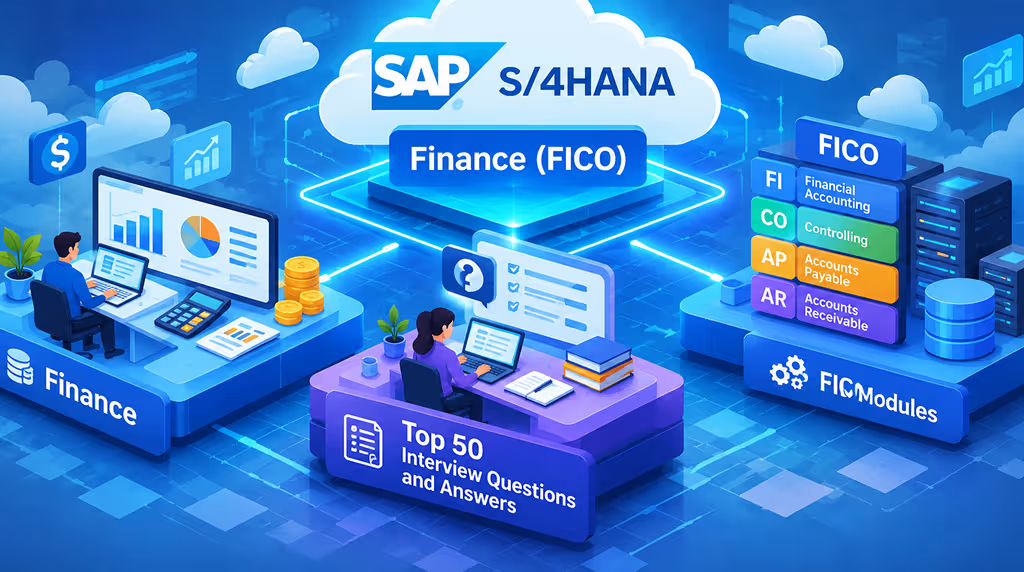
csp@admin
Every finance team wants to have real-time visibility on their figures without waiting for the month-end close, and SAP S/4HANA Finance happens to be the preferred choice to achieve this, and this is why FICO consultants are in such demand now as organisations migrate towards the latest cloud-based ERP.
Whether you are a fresher looking to get your first FICO job, or a working professional preparing for a FICO interview, or even an experienced FICO consultant brushing up before a client interview, it is vital that you prepare well.
Interviewers are placing significantly more emphasis on real-world applications and scenarios rather than theoretical concepts.
With automation, cloud-based ERP, analytics, and AI-driven finance operations taking over, the FICO interview questions and answers are evolving.
We have compiled the most important and frequently asked 50+ SAP S/4HANA Finance interview questions and answers, ranging from basic, functional, technical, and scenario-based to help crack the FICO interview.
Fresher’s and experienced professionals can choose to enroll with CloudShine’s SAP S/4HANA Training Online to gain first-hand experience with the practice instance while preparing for interviews.
SAP S/4HANA Finance is the finance and accounting module of the SAP S/4HANA ERP system that runs on the real-time HANA database, combining Financial Accounting (FI) and Controlling (CO) under one roof.
FI deals with external reporting requirements, including General Ledger, Accounts Payable, Accounts Receivable, Asset Accounting, and Bank Accounting, whereas CO deals with internal management accounting, including Profit Centers, Cost Centers, and Profitability Analysis.
In S/4HANA Finance, the data from FI and CO modules are combined under the Universal Journal (ACDOCA table), which helps eliminate the reconciliation process between the two modules that was a norm in the SAP ECC Finance system.
This is the primary distinction between SAP ECC Finance and S/4HANA Finance.
Unlike ECC Finance that used separate tables for FI and CO data storage, S/4HANA consolidated this information in one table to allow real-time reporting and analysis using the Fiori apps rather than the traditional batch jobs.
This is the main reason why organisations worldwide are adopting the S/4HANA Finance module, and in addition, they are also migrating towards the RISE with SAP model as the support for ECC ends on December 31, 2027.
As aforementioned, since SAP has decided to retire its SAP ECC ERP software on December 31, 2027, there is no doubt that the demand for consultants with SAP S/4HANA Finance expertise will skyrocket in the coming years.
This trend is bound to change the dynamics of FICO job interviews. Consequently, the SAP FICO interview questions in 2026-2027 will be more focused on the SAP S/4HANA Finance module rather than the SAP ECC Finance.
There has been a paradigm shift in the SAP certification exams; they are now placing greater emphasis on practical applications.
This trend is also reflected in the changing nature of FICO interview questions, where the interviewers are more interested in testing the candidate’s ability to implement the SAP S/4HANA Finance rather than regurgitating theoretical concepts.
For example, even though an SAP ABAP developer may have superior coding skills, the interviewer may disregard this information and ask more questions regarding the implementation and configuration process of SAP S/4HANA Finance based on their practical experience.
Similarly, FICO interviews are increasingly focusing on the candidate’s ability to navigate the Universal Journal and troubleshoot issues, rather than simply describing the FI and CO modules.
AI-driven analytics, automated reconciliation processes, and finance procedures are progressively being incorporated into the SAP Finance solutions.
As a result, it is essential that consultants are aware of how these technologies are being leveraged within the SAP S/4HANA Finance module.
SAP S/4HANA Finance is the finance and accountancy module of the SAP S/4HANA Enterprise Resource Planning (ERP) software that operates on the in-memory HANA database, offering real-time processing and reporting capabilities.It has merged the traditionally separate Financial Accounting (FI) and Controlling (CO) modules and stores all data in a single-line item table known as the Universal Journal.
SAP FICO refers to the combination of the Financial Accounting (FI) and Controlling (CO) modules available in the SAP S/4HANA Finance system. FI deals with external reporting, whereas CO deals with internal reporting.
SAP FI deals with statutory requirements, and it records all the financial aspects of a business, including General Ledger, Accounts Payable, Accounts Receivable, Asset Accounting, and Bank Accounting. On the other hand, SAP CO deals with managerial reporting; it focuses on analyzing the costs and profitabilities of various business activities.
The key features of SAP S/4HANA Finance include the following:
Unlike SAP ECC Finance, which used separate tables for Financial Accounting (FI) and Controlling (CO) data storage, SAP S/4HANA Finance stores this information in one line item table (ACDOCA). This way, organisations do not need to perform reconciliation procedures between FI and CO modules as opposed to the traditional SAP ECC Finance.
A company code is an organisational unit, which is the smallest organisation structure for which financial statements are prepared.
A chart of accounts is a list of general ledger accounts that are used within one or more company codes.
A fiscal year variant determines the period allocation of a fiscal year.
A posting period refers to a period within a fiscal year in which business transactions can be posted.
A document type determines the two-character key that specifies which accounts can be posted using a particular document type.
Document types include:
General Ledger Accounting is the component of Financial Accounting (FI) that deals with the recording of all monetary activities of a business, including the preparation and presentation of financial statements.
Accounts Payable is a sub-ledger that deals with all the business transactions related to vendors, including invoices, payments, and clearances.
Accounts Receivable is a sub-ledger that deals with all the business transactions related to customers, including invoices, payments, and clearances.
Asset Accounting deals with the acquisition, disposal, and management of assets, as well as their depreciation.
Bank accounting deals with the management of house banks, maintenance of bank accounts, and clearing of financial transactions.
A Business Partner is a new data structure in S/4HANA, and it replaces separate vendor and customer codes in ECC. It is possible to assign both vendor and customer roles to a single Business Partner.
Document splitting enables the generation of line items that satisfy the reporting requirements of different company codes, controlling areas, and profit centers by splitting the line items of a document per dimension.
Parallel ledgers enable organisations to meet various reporting requirements, such as local GAAP and international financial reporting standards (IFRS) using one company code.
Tax configuration entails the setup and management of tax procedures, tax codes, and jurisdiction codes that determine the taxes applicable to business transactions.
Automatic payment processing is a process that enables the system to automatically select open line items, apply appropriate payment terms, and generate payments.
SAP Controlling refers to the component of the SAP S/4HANA Finance system that handles management accounting. It provides organisations with the information and reports necessary to support managerial decision-making.
A controlling area is an organisational unit that enables the assignment of costs and revenues to specific departments and evaluates them on a periodic basis.
Cost centers are organisational units that enable businesses to record, classify, and analyse costs incurred in performing various activities.
Profit centers are organisational units that allow businesses to assess and report on the profitabilities of different activities.
Internal orders are short-term cost objects that help businesses track, monitor, and analyse costs associated with specific tasks or projects.
Cost elements are the equivalent of General Ledger accounts in Financial Accounting (FI). They help record and categorize the costs incurred by various departments.
Activity types are the units of measure used in connection with internal services, such as labor and machine hours.
Profitability Analysis is a component of SAP Controlling that determines the profitability of various business activities, such as products, customers, and sales channels.
Product Costing enables businesses to calculate the cost of manufacturing a product based on its planned and actual costs.
Cost Center Accounting records all the costs associated with business activities at various organisational units. This information is used to develop policies that help control costs and budgeting. Additionally, FI and CO modules are interdependent; the information contained in the FI General Ledger is used to prepare Cost Center reports.
FI integrates with CO by default, and this means that every document posted in the FI General Ledger automatically creates a CO document in real-time.
FI integrates with MM by recording all the relevant business transactions, such as goods receipt and invoice receipt.
FI integrates with SD by recording all the business transactions related to a sales order, including billing.
Account determination is the process of assigning specific General Ledger accounts to particular business transactions.
Validation and substitution are the processes of checking the accuracy of information contained in a document (validation) and modifying it to meet certain criteria (substitution).
organisational structures are configured by establishing relationships between company codes and controlling areas using a client as the base.
The Universal Journal in S/4HANA Finance records all the business transactions performed in the FI and CO modules using one single table, unlike in ECC Finance where they used separate tables for FI and CO.
SAP Fiori allows end-users to access real-time dashboards and analytical reports in the form of tiles in a role-centric interface, as compared to the traditional SAP GUI.
Financial reporting in S/4HANA is conducted using real-time data as opposed to the traditional periodic reporting.
SAP S/4HANA data migration refers to the process of transferring data from the legacy SAP ECC system to S/4HANA Finance. The data migration process requires analysts to map and validate the data being imported into the new system.
SAP Finance analytics entails the use of embedded analytics that allow organisations to monitor the performance of their financial operations in real-time without the need for separate reporting tools.
Financial Closing refers to the processes of month-end and year-end closing activities that are largely automated in S/4HANA Finance using the Financial Closing Cockpit.
Traditional ERP systems such as SAP ECC Finance used to rely on batch processing for reporting purposes, which is not the case with S/4HANA Finance.
I would start by examining the document flow to identify the source of the problem and then check account determination and validations before making any corrections.
I would start by reviewing the payment run log to determine the cause of the problem before correcting it.
I would begin by comparing the Universal Journal to the sub-ledger to identify the source of the discrepancy before correcting it.
I would start by reviewing the account determination configuration using OBYC, examine the clearing accounts, and then check the movement type configuration for goods receipt or invoice receipt.
I would start by reviewing the account determination for revenue and examine the billing document before reviewing the condition types.
I once worked on an S/4HANA implementation project, and I was involved in……
I handle production support by prioritizing incidents based on their impact on business operations and follow-up with clients to keep them informed of the progress being made in resolving the issue.
| Topic | Why It’s Tested |
| SAP FI | Core GL, AP, AR, Asset Accounting, and taxation fundamentals |
| SAP CO | Cost centers, profit centers, internal orders, CO-PA, management reporting |
| FI-CO Integration | Tests how financial and controlling postings interact in real time |
| SAP S/4HANA Finance | Universal Journal, Business Partner, and real-time architecture |
| Integration with MM/SD | End-to-end process understanding across modules |
| Implementation & Support | Configuration, troubleshooting, testing, and client communication |
Remuneration for these positions depends on the level of experience, additional certifications, and the complexity of the projects undertaken. In India, a fresher FICO consultant can earn between INR 3 to 6 LPA, whereas someone with at least one implementation experience can earn between INR 7 to 9 LPA. With eight plus years of experience, one can easily earn between INR 18 to 25 LPA and higher depending on the employer. In addition, FICO is among the highest-paid SAP modules because of the demand for consultants and the relatively fewer professionals in this field.
Cracking a SAP S/4HANA Finance interview in 2026-2027 requires a strong conceptual understanding of the FI and CO fundamentals, including the Universal Journal, configuration, and cross-module integrations. Moreover, it is important to develop practical experience with the SAP Fiori interface and the ability to discuss real-world scenarios and troubleshooting procedures pertinent to the SAP S/4HANA Finance module.
With the SAP ECC Finance set to retire at the end of 2027, employers are now placing more emphasis on candidates with SAP S/4HANA Finance skills. As such, it is important to stay abreast with the changes and updates to this ERP module while also gaining practical experience with the system.
A combination of theoretical knowledge, SAP certification, and practical experience will give you the best chance to ace the SAP S/4HANA Finance interview.
CloudShine’s SAP S/4HANA Finance interview preparation courses can help you prepare for interviews by providing you with the requisite knowledge and hands-on practice to configure the system.
The FI and CO fundamentals, configuration, integration, universal journal, financial reporting, data migration, and scenario-based troubleshooting are some of the areas that are tested during technical interviews.