
C
csp@admin
September 22, 202611 min read

csp@admin
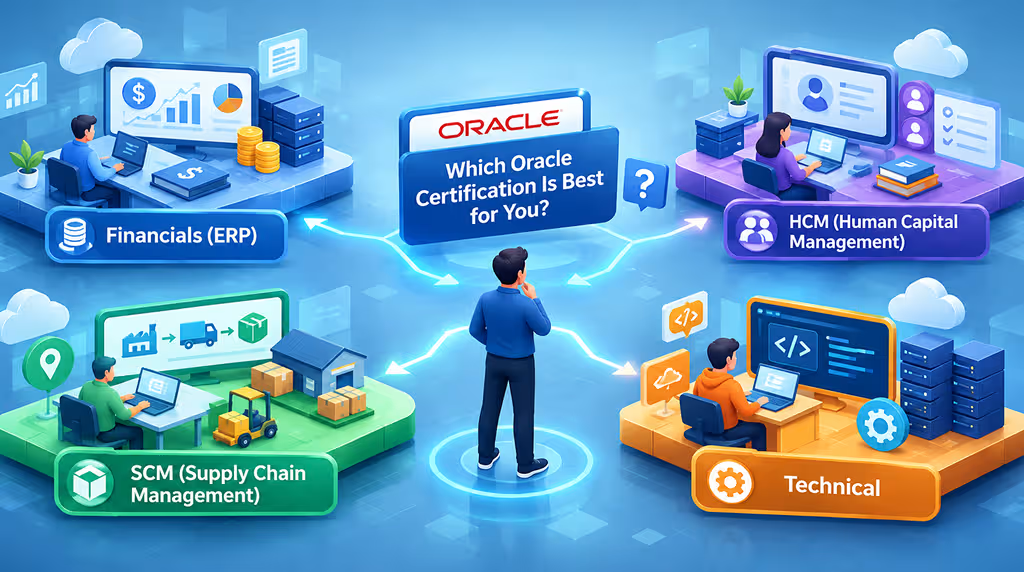
Picking a career path in cloud ERP can feel a bit confusing with many equally tempting choices. Oracle certifications have become one of the smartest ways for professionals to build specialized, in-demand skills in cloud ERP, and Oracle backs that up with several distinct routes: Financials, HCM, SCM, and Technical.
However, there is no universal best oracle certification that works for everyone. The right choice depends entirely on your educational background, your career goals, your existing experience and what you actually enjoy doing at work. The professionals who genuinely thrive in the Oracle ecosystem are the ones who picked a path that matched their actual strengths, not the one with the loudest marketing.
In this guide, we will walk through a genuine oracle comparison of Financials, HCM, SCM, and Technical certifications to help you understand which path lines up with where you want your career to go.
Oracle certifications are official credentials, issued through Oracle University, that validate your knowledge of Oracle Cloud applications and the technologies behind them. They are identified as proof that you actually know how to configure, implement, or support Oracle’s cloud ERP suite, rather than just having watched a few tutorial videos.
Broadly, Oracle certifications split into two categories: functional and technical.
Neither is better in absolute terms; they simply serve different kinds of professionals.
These certifications genuinely earn their keep in career advancement. A relevant certification signals to recruiters that you understand a specific Oracle Cloud domain deeply enough to be useful from day one. This matters enormously in ERP consulting, where ramp-up time is expensive. The four major paths worth exploring are Oracle Financials, Oracle HCM, Oracle SCM, and Oracle Technical certifications, and we’re about to unpack each one.
It is also worth noting that certifications are not static badges you earn once and forget. Oracle regularly updates its Cloud applications, thus, being consistent through refreshed exams, newer module coverage or supplementary training keeps your credential genuinely relevant.
Oracle Financials certification sits right at the intersection of accounting, finance and ERP operations. If numbers, ledgers and financial reporting genuinely interest you, this will be the best choice for you. The curriculum covers the modules that keep a company’s financial engine running, such as General Ledger, Accounts Payable, Accounts Receivable, Cash Management and Financial Reporting.
This certification suits professionals who already understand how money moves through a business. It helps them to seamlessly translate their knowledge into a cloud ERP context rather than starting from scratch on the technical side.
What makes Financials such a comfortable entry point is that it speaks the same language that finance professionals already use every day with terms like debits, credits, reconciliations and reporting cycles. You are not learning an entirely new discipline; you are learning how a familiar discipline now runs inside Oracle Cloud instead of a legacy on-premises system.
Who Should Choose Oracle Financials?
Career-wise, Financials-certified professionals typically move into roles like Financials Consultant, ERP Finance Analyst, or Finance Systems Specialist. If this sounds like something that excites you, Oracle Fusion Financials training is exactly where you should start. It is genuinely one of the more accessible ways into cloud ERP if you already speak the language of accounting.
Oracle HCM Cloud is all about people, not spreadsheets. It manages the human resources processes that keep an organization’s workforce functioning smoothly, and it covers a genuinely broad canvas like Core HR, Talent Management, Recruiting, Payroll, Compensation, and Workforce Management.
This path resonates strongly with HR professionals who are tired of manual processes and curious about the technology reshaping their own function. It is also a natural fit for aspiring HCM consultants who want to bridge the gap between HR person and HR technology expert.
There is something quietly satisfying about HCM work as well. You are not just configuring a system; but you are shaping how thousands of employees experience onboarding, payroll and performance reviews. Few Oracle specializations put you this close to the everyday human side of a business.
Who Should Choose Oracle HCM?
HCM-certified professionals often step into roles like HCM Functional Consultant, HR Systems Analyst, or Payroll Implementation Specialist. Anyone eyeing this path should look seriously into oracle fusion cloud HCM online training. This choice genuinely rewards structured and hands-on learning rather than piecing it together from scattered videos.
Oracle Supply Chain Management Cloud governs the operational backbone of a business. It looks into how goods move, how inventory is tracked, and how orders actually get fulfilled. The certification covers Procurement, Inventory, Order Management, Manufacturing and Supply Chain Planning, giving certified professionals a genuinely end-to-end view of how products flow from supplier to customer.
Building a career here rewards people who are naturally process-minded, comfortable with logistics complexity, and interested in the operational side of business rather than pure finance or pure HR.
SCM also tends to appeal to problem-solvers who enjoy untangling messy, moving-parts scenarios, a shipment delayed, a demand forecast, and figuring out how the system should respond. If that sounds more interesting than frustrating, SCM might genuinely be the best choice you make.
Who Should Choose Oracle SCM?
SCM-certified professionals typically progress into SCM Consultant, Procurement Analyst, or Supply Chain Systems Specialist roles. If you are looking for oracle fusion SCM training online options, look for a course that includes real procurement and inventory scenarios, not just slide decks.
Oracle Technical certifications are the odd one out on this list, and deliberately so. Where Financials, HCM, and SCM are functional paths built around business processes, Technical certifications live in the code, the integrations, and the architecture underneath everything else. Expect to work with Oracle Integration Cloud, SQL, database technologies, APIs, application development, and technical architecture.
Technical professionals are the ones who make Oracle Cloud implementations actually work under the hood, building integrations, customising reports, and troubleshooting.
Who Should Choose Oracle Technical Certification?
Employers typically look for strong SQL fundamentals, comfort with APIs and genuine integration experience. Career paths here include Oracle Technical Consultant, Integration Specialist, Developer and Technical Architect. To be honest, the technical route often comes with the steepest learning curve, but also some of the highest ceilings in the Oracle ecosystem.
Here is a quick comparison so you can make the right choice
| Certification | Best For | Key Skills | Typical Career Path |
| Oracle Financials | Finance professionals | Accounting, ERP, financial processes | Financials Consultant |
| Oracle HCM | HR professionals | HR processes, workforce management | HCM Consultant |
| Oracle SCM | Supply chain professionals | Procurement, inventory, logistics | SCM Consultant |
| Oracle Technical | IT professionals | Integration, development, databases | Technical Consultant |
Weigh each option against your background, the difficulty you are genuinely willing to take on, realistic career opportunities, the technical depth and long-term growth rather than just chasing whichever certification is trending.
That is really the heart of any honest comparison between oracle courses. It is rarely about which certification is objectively the best, and almost always about which certification choice fits you.
A finance degree naturally leans toward Financials, an HR background toward HCM and supply chain or operations experience toward SCM, while IT or computer science graduates gravitate toward Technical. If you are coming from a non-technical background, functional paths are specifically designed to be approachable without a coding foundation. Make sure to consider your educational specifications before making any choice.
Keep your career goals in mind while choosing a certification. If the role of Finance Systems Manager excites you more than being an Integration Architect that tells you almost everything you need to know about which certification to pursue first.
Any prior experience in finance, HR, procurement, supply chain, programming, or general IT is not wasted; it is leverage. Each of those backgrounds maps fairly cleanly onto one of the four Oracle paths, giving you a genuine direction for choosing the suitable certification. A foundational understanding of the Oracle paths is better than starting without any idea.
Look at real job postings, not just certification marketing pages. This will give a clear idea about which skills are actually being hired for in your target market and region. Oracle Fusion skills, across all four domains, have remained in consistently high demand. More mid-sized organizations have migrated off legacy ERP systems onto the cloud which is genuinely good news for whichever path you pick.
Training fees, exam costs and the quality of hands-on practice environments all vary significantly between providers. Cheaper is not automatically worse and expensive does not automatically mean better. What matters most is whether the training actually includes real and hands-on practice rather than just pure theory.
Short answer: yes, absolutely. You do not need prior Oracle or ERP experience to get started; however, your existing background will certainly shape which path feels most natural. Freshers from finance, HR or supply chain backgrounds often find functional certifications (Financials, HCM, SCM) more approachable. Those with even basic programming exposure can reasonably start exploring technical certifications.
The trick for beginners is building foundational knowledge before diving into full certification courses. It is highly recommended to understand core ERP concepts, business processes and how Oracle Cloud is structured before tackling the deeper module-specific content. This is exactly where structured training, genuine hands-on practice and some project exposure make the difference between a certification that is just a certificate and one that actually gets you hired.
Start by building a genuine understanding of Oracle Cloud itself, and then narrow into your chosen functional or technical domain. Skipping the fundamentals and jumping straight to making a choice rarely ends well.
Instructor-led training, self-paced online learning, practical exercises and project-based learning all have their place and benefits, but the best programs blend more than one. Look for training that actually includes real-world scenarios and practical experience and not just recorded lectures.
There is simply no substitute for working inside an actual Oracle Cloud environment. Practical exposure is what separates candidates who can just pass an exam from those who can walk into a live implementation project and be useful immediately.
Study the official syllabus properly without any shortcuts. Practise the specific concepts it covers and use mock tests to identify weak spots.
Certification alone rarely gets anyone hired. Focus on gaining implementation knowledge, troubleshooting instincts, clear communication, and genuine business-process understanding. These are the skills that can give you a competitive edge.
Let us talk about an honest truth! There is no single oracle best certification that outranks the others for everyone. Career potential depends heavily on your professional background, genuine interests, technical comfort level, and the roles you are actually targeting. It never depends on whichever path has the flashiest ads or is being talked about the most.
Rather than choosing based purely on popularity or headline salary figures, pick a specialization that you would still enjoy after two years from now. A genuinely underused strategy is combining functional expertise with technical or integration skills.
For instance, Financials plus a working knowledge of OIC tends to open considerably more doors than staying purely in one lane. Among the top oracle certifications for long-term career resilience, the ones that consistently blend functional skills with technical fluency come out ahead.
Financials, HCM, SCM and Technical each open a genuinely different door into the Oracle Cloud ecosystem. Every path you choose is just the start of a specialization and not a one-time learning. The right one isn’t about chasing trends, but it is about matching the certification to your existing skills and strengths and where you actually want to grow.
This is exactly where CloudShine fits in. Whether you are drawn to oracle fusion financials training online, Oracle Fusion HCM training, Oracle Fusion SCM training, or the Oracle Fusion Integration Cloud path, CloudShine pairs experienced and Oracle-certified trainers with genuine sandbox access, real project-based learning, and dedicated placement support. This ensures that your certification actually translates into a job and doesn’t end up being just a line on your resume.
If you are still weighing options, our certification programs page is a good next stop before you commit.
Functional paths like Oracle Financials or HCM tend to be more approachable for freshers without prior ERP experience. These certifications lean on business-process understanding rather than heavy coding.