
C
csp@admin
August 12, 202612 min read

csp@admin
If you have spent any time browsing HR tech job listings lately, you have probably noticed the same two names popping up again and again. Workday and Oracle HCM Cloud dominate the enterprise HR software conversation and honestly, for good reason.
Businesses everywhere are shifting away from clunky and on-premise HR systems towards intelligent and cloud-first platforms that can handle everything from recruitment to payroll to workforce analytics in one place.
This shift is not a small trend either.
That is not a niche corner of enterprise software. That is a genuinely booming industry, and it is exactly why so many professionals are asking themselves the same question: Workday HCM vs Oracle HCM, which one should I actually learn?
This decision matters more than it might seem. Your choice shapes the kind of projects you will work on, the companies you will interview with, and quite possibly your salary trajectory for years to come. It is not simply a matter of picking whichever platform has the shinier marketing website. Employers hiring for enterprise HR roles are increasingly specific about which system they need and switching ecosystems later in your career, while possible, does take time and effort.
So, let us properly unpack this HCM comparison and help you figure out which platform genuinely fits your career goals, your existing skills, and the kind of organisations you would like to work with. Whether you are a fresh graduate exploring HR technology for the first time or an experienced consultant weighing up a second certification, this guide should give you a clear, honest picture before you commit your time and money.
Workday HCM is a cloud-native Human Capital Management platform, built from the ground up for the cloud rather than adapted from older, on-premise software. Launched in 2006 by former PeopleSoft executives, Workday set out to solve the exact frustrations that traditional HR systems created, like
It brings together core HR, recruiting, payroll, talent management, and workforce analytics into a single, unified system, updated twice a year with fresh features and improvements.
What genuinely sets Workday apart is its user experience. It was designed with the end user in mind from day one, which is a big part of why organisations like Netflix, Airbus, and Dell rely on it to manage their global workforces.
Its talent management tools are spread thoughtfully across payroll, recruiting, and employee training modules to keep the platform feeling connected rather than fragmented. Meanwhile, Workday’s workforce prediction tools calculate the total cost of the workforce from the ground up. This gives HR leaders genuinely useful data to support budget approvals and hiring decisions, often visualised through intuitive dashboards rather than raw spreadsheets.
If you are researching Workday vs Oracle as a beginner, Workday’s intuitive design is often cited as one of its biggest selling points. Many learners find that within just a few weeks of hands-on practice, navigating the system starts to feel genuinely second nature. This is one of the reasons why it remains such a popular first certification for people new to enterprise HR technology.
Oracle HCM Cloud, released in 2011, took a different route. Rather than being built entirely from scratch, it emerged from Oracle’s long history in enterprise software, evolving to compete directly with Workday’s cloud-first approach.
Oracle HCM Cloud is built on Oracle’s own cloud database infrastructure. It is powered by an AI-based digital assistant that supports everyday HR tasks, from answering employee queries to surfacing relevant workforce insights. As Oracle HCM sits so closely alongside Oracle’s financial and ERP systems, it tends to shine in organisations that already run on Oracle Fusion applications for finance, supply chain, or procurement.
Its Talent, Recruiting, and Workforce modules operate as distinct, deeply configurable tools, which give larger enterprises significant flexibility, albeit with a steeper learning curve. Oracle’s recruiting tools, for instance, are built:
This becomes a genuine advantage for organisations wanting everything under one roof.
For professionals already comfortable with Oracle’s broader ecosystem, moving into Oracle Fusion HCM training often feels like a natural next step rather than starting from scratch. Those who already understand Oracle’s data structures, security roles and reporting tools tend to pick up the HCM-specific modules considerably faster than complete newcomers.
Certifications alone do not guarantee a job, but they genuinely open doors that would otherwise stay shut. Recruiters and hiring managers use certifications as a fast and reliable filter when they are sifting through hundreds of CVs. Also, in a market this competitive, that filter matters more than most candidates realise.
The numbers back this up convincingly.
These figures are a true reflection of making the investment in certification training genuinely worthwhile.
It is a similar story on the Oracle side. As enterprises continue migrating from legacy PeopleSoft and on-premise HR systems to Oracle Fusion Cloud, demand for certified Oracle HCM consultants keeps climbing steadily. Techno-functional consultants, in particular, who can bridge HCM configuration with broader Oracle Fusion knowledge, are increasingly sought after by consulting firms and large enterprises alike.
Whichever platform you choose, one thing is clear. Employers are actively rewarding certified, hands-on expertise over generic HR knowledge, and that trend shows no sign of slowing down in 2026.
If you are weighing up your options, exploring a structured programme like CloudShine’s Oracle Fusion HCM Training is a genuinely sensible place to start comparing course content, live lab access, and placement support before you commit.
| Factor | Workday HCM | Oracle HCM Cloud |
| Launch Year | 2006 | 2011 |
| Architecture | Built cloud-native from scratch | Evolved from Oracle’s broader ERP ecosystem |
| User Interface | Highly intuitive, consumer-grade UX | Powerful but comparatively complex |
| Learning Curve | Moderate, beginner-friendly | Steeper, benefits from ERP background |
| Update Cycle | Twice-yearly structured releases | Continuous updates within Oracle Cloud |
| Best Fit For | Mid-size to large global enterprises | Enterprises already using Oracle Fusion apps |
| AI Capabilities | Predictive workforce analytics, Illuminate AI agents | AI-powered digital assistant, embedded across modules |
| Career Path | Workday Consultant, HRIS Analyst | Oracle Fusion HCM Consultant, Techno-Functional Analyst |
| Certification Cost (approx.) | USD 1,500 to USD 2,500 | Varies by module and training provider |
Both platforms enjoy strong hiring demand globally, though the split often depends on region and industry.
If you have a specific industry in mind, it is genuinely worth researching which platform that sector leans towards before committing to a certification path.
Salaries across both ecosystems remain genuinely competitive, and in many cases, comparable. Specialisation matters more than platform choice here.
Location, years of experience and whether you work as a freelance consultant or within a permanent role all influence final numbers considerably.
Whether you pursue Workday HCM Certification or Oracle’s role-based HCM credentials, structured, instructor-led training with live sandbox access consistently outperforms self-paced video-only courses.
This is precisely where quality workday HCM training online and Oracle Fusion HCM programmes prove their worth, giving learners the hands-on configuration practice that theory alone simply cannot replicate.
Look for programmes that include real instance access, mock interviews, and genuine placement support rather than just recorded lecture content.
Both platforms are racing to embed AI deeper into their platforms.
Professionals who understand how to configure, govern, and work alongside these AI features will have a genuine edge over those with purely theoretical knowledge.
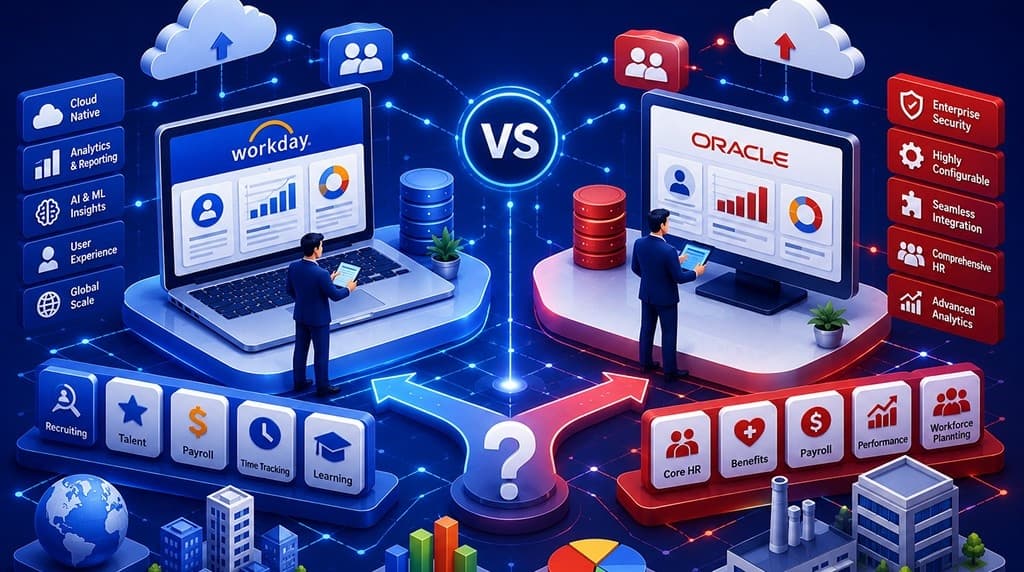
Workday vs Oracle; honestly, this question does not have one universal answer.
If you are a fresh graduate or an HR professional with no prior ERP exposure, Workday’s cleaner interface often makes for a gentler entry point into cloud HCM. Its structured, twice-yearly release cycle also makes learning feel more predictable and less overwhelming.
If you come from a finance, SCM or broader Oracle Fusion background, learning Oracle HCM Cloud first will let you leverage skills you already have. It opens the door to techno-functional roles that blend HCM with finance or procurement. These roles often command a premium in the job market precisely because fewer professionals can comfortably straddle both domains.
Many consultants eventually become proficient in both platforms over the course of their careers; since large enterprises frequently run parallel systems or migrate between them during mergers, acquisitions or digital transformation projects.
Starting with one does not lock you out of the other. In fact, several experienced consultants we have trained at CloudShine describe their second platform certification as considerably faster to pick up than their first. This is simply because the underlying HR concepts, business processes, and reporting logic carry across so well.
Tip: If you are still unsure, a genuinely useful exercise is to shortlist 5-10 job postings in your target city or industry and simply count how often each platform appears. That small bit of research often clarifies the decision far more effectively than any single blog post ever could.
If you are an HR professional transitioning into HR technology, or you simply want the fastest, most beginner-friendly entry point into cloud HCM, Workday is likely your better starting point. Its intuitive design and strong presence in tech and services sectors make it a smart, practical first certification, particularly if you want to see tangible progress within the first month of learning.
If you already have experience with Oracle ERP, SCM, or Financials, or you are targeting roles at large, traditionally Oracle-heavy enterprises, then Oracle HCM Cloud will let you build on existing knowledge and access techno-functional career paths. This route particularly suits professionals already working within an Oracle Fusion environment who want to expand their scope into HR-specific modules.
Expert Suggestion: Professionals from a general HR consulting background often find success starting with Workday and gaining genuine implementation experience, then adding Oracle HCM skills later.
Those already embedded in enterprise IT or ERP consulting, frequently find Oracle Fusion HCM a more natural fit from day one, since much of the underlying platform logic will already feel familiar.
There is no shame in changing your mind partway. Plenty of successful consultants started down one path, realised a different specialisation suited them better, and pivoted without losing much momentum.
At the end of the day, there is no universally better platform between Workday HCM and Oracle HCM. Both are genuinely powerful, both are in strong demand and both can lead to rewarding, well-paid careers in HR technology.
What matters far more is matching the platform to your background, your target industry and the kind of projects you actually want to work on. Rushing into a certification simply because it is trending on social media rarely pays off in the long run.
Take stock of where you are right now. If you are new to enterprise HR software altogether, start with the platform that feels intuitive and lets you build early confidence. If you already have relevant ERP or Oracle experience, use that advantage rather than starting from scratch.
When choosing a platform, ensure to prioritise training providers who offer live and practical access over anyone promising a shortcut through recorded videos alone.
If you are ready to move from research to action, CloudShine’s Workday HCM Training and Oracle Fusion HCM Training programmes are built to offer real-world, project-based learning, with live instance access and practical assignments rather than theory alone.
You can also explore our detailed breakdowns in Workday HCM Tutorial and Oracle HCM Training Online: Top Courses & Certification to dig deeper before making your decision. Browse our blog for more comparisons and career guidance.
Whichever path you choose, the demand is real, the opportunities are growing and there has genuinely never been a better time to start.
Workday is generally considered more beginner-friendly thanks to its intuitive, consumer-grade interface. Oracle HCM Cloud suits learners who already have some ERP or Oracle Fusion exposure.