
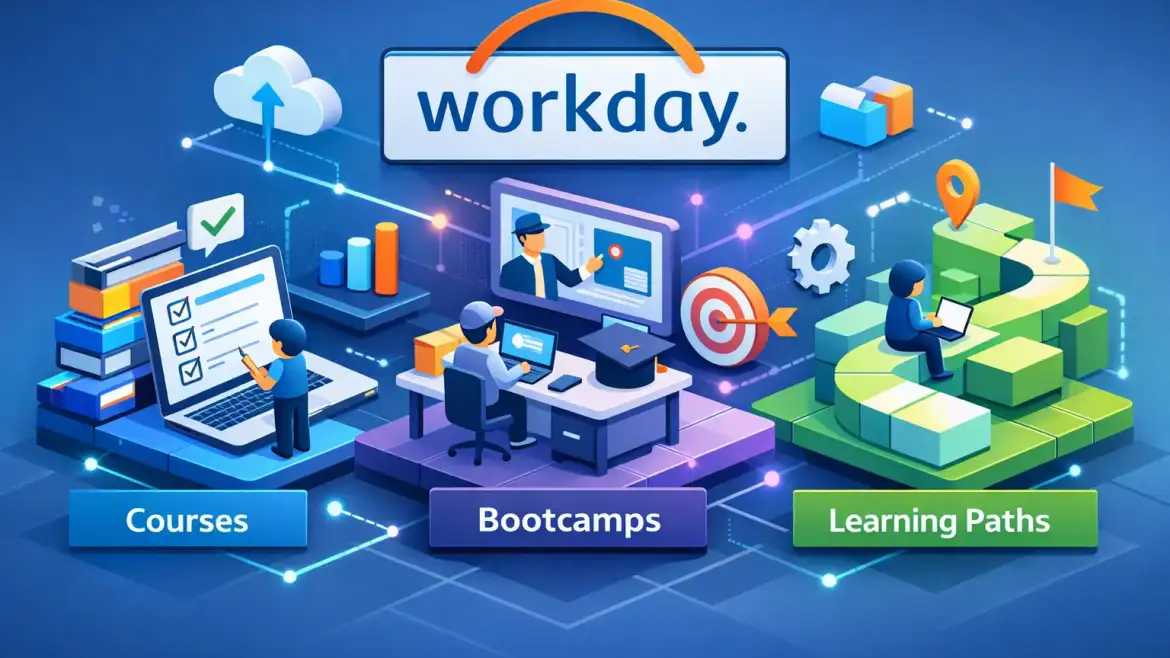
Workday training follows four practical routes: official Workday Learning (best for employer‑recognized certification), partner bootcamps (best for rapid, hands‑on readiness), MOOCs/self‑paced courses (best for low‑cost orientation), and employer programs (best for immediate deployment). If your goal is a recognized credential and the highest hiring ROI, aim for Workday Pro; if you need interview‑ready configuration skills in weeks, choose a partner bootcamp with sandbox access — CloudShine is one provider that combines live tenants, practitioner mentors and placement support.
Official Workday Learning vs partner bootcamps — what you get and who should pick each
Direct takeaway: Official Workday Learning gives employer‑recognized badges and deep module coverage; partner bootcamps deliver condensed, practical experience useful for consultant and interview readiness.
Official paths (Workday Learning / Workday Pro) cover module‑level topics — HCM Core, Financials, Payroll, Integrations and Platform Admin — and validate knowledge through proctored exams (about 50 questions, ~100 minutes, typically ~80% pass). These tracks are designed for customers and partner employees and often require partner affiliation for some implementer credentials. Expect a multi‑week learning curve and costs ranging from a few hundred for badges up to a few thousand for full certification bundles, often sponsored by employers. (If you’re comparing role expectations across platforms, see Oracle Fusion Finance Important Roles | Roles in Fusion Applications | CloudShine for a comparable finance role breakdown.)
Partner bootcamps compress that learning into 1–6 intensive weeks with a heavy focus on labs, configuration workflows and interview scenarios. They’re typically led by ex‑consultants who teach real‑world artifacts you can show employers. Bootcamps rarely grant official Workday Pro credentials by themselves, but they make you deployable fast.
Choose official learning if you need a recognized corporate badge or will work on vendor teams; choose a reputable bootcamp if you need practical tenant experience in 4–8 weeks to pass consultancy interviews.
Self‑paced courses and MOOCs — smart uses and clear limits
Direct takeaway: Short online courses are a low‑cost way to confirm interest and learn navigation and reporting basics, but they won’t replace sandbox practice or the hiring signal of an official cert.
Platforms like Coursera, LinkedIn Learning and Udemy are useful for building foundational understanding: navigation, business process concepts and basic reporting. They’re excellent for non‑technical end users or for someone deciding whether to commit time and money to a deeper path. For a focused business‑user introduction, consider the Workday Human Capital Management course on CloudShine as a low‑cost way to validate interest and learn core navigation.
Limits are clear: most MOOCs don’t include tenant access, they rarely qualify for official Workday certification credit, and they’re a weak signal for technical hiring. Use them as pre‑work: complete a short course to confirm interest, then upgrade to a bootcamp or an official path that includes labs and exam prep.
Certifications and employer value — what hiring managers actually look for
Direct takeaway: Certifications materially improve hiring odds and pay, but employers want both a badge and evidence of hands‑on tenant work.
Common certs—Workday Pro HCM, Financials, Payroll, Integration and Platform Admin—map directly to roles. Certified candidates commonly see a 15–35% salary uplift (roughly $10k–$30k annually in many markets) and access to higher‑value roles like Workday consultant, HRIS analyst or system administrator. In practice, employers screen for certification first and then require tangible sandbox artifacts: configured business processes, reports, or an integration mapping you built. (For a sense of finance‑side pitfalls to avoid when presenting artifacts, you may find the Common Errors in Oracle Fusion Cost Accounting, CloudShine article a useful reference.)
To align your effort with hiring outcomes, pick the certification that matches your target role (HCM for HR roles, Financials for FP&A/accounting, Integrations for middleware/technical positions), secure exam vouchers or partner sponsorship, and plan for 3–6 months of demonstrable sandbox projects to present in interviews.
Why hands‑on labs and tenant hours are non‑negotiable — and how to verify them
Direct takeaway: Sandbox access and graded labs separate “knows Workday” from “can implement Workday.”
Hands‑on practice lets you build and test hire‑to‑retire business processes, run integrations, and validate reports safely. Real tenants have operational constraints (weekly refreshes, limited retention windows, and integration test limits) — trainers who know these constraints teach you how to plan realistic test cycles and produce artifacts employers will accept. Also review common approval hierarchies and purchasing workflows when you build sample labs (for a primer on approval methods, see Understanding Fusion Purchasing Approvals Hierachy | Know about Oracle Fusion Approval Methods | CloudShine).
When evaluating providers, insist on seeing a sample lab, a tenant demo and a clear retention policy. Ask for deliverables you can use in interviews: screenshots, configuration notes, a short walkthrough video and a reconciliation report. Review providers’ lab formats against known challenge‑style exercises such as the hands‑on challenge labs model to ensure you’ll get graded, practical tasks rather than passive demos.
CloudShine’s practical edge is factual: we focus on 100% practical labs, provide direct instance access, and assign mentors with 15+ years of implementation experience. For learners aiming for placement, CloudShine pairs tenant work with resume polishing and mock interviews so your lab portfolio becomes part of the hiring narrative. If you plan to include procurement or self‑service examples in your interview portfolio, a short sample lab on procurement tasks can be useful (see Oracle Fusion Self Service Procurement Important Roles | Oracle Fusion Self Service provider | CloudShine for role examples and artifacts you can adapt).
How to choose: match your role, budget and timeline
Direct takeaway: Match the training route to your persona, then verify five provider questions before you enroll.
A quick persona map helps decide the route. An Aspirant (recent graduate) should start with a MOOC, move to a bootcamp with sandbox and join a placement program (8–12 weeks). A Pivoter (ERP/SAP or HR pro) benefits most from a partner bootcamp plus targeted Workday Pro certs (6–12 weeks) and hands‑on tenant work. An Enterprise leader should opt for employer‑run upskilling tied to implementation timelines. Platform or admin specialists should target the official Platform Administrator path and integrations labs.
Before you pay, get providers to answer these questions live:
- Does the syllabus include hands‑on tenant hours and sample labs I can show in interviews?
- Who are the trainers — can they share implementation artifacts or LinkedIn profiles?
- Is the training tied to official Workday certification paths and exam vouchers?
- What placement support, mock interviews and alumni outcomes do you provide?
- What is your tenant access policy (hours, data retention, refresh schedule) and refund policy?
Make the provider demonstrate a lab and show a graded deliverable before you commit — that one check is worth more than any brochure. For guidance on evolving certification requirements and training changes you should be aware of, review the industry summary on Workday certification and training changes: what you should know.
Enrollment script, quick provider email and FAQs
Direct takeaway: Use a short 15‑minute verification call to remove ambiguity before you commit.
Use this short enrollment script on a 15‑minute call. If the provider hesitates to show these, walk away:
- “Please demo a tenant lab and show a sample deliverable I can take to interviews.”
- “Do you provide exam vouchers or official partner access for Workday Pro paths?”
- “What are your placement rates, mock interview format and alumni results?”
- “How many tenant hours are included and how long is data retained?”
- “Who will be my trainer — can I see their LinkedIn and a sample implementation artifact?”
One‑sentence comparison email you can send to multiple providers:
“Please share a 1‑page sample lab, trainer CV and your exam‑voucher/refund policy so I can compare offers.”
Frequently asked questions
No. Foundational courses accept beginners, but consultant/admin tracks accelerate with ERP or HR domain experience and hands‑on sandbox practice.
Expect 4–12 weeks of focused study plus labs for most module certs; implementer tracks and partner sponsorship can lengthen that timeline.
Usually not. Those platforms are great prep but official Workday Pro paths and some certs require Workday Academy or partner course completion.
Typical uplifts are 15–35% (roughly $10k–$30k annually), depending on role, geography and experience.
Screenshots of configured business processes, a short sandbox walkthrough video, and a report or integration mapping you built are the strongest evidence.
If you want a tailored recommendation, match your role and budget to the persona map above — or book a short advisory session. CloudShine offers a free 15‑minute discovery call where we demo a sample tenant lab, show trainer credentials and explain our placement support so you can compare options with confidence. For extra reading on certification logistics and next steps, see an accessible Workday certification guide that outlines common program structures and provider expectations.


