If your goal is official certification and long‑term access to Oracle’s materials, Oracle University is the straightforward choice; if you need job‑ready, implementation‑level practice plus placement support, a specialist provider like CloudShine is usually faster and more practical. This guide gives a clear 30–90 day plan, cost benchmarks, and a role‑based recommendation so you can pick the right Oracle Fusion SCM course for your needs and budget.
Why trust this guide: CloudShine has trained 500+ consultants and runs a 100% practical lab model with live Oracle Fusion instances, and the numbers below use published Oracle pricing and common third‑party ranges for realistic comparison.
1) Quick pick: which Oracle SCM course fits your role and budget?
Short takeaway: Aspirants (fresh grads) — choose a targeted module course with heavy labs and placement support; Pivoters (experienced in ERP) — pick a focused implementation track plus intensive hands‑on labs; Enterprises — buy Oracle University learning subscriptions for catalogue depth and release coverage or partner with a specialist for recruit‑train‑deploy projects.
If you have 60 seconds, answer these checkpoints:
- Do you need formal certification alignment and access to the full catalog? → Oracle University subscription.
- Do you want a short, low‑cost deep dive on one module? → reputable third‑party self‑paced or live micro‑bootcamp.
- Do you need job‑ready practice, résumé/placement help, and live instances? → a specialist like CloudShine (practical labs + placement cell).
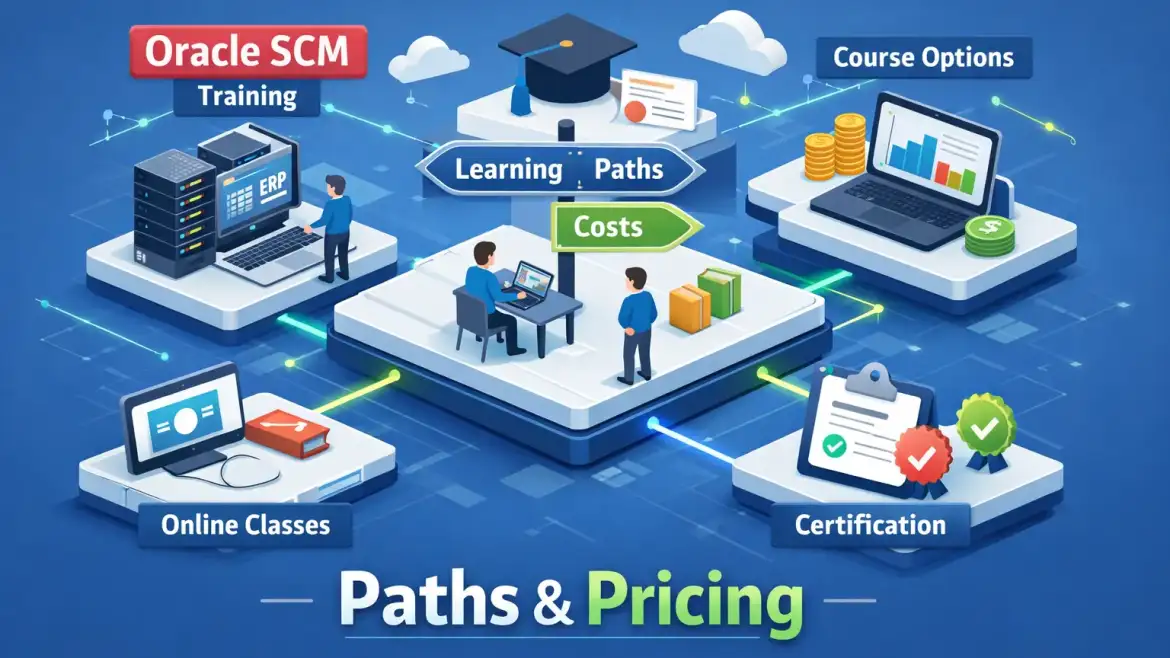
Budget snapshot: Oracle University Cloud Applications subscription runs in the ballpark of $4,995/year and includes several exam attempts; standalone lab seats are offered around $29/month or $299/year. Third‑party offerings vary widely from $10 (intro courses) to $1,500 (intensive bootcamps). Specialist training with live instances and placement support typically sits between third‑party and Oracle pricing—worth the premium if you need guaranteed hands‑on hours and hiring help.
2) Official Oracle University: catalog, labs, costs and exam facts
Oracle University provides role‑based learning paths across Inventory, Procurement, Order Management, Manufacturing, Supply Chain Planning, PLM and Logistics, packaged as structured digital courses plus interactive videos and official exam prep. The value is end‑to‑end coverage, product‑launch updates, and official exam alignment which employers recognize.
Concrete numbers: the Cloud Applications learning subscription is roughly $4,995 per year for unlimited access to the apps catalog, and Oracle offers lab subscriptions about $29/month or $299/year for sandbox practice. Example certification: Oracle Cloud Warehouse Management Implementation Professional (exam 1Z0‑1045‑26); typical cloud application exam fees are about $245—always verify current codes and prices on Oracle University before booking.
Best use case: if you need certification alignment, ongoing access to product updates, and official exam attempts, Oracle University is the defensible investment. Tactical tip: buy lab access by month and book concentrated lab weeks—mirror real business process cycles in the sandbox for better retention.
3) Third‑party and specialist training: tradeoffs and where CloudShine fits
Third‑party providers trade cost for convenience: faster schedules, lower prices, and often focused instructor time, but lab depth and placement support are inconsistent. Marketplaces (Udemy, Coursera) are cheap and useful for concepts; boutique vendors and live bootcamps are better for practical skills but watch the instance access promise.
Providers to research include Trio Tech, GoLogica, Besant, AADS, Proexcellency, MaxMunus and igmGuru—each has different delivery modes and variable trainer experience. Pros: lower cost, faster timelines, targeted module learning. Cons: variable lab realism, trainer depth, and limited hiring support compared to official or specialist programs.
Where CloudShine sits: CloudShine is a specialist with a 100% practical, project‑based curriculum, live Oracle Fusion instances, mentors who have 15+ years of implementation experience, and a placement cell that includes résumé building and mock interviews. We follow a 60:24 rule (roughly 60 hours instructor‑led : 24+ hours lab time) to ensure you have verifiable instance hours recruiters care about.
| Provider | Price (typical) | Lab access | Certification alignment | Placement assistance | Best for |
|---|---|---|---|---|---|
| Oracle University | High (~$4,995/yr) | Official labs ($29/mo or $299/yr) | Full alignment (official exams) | Limited (self‑guided) | Certification, end‑to‑end learning |
| Third‑party (Udemy/Coursera/bootcamps) | Low–Medium ($10–$1,500) | Varies; often limited sandbox | Partial; may lack vouchers | Rare | Targeted module refresh |
| CloudShine (specialist) | Medium (packaged pricing; enquire) | Live Oracle Fusion instances included | Practical prep for Oracle exams | Dedicated placement cell (resumes, mocks) | Job‑readiness, placement, hire‑ready consultants |
4) What you’ll actually learn: core modules and 10 sample hands‑on labs
Employers hire for the problem you can solve, not the course name. Translate module knowledge into operational tasks: configure a procurement org, fix a fulfillment break, or tune a supply plan so a plant doesn’t run out of parts.
Core module one‑liners: Procurement—source‑to‑pay and supplier lifecycle; Inventory—material tracking and valuation; Order Management—order promising and fulfillment orchestration; Manufacturing—BOMs, production orders and execution; Supply Chain Planning—forecasting and replenishment; Logistics—warehouse and transportation; PLM—engineering changes and product data.
- Configure a procurement organization, create a supplier, run a PO and complete goods receipt.
- Create an item, manage sub‑inventories, perform a cycle count, and adjust valuations.
- Enter a sales order, simulate order promising and fulfillment orchestration.
- Model a BOM, create a production order, and complete a move order in Manufacturing Cloud.
- Build a weekly supply plan, resolve exceptions, and analyze forecast vs actual.
- Configure WMS locators, pick/pack/ship using wave management and mobile transactions.
- Set up transportation lanes and run a shipment tendering scenario.
- Implement supplier qualification and source selection for a multi‑site purchase.
- Execute a PLM change order and push revisions to the item master.
- Create a dashboard report for supply chain KPIs and export inventory aging analysis.
Expect 2–6 hours per lab depending on complexity. Resume bullets to add: “Configured Procurement org and executed end‑to‑end PO cycle (X hours of instance time)” or “Implemented WMS pick/pack/ship flows and reported a 0.5% inventory accuracy improvement in lab scenario.”
5) Certification mapping: which certifications to take, prerequisites and job roles
High‑level path: Foundation → Module Specialization → Implementation Professional → Cross‑module consultant. Start with a single module, prove implementation skills with labs and projects, then expand to complementary modules to become a full consultant. For a curated certification roadmap, review Oracle’s official certification learning paths and pillar pages to confirm required exams and prerequisites.
Role mapping: Procurement/Order Management/Inventory are entry‑level friendly and good for Aspirants. Manufacturing and Planning are intermediate and suit Pivoters with domain experience. Warehouse/Logistics implementation certs (e.g., 1Z0‑1045‑26) are aimed at implementers and senior consultants.
Timeline: plan 6–12 weeks per module if you study part‑time with targeted labs; expect 3–6 months to reach full consultant readiness if you combine certification with mock projects and interview prep. Preparation checklist: complete official or trusted training, log 40–100+ lab hours, attempt 2–3 practice exams, document an implementation case study, and rehearse targeted interview scenarios such as configuring a PO workflow; resolving a supply plan exception; demonstrating WMS picking flows; executing a BOM change; and tracing a serialized lot from receipt to shipment.
Hiring signal shorthand: list module names and exam codes; add a short project description with scope and measurable outcome; include hours of hands‑on instance time (e.g., 80+ hours); and present certifications with exam codes on your résumé. For official exam paths and pillar details, review Oracle’s certification path documentation to align your study plan with recommended prerequisites and role mapping.
6) 30–90 day study & enrollment plan — step‑by‑step plus FAQs and next steps
Aspirant (90 days): Weeks 1–4 focus fundamentals (20–30 hours study + ~20 hours labs); Weeks 5–8 specialize in one module with 40 hours of labs and a capstone mini‑project; Weeks 9–12 do exam prep, finalize a one‑page project case study, polish your résumé and do three mock interviews.
Pivoter (60 days): Week 1 map your transferable processes against Oracle features; Weeks 2–5 run an intensive module course with 40–60 lab hours and a migration exercise; Weeks 6–8 prepare an implementation case study, rehearse technical storytelling and do targeted mocks with scenario tasks.
Fast consultant upskill (30 days): two‑week lab sprint (40 hours of focused instance work), one week of cross‑module integration scenarios, final week for mock runs and interview prep. Enrolment checklist: pick target cert and learning mode; buy one month of official labs or specialist instance access; schedule daily lab blocks; join a cohort or mentoring calls for accountability.
FAQs
Do I need prior ERP experience to start Oracle SCM training?
No. Several module paths are entry‑level with practical labs; manufacturing and planning benefit from domain knowledge but many learners start from zero and progress with hands‑on practice.
Are Oracle University labs better than third‑party labs?
Official labs mirror product updates and are ideal for certification alignment. Third‑party and specialist labs often provide richer business scenarios and placement help—choose based on whether your priority is certification currency or job readiness. For official SCM training offerings, consult Oracle’s SCM training catalog for course and lab options.
How long until I can get a job after certification?
Depends on baseline experience. Freshers usually need 2–3 months of portfolio projects and interview prep; experienced pivoters often place faster if they can demonstrate implementation hours and a case study.
Where to verify exam codes and fees?
Always confirm current exam codes, objectives and prices on Oracle University—the list of exams evolves with product releases. For a current discussion of certification costs and what to expect, Oracle University has a cost overview that is helpful when budgeting your study plan.
Final takeaway: If certification currency and product breadth matter, buy Oracle University; if you need practical instance hours and placement support, choose a specialist like CloudShine. Next step: if you want official catalog access, book the Oracle University learning subscription; if you want job‑readiness, book CloudShine’s free demo and placement consultation to see our live Oracle Fusion instances, mentor availability, and placement process in action. If you’re evaluating options for corporate programs or hiring partners, see our guidance on how to choose an Oracle Cloud training institute for corporate training and what to consider when hiring an Oracle consultant firm.