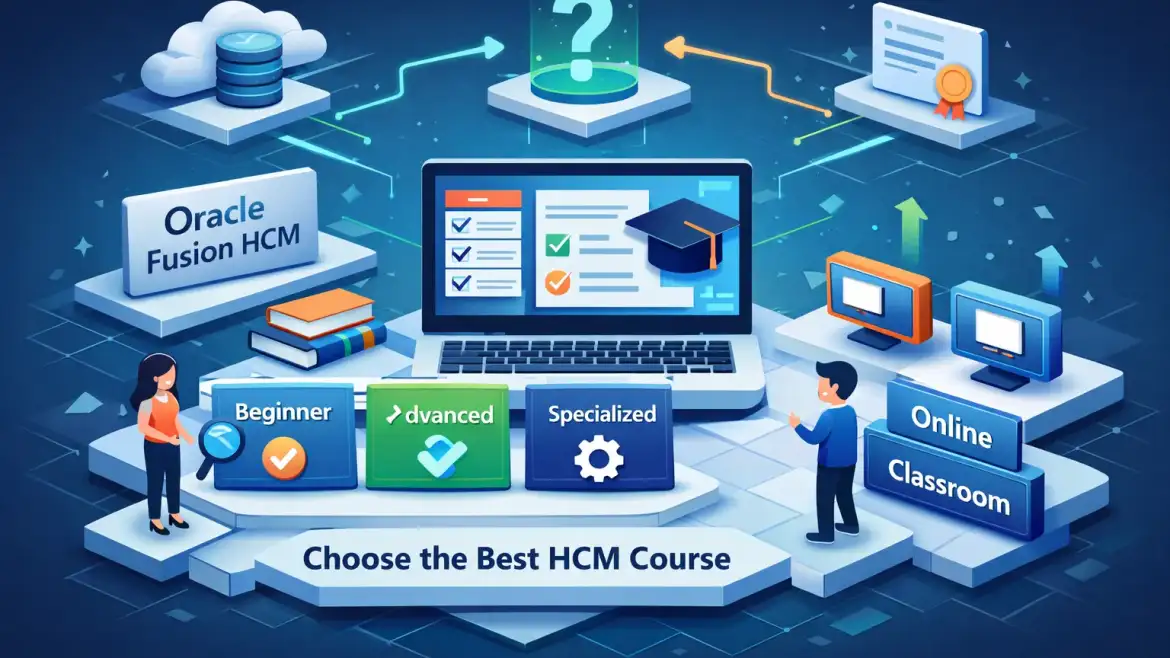
If you need an officially recognized path and deep product knowledge, start with Oracle University’s role‑based learning subscription. If you need rapid, implementation‑grade experience plus placement, choose an intensive bootcamp (CloudShine is one practical option).
This oracle fusion hcm course guide helps you compare official training, bootcamps, and marketplace options and pick the best route for your career goals. Read on to leave with a simple decision rule, a certification roadmap, a provider comparison, and a 90‑day plan you can follow.
Quick answer: Which oracle fusion hcm course should you pick?
Aspirant / Beginner: Choose a comprehensive Core HR + Talent learning path — either Oracle University’s role‑based path or a structured bootcamp that guarantees live labs. That gives you end‑to‑end exposure (hire‑to‑retire) and a portfolio capstone.
Pivoter / Experienced: Combine a focused implementer bootcamp with targeted Oracle certification prep. Prioritize hands‑on labs first, then sit the implementer exam once you can demo real configurations.
Enterprise buyers / HR teams: Buy Oracle’s learning subscription for continuous updates and MyLearn labs, or arrange a corporate CloudShine‑style cohort that includes instance access, role‑based labs, and placement support for new hires.
Rationale: Oracle University = recognition and continuous updates; bootcamps = speed and practical confidence; marketplaces = low cost for conceptual learning. If you want a single next step now: request CloudShine’s syllabus or view Oracle MyLearn paths.
Official Oracle paths vs. bootcamps and marketplace courses
Oracle University training provides role‑based learning subscriptions and structured paths for implementers, admins, and business users. The advantage is official content, exam alignment, and regularly updated MyLearn labs. The trade‑off is subscription cost and a focus on credentialing rather than placement coaching.
Bootcamps (paid third‑party providers like CloudShine and similar vendors) are short, immersive cohorts that emphasize implementation scenarios, live instance access, and portfolio projects. Good bootcamps compress the practical experience you need to be interview‑ready.
Marketplaces (Udemy, Teachable, etc.) offer low‑cost, self‑paced courses. They’re fine for conceptual overviews or refreshing specific features, but most lack verified live instances and structured placement support.
Practical checklist to pick between them
- Time: can you commit full weeks or only evenings/weekends?
- Budget: subscription vs. one‑time bootcamp fee vs. low‑cost course.
- Hands‑on need: do you require live instance access for interviews?
- Placement: do you need resume/mocks and recruiter introductions?
- Employer recognition: will your next employer value Oracle certification?
CloudShine callout: CloudShine combines live Oracle instance access, 100% practical labs (a 60:24 instructor:lab split), and a placement cell — a practical option for learners prioritizing real configurations and interviews. Trainers have 15+ years of industry experience and students get extended instance access for practice.
What to look for in any Fusion HCM training (curriculum, labs, prerequisites)
Curriculum essentials should cover Core HR, Payroll basics, Recruiting & Onboarding, Talent Management (performance, goals, succession), Absence & Time, Workforce Management, Security/roles, Integrations, and reporting (OTBI and BI Publisher). A course that omits Core HR or reporting is incomplete for implementer roles. For procurement or supplier workflows, review the details for Oracle Fusion Supplier Qualification Management Important Roles | CloudShine and the Oracle Fusion Supplier Portal Important Roles | CloudShine.
Hands‑on lab requirements
- Live or verified demo cloud instance access (not just screenshots).
- Step‑by‑step scenario exercises: hire‑to‑retire, payroll run, talent review.
- Data load/export tasks, integrations, OTBI report builds and BI Publisher templates.
- A capstone implementation project you can document and demo in interviews.
Prerequisites and time to competency vary. No‑HR beginners should expect 8–12 weeks of focused study at 10–15 hours/week to reach basic implementer competence; professionals with ERP experience can compress that to 4–8 weeks with daily hands‑on practice. These are estimates—actual readiness depends on practice hours and the complexity of local payroll/localization needs.
Red flags: slide‑only courses, no verified lab environment, anonymous or unverified trainers, and vague placement claims without metrics. If a provider can’t show a syllabus or a sample lab exercise before you enroll, ask why.
Certification roadmap and exam prep
Certification flow is simple: pick a role (implementer, admin, business user), complete aligned training and hands‑on practice, map study to exam objectives, sit the Oracle exam, and maintain credentials via updated courses or MyLearn. Oracle updates exams regularly—always confirm current exam names and codes on Oracle University / MyLearn.
Practical exam prep: prioritize hands‑on labs first. Build two or three end‑to‑end implementation scenarios (hire‑to‑retire, payroll cycle, talent review) you can demo in 5–10 minutes each. Use MyLearn guided labs or your bootcamp instance to reproduce scenarios, then take timed practice tests and review official exam objectives.
Sample 8‑week timeline for an intermediate learner: weeks 1–3 = Core HR configuration + hire/test hires; weeks 4–5 = Payroll/Absence/Time labs; week 6 = Talent & Recruiting scenarios + OTBI reports; week 7 = mock exam + gap study; week 8 = final review and exam application. Adjust pace for experience levels and verify exact exam prerequisites on Oracle University.
Provider comparison: Oracle, CloudShine, bootcamps and marketplaces — who fits which goal
Oracle University — Pro: official content, certification alignment, MyLearn labs and continuous updates. Con: subscription cost and less emphasis on placement help. If you plan to purchase at scale or for an HR team, consider the Oracle learning subscription purchase options.
CloudShine (practical alternative) — Pro: 100% practical curriculum, real Oracle instance access, 60:24 instructor:lab structure, trainers with 15+ years, and a dedicated placement cell (resume building, mock interviews). Con: smaller scale than Oracle — confirm batch timings and exact placement program details before enrolling.
Mid‑sized bootcamps (Mindmajix, Apps2Fusion, TrioTech) — Pro: cohort structure and practical focus. Con: lab depth varies; always ask for sample labs and trainer CVs. For roles that cross into supply chain topics, review Oracle Fusion Inventory Management important roles for expected responsibilities and configuration scope: Oracle Fusion Inventory Management Important Roles | CloudShine.
Marketplace courses (Udemy, Teachable) — Pro: very low cost and quick conceptual refreshers. Con: typically no live instance and inconsistent instructor quality.
Decision rule in prose: choose Oracle University when certification and ongoing product updates matter; choose a bootcamp like CloudShine when you need interview‑ready, hands‑on experience quickly; use marketplace courses only to preview or supplement study on a budget. Before you enroll, get the syllabus with module list; ask for demo lab access; verify trainer profiles and placement metrics; and confirm refund/transfer policies. If you’re evaluating vendors, this What To Consider When Hiring An Oracle Consultant Firm, CloudShine guide can help.
90‑day learning plan: beginner → job‑ready (what to deliver)
Beginner (90 days)
Weeks 1–4: Core HR fundamentals + hire/transfers/assignments labs. Weeks 5–8: Talent, Absence, Time, and OTBI reporting labs. Weeks 9–12: capstone implementation project (hire‑to‑retire flow), 2 mock interviews and resume polish. Deliverables: 3 lab screenshots, one exported OTBI report, and a 1‑page implementation case study.
Mid‑level (60–90 days)
Compressed implementer track: position hierarchies, payroll cycle, integrations, OTBI dashboards, and certification study. Two weeks for interview prep and mock exams. Deliverables: capstone config, sample payroll run export, and certification checklist.
Experienced transferrer (30–60 days)
Pick 2–4 modules for deep dive (e.g., Payroll + Absence), complete a capstone, and run 3 mock interviews. Deliverables: configuration demo, implementation document, and updated resume showing cloud instance experience.
Concrete outputs for recruiters: three lab screenshots, one exported sample report, and a concise one‑page implementation case you can walk through in interviews. Next actions: verify the provider’s lab access window, request a demo class, or learn why Oracle Fusion Cloud matters and contact CloudShine to join a practical cohort.
FAQs
Do I need HR experience to join?
No. You can start without prior HR experience, but you’ll need time to learn HR concepts alongside system configuration. Bootcamps with guided labs accelerate this.
How long to become job‑ready?
Expect 2–3 months of disciplined, hands‑on practice for beginners; 4–8 weeks for those with ERP experience. Real readiness depends on practical lab hours, not course length alone.
Do Oracle certifications expire or need renewal?
Oracle updates its cloud certifications regularly. Check Oracle’s HCM training and MyLearn pages for current maintenance policies and upgrade paths.
Will a bootcamp prepare me for the Oracle exam?
Good bootcamps focus on hands‑on skills and should map labs to exam objectives. Always verify the syllabus explicitly states which exam objectives are covered.
What’s the difference between Oracle’s learning subscription and a bootcamp?
Oracle’s subscription is about official content and continuous access; bootcamps compress practical, interview‑focused experience with instance access and placement support.
Final note: if certification and long‑term updates matter, start with Oracle MyLearn; if you want implementation confidence and placement readiness quickly, join a practical bootcamp. If you want hands‑on instance access plus placement prep, request CloudShine’s syllabus or check Oracle MyLearn paths today.