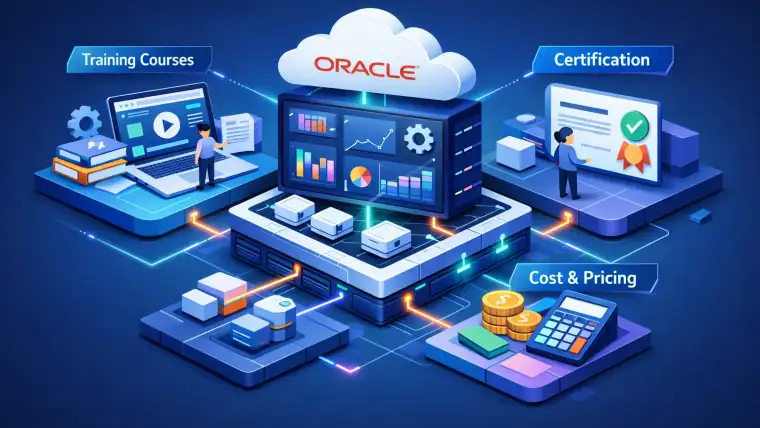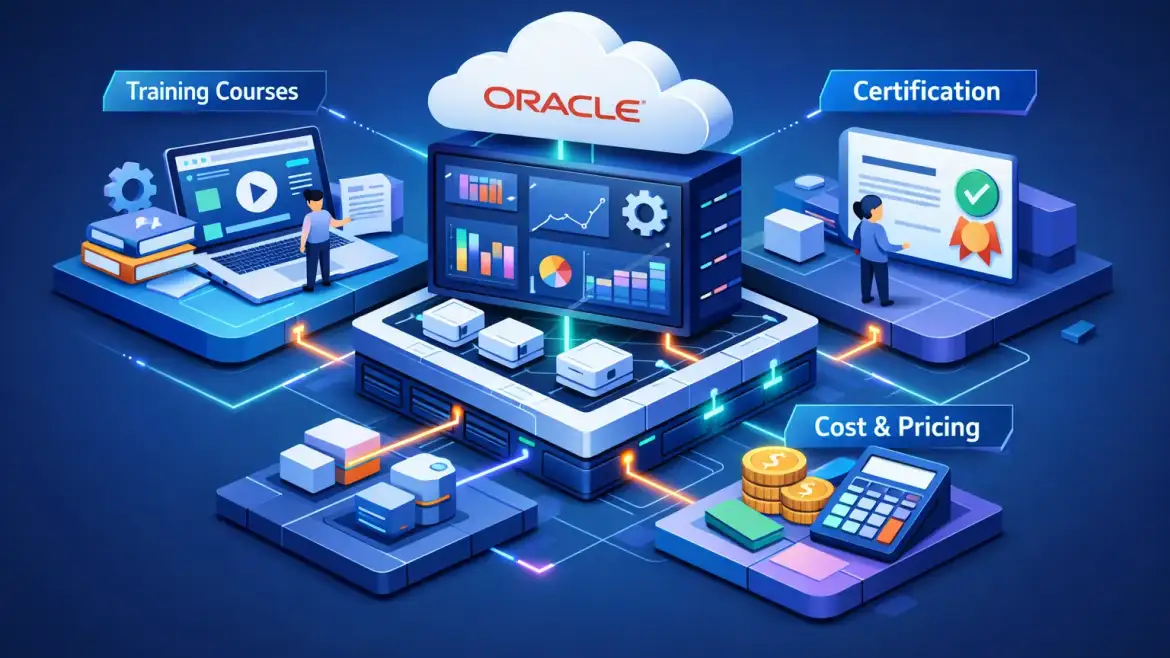
If you’re comparing oracle fusion apps training options, this guide shows what each provider actually delivers (Oracle MyLearn, third‑party bootcamps, and hands‑on vendors like CloudShine), how much time and money to plan for, and a step‑by‑step certification plan for ERP, HCM, SCM and CX roles. I cut the marketing: you’ll get a decision framework, timelines, and interview‑ready checklists so you can pick a path and become hireable.
Sources: Oracle University/MyLearn pages for course names and subscriptions, public list prices (flagged as estimates). Always verify latest exam codes on Oracle’s certification portal before booking.
Quick verdict: MyLearn, a bootcamp, or a hands‑on provider?
Short answer: Oracle MyLearn is the canonical catalog and certification source; third‑party bootcamps buy you schedule flexibility; if your goal is immediate job readiness with real instance practice, a hands‑on provider like CloudShine usually gets you there fastest.
What each gives you: MyLearn provides official role paths, Process Essentials, and implementation certification tracks (subscription access to many modules). Third‑party bootcamps add condensed schedules and varied pricing. Hands‑on vendors focus on live instance time, project deliverables and placement support.
Hard facts (approximate): Oracle Cloud Applications Learning Subscription is commonly cited around $4,995/year; hands‑on labs individually are often $29/month or $299/year; certification exam fees are roughly $245 — verify regionally and for 2026 exam versions.
Who should pick what:
- Pivoter (experienced ERP/HCM pro): pick instructor‑led + implementation labs or CloudShine’s practical bootcamp to convert existing skills quickly.
- Aspirant (graduate/newcomer): start with free Process Essentials and one paid lab month; consider a hands‑on placement track for faster hiring.
- Enterprise (HR/CTO buying training): choose MyLearn subscription for breadth or CloudShine’s 25–30 day corporate upskilling if you need a recruit‑to‑ready program.
One‑line decision rule: Want official certs + catalog depth → MyLearn; want live system practice + placement → CloudShine; want low cost/flexibility → self‑paced + pay‑per‑lab.
Role‑based roadmaps: start here for ERP, HCM, SCM and CX
Start with Oracle’s free Process Essentials to learn the business flow, then pick 2–3 core modules and finish with an Implementation Professional cert plus one hands‑on project to prove you can deliver.
ERP (Finance / Procurement)
Sequence: ERP Process Essentials → Common Features Fundamentals → General Ledger / Payables / Receivables implementation courses → Implementation Professional (example: General Ledger 1Z0‑1054‑26). Expect 60–120 hours total depending on experience. For a short read on platform differences and migration considerations, see the Oracle ERP Cloud (Fusion) vs Oracle EBS (Comparison Summary).
HCM
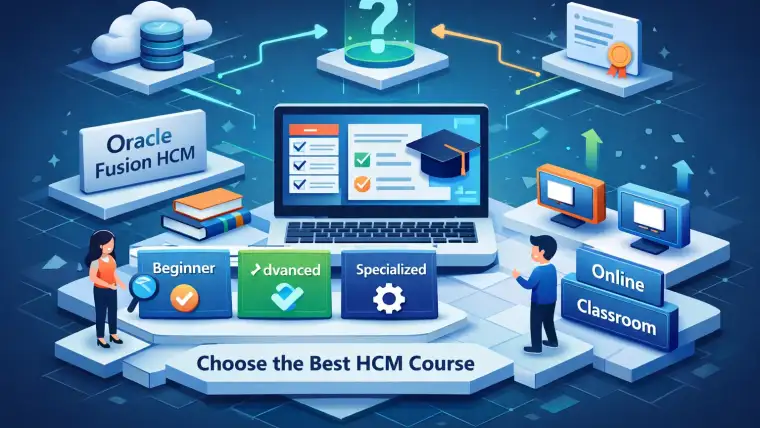
Sequence: HCM Process Essentials → Global HR / Recruiting / Time & Labor fundamentals → HCM Implementation Professional tracks. Plan 50–100 hours to reach implementer readiness. For focused online learning options and course benefits, review the Benefits of Oracle Fusion HCM Cloud Online Training and high‑level product advantages in Benefits of Oracle Fusion Human Capital Management.
SCM & PLM
Sequence: SCM Process Essentials → Inventory / Procurement / PLM courses → module implementation cert. Time: 50–120 hours depending on module complexity and prior supply‑chain knowledge.
CX (Service / Field Service)
Sequence: CX Process Essentials → Service fundamentals → Service/Field Service Implementation Professional. Focus on one service cycle (case → resolution → customer feedback).
How to choose modules: scan target job descriptions and prioritize modules that map to a full business cycle (Hire‑to‑Retire, Procure‑to‑Pay, Order‑to‑Cash).
Actionable checklist: pick 2 core modules, complete one end‑to‑end scenario in a live instance, and earn Process Essentials as a baseline credential.
Formats, labs and realistic budgets
Budget and timeline depend on format: free for orientation, low for self‑paced + lab, mid/high for instructor‑led or corporate programs. Decide by how much live instance time you need.
Format breakdown:
- Free Process Essentials (MyLearn preview) — orientation and flow maps.
- Self‑paced + pay‑per‑lab — low cost; labs commonly $29/month or $299/year (estimate).
- Oracle Learning Subscription — broad access, typically listed around $4,995/year (confirm with Oracle). Learn more about Oracle’s training and subscription options on the official Oracle training page.
- Instructor‑led / Bootcamps — variable pricing; ask for lab hours and project deliverables.
- Corporate upskilling (CloudShine) — intensive 25–30 day programs focused on job readiness, live instances and placement assistance (contact for pricing).
Typical market ranges (approximate): Aspirant (self‑paced): $0–$700; Serious pivot (instructor‑led + projects): $1,500–$5,000; Enterprise cohort: negotiable and volume‑discounted.
Time planning: part‑time learners should budget 3–6 months; full‑time bootcamps can compress learning into 4–8 weeks.
Actionable takeaway: compute ROI — training cost vs expected salary uplift and time‑to‑hire — and always ask vendors for explicit lab hours and placement metrics before you buy.
Certification study plan: an 8‑week blueprint + exam strategy
Follow a paced, lab‑heavy plan: learn concepts, immediately apply them in a live instance, then validate with practice exams and interview walkthroughs.
8‑week blueprint (high level):
- Week 1 — Complete Process Essentials and get lab access; run a guided starter scenario.
- Weeks 2–4 — Deep dive into two core modules: do configuration tasks and one business scenario per module.
- Week 5 — Build one end‑to‑end process (e.g., Procure‑to‑Pay or Hire‑to‑Retire) in the lab and document all steps.
- Week 6 — Take timed practice exams; identify gaps and review weak areas.
- Week 7 — Mock interviews and scenario walkthroughs; refine how you explain config decisions.
- Week 8 — Sit the exam; post‑exam, produce a one‑page project summary for your resume and LinkedIn.
Lab checklist (must‑do tasks): configure enterprise structure, create ledgers/GL, set up supplier/payment terms, load sample data, run a reconciliation/report, perform an integration test.
Exam strategy: aim for >85% on mocks before booking; practice time allocation, flag questions and return, and learn Oracle’s exam format from the cert page. Book labs before the exam so you can reference real screenshots in interviews. For official certification details and exam listings, check Oracle’s certification portal.
How to evaluate providers and get interview‑ready
Direct answer: buy a program that provides live instance hours, measurable deliverables, and interview practice — not just slide decks.
Vendor evaluation — 8 non‑negotiables:
- Live Oracle Fusion instance access with specified hours/duration.
- Trainer credentials: 10–15+ years of real project experience.
- Practical curriculum with at least one end‑to‑end scenario.
- Mock interviews, resume review, and placement support.
- Reasonable batch size, recorded sessions, and post‑class lab access.
- Clear mapping to Oracle certification paths and delta exam support.
- Measurable alumni outcomes (placement rate, sample job titles).
- Transparent refund/retake policy.
Exact questions to ask vendors: “How many live instance hours do I get?”, “Can I see a sample week‑by‑week syllabus?”, “What is your placement rate for Fusion roles?”, “Who will mentor my lab projects?”
CloudShine example (what we provide): live Fusion instances, 60:24 teaching/lab balance, mentors with 15+ years of implementation experience, scenario‑based curriculum, mock interview & resume cell, and a 25–30 day corporate upskilling option. Ask for alumni placement stats and concrete project samples. For a deeper view on why to pursue a technical Fusion track, see Why Should You Learn Oracle Fusion Cloud Technical?.
Resume bullet templates (translate lab work into employer language):
- Configured Oracle Fusion General Ledger structures and executed data loads supporting Procure‑to‑Pay reconciliations.
- Implemented Payables setups and automated supplier payments using bank‑file integrations.
- Delivered end‑to‑end Hire‑to‑Retire configuration including workforce structures and payroll validation scenarios.
- Built inventory and procurement flows in Fusion SCM; executed cycle counts and stock reconciliation.
- Created custom reports for month‑end financial close and reconciled ledger anomalies.
- Led a migration exercise: test data load, validation, and post‑go‑live support runbook.
Actionable takeaway: choose the vendor that gives measurable project deliverables you can show and speak to under interview pressure.
FAQs
Q1: How long does it take to become job‑ready in Fusion Cloud?
A: Typically 2–6 months part‑time or 4–8 weeks full‑time in an intensive program with hands‑on labs. Tip: prioritize one full end‑to‑end scenario and lab time over reading slides.
Q2: Which certification should I take first?
A: Start with Oracle Fusion Process Essentials, then target the Implementation Professional for the module you’ll implement (e.g., Financials General Ledger). Match the cert to target job descriptions.
Q3: Do Oracle MyLearn courses include hands‑on labs?
A: Many MyLearn paths include labs; Oracle also sells lab access separately (commonly $29/mo or $299/yr). Verify per course. For the official Process Essentials orientation, see the Oracle Process Essentials page for details on what’s included and how to enroll: Process Essentials.
Q4: How hard are the Fusion certification exams?
A: Moderate to challenging. Aim for >85% on practice tests before attempting; official passing scores and formats are listed on Oracle’s certification portal.
Q5: Can a provider guarantee placement?
A: No reputable provider ethically guarantees a job. Choose vendors with demonstrable placement processes (mock interviews, resume prep, employer introductions); request metrics. CloudShine offers a placement program with defined services — ask for performance numbers.
Final takeaways & next steps
Two quick points: (1) Start with Process Essentials and at least one month of lab access; (2) If your goal is hireability, prioritize live instance time and a project‑based deliverable you can present.
Next steps:
- If undecided: do the free Process Essentials course today and try one paid lab month.
- If you need fast job readiness: request CloudShine’s syllabus and alumni placement stats or ask Oracle for a MyLearn trial.
- If buying for a team: request a 25–30 day corporate plan and a formal ROI estimate.
Quick comparison
| Provider | Strength | Typical cost | Best for |
|---|---|---|---|
| Oracle MyLearn | Official curriculum, certifications, broad catalog | Subscription ≈ $4,995/yr; labs $29/mo (est.) | Certification depth and product updates |
| Third‑party bootcamps | Schedule flexibility, focused cohorts | Variable ($1,500–$5,000 typical) | Flexible schedules and shorter timelines |
| CloudShine | Live instances, 100% practical labs, placement support | Contact for pricing (corporate plans available) | Immediate job readiness and recruit‑to‑ready upskilling |
For context on Oracle’s broader shift and product focus, you may also find the CloudShine write‑up on Oracle’s platform migration useful: Celebrating a milestone: Oracle completes its move to Fusion Cloud ERP.