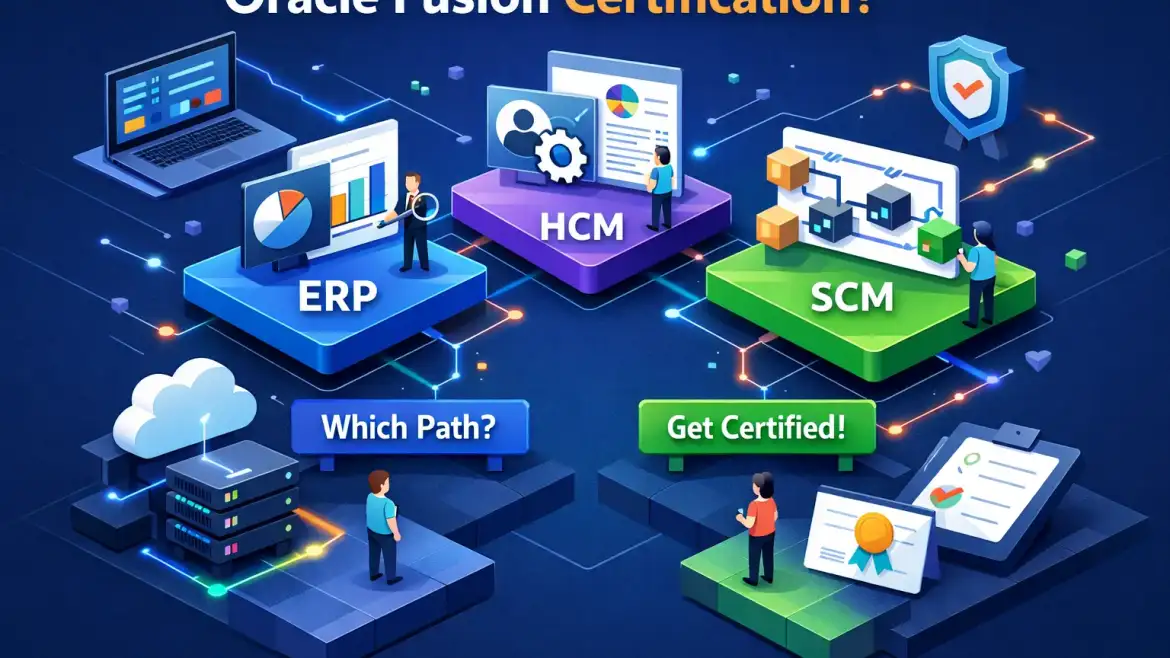
If you need to pick an oracle fusion certification, do it by role: new to enterprise apps → Foundations/Process Essentials; functional ERP/HCM/SCM consultants → the Implementation Professional for your module; integrations/developers → integration, developer or AI Agent Studio tracks. This role-first rule gets you career-ready in the shortest time.
At CloudShine we teach to pass and to work: live Fusion instances, project labs and placement coaching.
Quick pick: choose the right cert by role and career goal
Pick one sentence: if you’re an aspirant or recent grad, start with Process Essentials (Foundations) and follow with one module Implementation Professional. If you’re a functional consultant (Finance, Procurement, HR), go straight to the Implementation Professional for that module. If you build integrations or customizations, target integration/developer tracks and the new AI Agent Studio labs. Enterprise leaders should pick Foundations plus certs that mirror their team’s responsibilities.
Why this matters to recruiters: a module-specific Implementation Professional signals actionable configuration and deployment skills, while Foundations shows broad process understanding. Recruiters look for hands‑on instance experience above all — not just the badge.
Actionable takeaway: choose 1 Foundations + 1 module cert and book the exam 60–90 days out if you’re working full‑time.
The certification landscape: levels, product areas, and sample exam codes
Oracle offers three useful levels for Fusion Cloud credentials: Foundations/Process Essentials (associate-level context and flows), Implementation Professional (hands-on configuration and deployment), and developer/specialty tracks for integrations and AI. Start at Foundations if you lack enterprise SaaS exposure; choose Implementation Professional when you want to be billable on projects.
Product areas and sample exam codes
Below are representative product areas and example exam codes — always verify the live exam page for exact codes and versioning.
ERP (Financials): Process Essentials (1Z0‑1160‑1); General Ledger (1Z0‑1054‑26); Payables/Expenses (1Z0‑1055‑26).
HCM: Process Essentials (1Z0‑1162‑1) and module-specific implementation exams for benefits, payroll and talent.
SCM: Process Essentials (1Z0‑1163‑1); Procurement Implementation (1Z0‑1065‑26) and supplier roles (see Oracle Fusion Supplier Qualification Management Important Roles); Order Management tracks (see our notes on Order to Cash Drop Shipment Flow).
CX & Service: CX Process Essentials (1Z0‑1161‑1); Field Service Implementation (1Z0‑1003‑26).
Developer / AI: AI Agent Studio Foundations (1Z0‑1145‑1 BETA) and cloud integration/developer specialist exams.
Practical note: Oracle updates exams by release year and retires older versions. Always open the Oracle Certification portal, search your exam, and download the “exam topics” PDF to confirm scope and retirement dates.
Exam logistics: costs, format, registration, retakes & maintenance
Format & timing vary: many Implementation Professional exams are hands‑on performance or multiple choice-plus-scenario, typically 60–90 minutes. Passing scores commonly sit in the mid‑60s to low‑70s; for example, 1Z0‑1054‑26 (General Ledger) lists 36 questions, 90 minutes, passing 68% — but check the exam page for your target.
Cost expectations: Fusion Cloud app exams commonly fall between about $95 and $245 depending on level and region. OCI defaults to $245; Applications pricing varies. Don’t lock on a number — confirm on Oracle or Pearson VUE for local currency. For a quick read on typical certification costs, see what Oracle University says about certification costs.
Registration (short steps): create an Oracle SSO, sign into MyLearn/Certification portal, find the exam, purchase the attempt, schedule it within the allowed window, and run the Oracle proctoring system check before exam day.
- Exam‑day checklist: run the Oracle system check 48 hours before; secure a quiet room and government ID; have a 15–30 minute buffer; save screenshots of confirmations; meet your practice-test benchmark before booking.
Retakes and maintenance: retake rules and recert windows differ by track. Some app certs have 18‑month validity; OCI often uses 24 months. Always check CertView and the exam page for recertification guidance.
Actionable rules: book only after hitting your practice-test threshold; run system checks 48h before; keep receipts and CertView access for badge management.
A practical 30/60/90 study plan (role‑based, with hours and metrics)
Set expectations upfront: working professionals should plan 10–15 hours/week; full‑time learners 25–40 hours/week. Use the “60:24” model: roughly 60% guided learning (videos, docs), 24% hands‑on lab practice, rest for revision and mocks. CloudShine’s model follows this split in live cohorts.
Days 1–30 — Foundations & orientation. Goals: read the official exam topics, complete Process Essentials if needed, finish Oracle introductory modules, and execute 3 basic labs (login, navigation, core transactions). Metric: complete one end‑to‑end scenario and score ~60% on first practice quiz.
Days 31–60 — Module deep dive. Goals: complete module configuration workflows, 8–10 hands‑on exercises, follow Oracle University advanced lessons, and run sandbox integrations if applicable. Metric: consistent 70%+ on topic practice sets and document two end‑to‑end scenarios to discuss in interviews.
Days 61–90 — Exam readiness & polish. Goals: take three full timed practice exams, fix weak areas, run final labs (data load/reconciliation), and conduct a mock interview. Metric: 80%+ on two consecutive full mocks before booking the exam.
Role variants: newcomers should front‑load Process Essentials and 2–3 labs in month one. Functional switchers must build 5 real business scenarios (e.g., Procure‑to‑Pay). Technical candidates allocate more time to integration flows and API labs and practice three integration scenarios.
Actionable micro‑plan example: Week 1 = read topics + 2 labs; Week 2 = OU course Module 1–2 + lab; Week 10 = 3 mocks and exam booked.
Study resources: official courses, practice exams, bootcamps — and where CloudShine fits
Official first: Oracle MyLearn, Cloud Applications Learning Subscriptions, the exam topics PDF and Oracle hands‑on labs map directly to the exam scope and should be your baseline. Use official docs to trace exact task lists that appear on the exam topics PDF.
Third‑party options: Udemy courses and specialist books can fill gaps in explanations and provide affordable video time. Bootcamps and paid labs accelerate practice but cost more — they’re worth it if you need fast, guided hands‑on time.
Community: use Oracle Community forums, LinkedIn product groups, and GitHub repos for scripts and sample integrations. Vet practice tests by checking they reference the correct exam code and recent release updates.
Where CloudShine fits: our cohorts provide live Fusion instances, the 60:24 practical split, mentors with 15+ years’ experience, curated 30/60/90 paths, mock interviews and a placement cell that supports resume building and interview prep. For working professionals who lack lab time or career switchers needing job‑ready projects, live instance access and placement coaching close the “cert-to-job” gap. If you need help selecting a provider, read our guide on how to choose an Oracle Cloud training institute for corporate training, and if your company is evaluating external support, see what to consider when hiring an Oracle consultant firm.
- Recommended stacks: Free + official resources (low budget); Udemy + updated practice tests (self‑directed, low cost); CloudShine bootcamp (live instances + placement support, premium).
Final checklist, interview‑ready resume hooks, and FAQs
- Pre‑exam checklist: confirm exam code and date, hit mock threshold (80% target), complete three end‑to‑end labs, verify proctoring environment, and have a backup ID.
Day‑of and post‑exam: immediately save confirmation and screenshots; note areas you missed for follow‑up certs or job interviews. If you pass, add the badge to LinkedIn and prepare one 90‑second scenario that describes a business problem you solved in the instance.
Resume / LinkedIn hook example: “Oracle Fusion Cloud Financials — Implementation Professional (expected 2026). Configured Procure‑to‑Pay flows, reconciled GL using Accounting Hub, and executed data migration for three test companies.” Interview bullets: explain context → your action (configs, data loads) → measurable result (reconciled, cut error rates, shortened cycle time).
FAQs
Q: Do I need prior experience to take an Implementation Professional exam?
A: No strict prerequisite for most tracks, but Process Essentials or hands‑on lab time is strongly recommended for success.
Q: How much should I budget?
A: Expect $95–$245 for the exam itself; training and lab access vary widely — budget $300–$2,000 depending on route. Verify current pricing on Oracle’s pages.
Q: How long are Fusion credentials valid?
A: Validity varies by credential and release; some Application certs use 18 months, OCI commonly uses 24 months. Always check CertView and the exam page.
Q: Will a certification get me a job?
A: A badge helps, but hiring decisions favor demonstrable hands‑on projects and interview performance. CloudShine pairs cert training with placement prep to bridge that gap. For help practicing interview scripts and job‑focused questions, consider practice sets and mock interviews that include finance interview resources such as Workday Finance Interview Questions.
Q: How do I confirm the exact exam code and topics?
A: Go to the Oracle Certification portal → search the exam → download the “exam topics” PDF and check the retirement/release notes. For specific exam registration steps, Oracle’s scheduling flow is available through their certification pages and exam listings.
Summary: pick by role (Foundations + one module), follow a 30/60/90 plan with lab practice, and verify exam details on Oracle’s pages. If you want a printable 30/60/90 checklist or a short demo of CloudShine’s live Fusion labs and placement support, request a low‑commitment consultation to see how live instances and project coaching fit your timeline. For an unrelated example of a ranked product post, see Best STLTH Flavours of 2026 — 10 Vaper-Ranked Picks to Try.