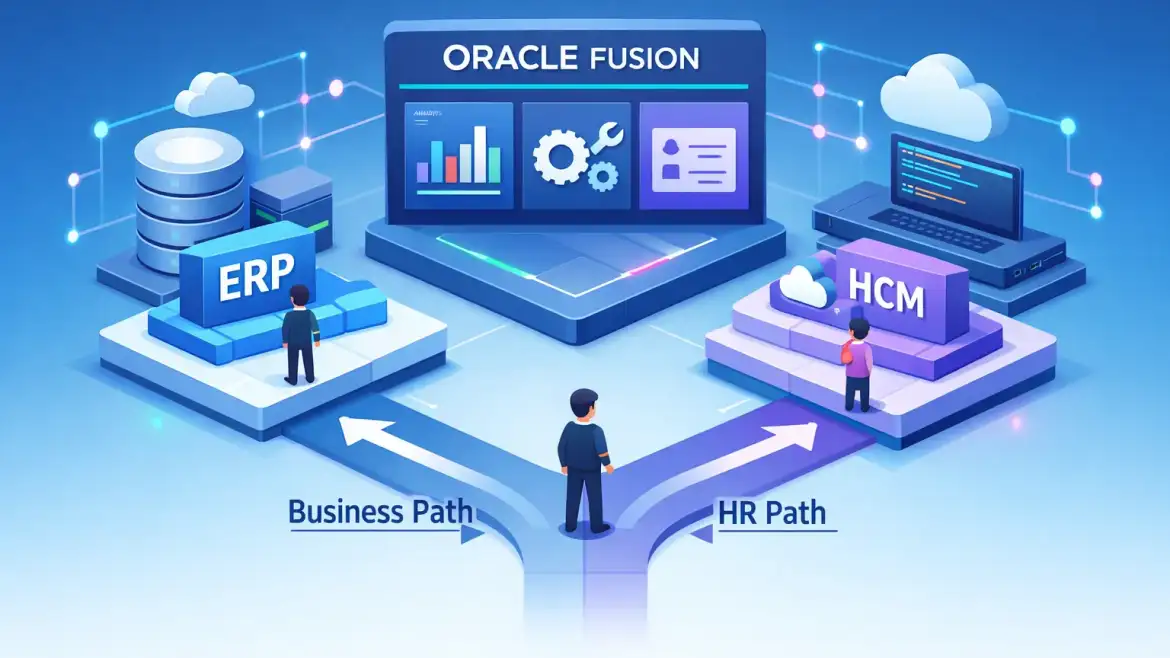
Direct answer: If your objective is vendor‑aligned certification and official curriculum, Oracle University is the safe, compliance‑friendly route. If you need job‑ready skills, live Fusion instances and placement support, a high‑quality third‑party program (or CloudShine’s practical track) is faster and usually cheaper.
This article is written for three audiences: the Pivoter (EBS/on‑prem consultants moving to cloud), the Aspirant (recent grad seeking job‑ready experience) and the Enterprise buyer (HR/IT leaders upskilling teams). Recommendations below use Oracle University exam mapping and real‑world lab requirements to help you choose the right training path and follow an 8‑week plan to get interview‑ready.
Which Oracle Fusion course fits your role?
Direct answer: Start by matching your role to the course type — functional consultants need role‑based application tracks (Financials, HCM, SCM); technical implementers need configuration, integration and data‑migration training. Below are concise, practical picks for common personas.
Pivoter (EBS/on‑prem consultants). Recommended path: Oracle Fusion Financials/ERP Implementation course plus extended hands‑on sandbox time. Focus your labs on GL setup, AP/AR flows and integrations that mirror your old EBS processes.
Aspirant (recent graduate). Recommended path: foundation Fusion Cloud course (ERP or HCM basics) paired with a third‑party practical programme that provides live instances and placement support. You need real tasks to show on a resume — not just slides.
Enterprise buyer / HR leader. Recommended path: use Oracle University for official process alignment and compliance, and supplement with targeted corporate upskilling (25–30 day bootcamps) that emphasize hands‑on adoption and cutover readiness.
Decide now: pick your role, estimate time available (weeks), and choose the top two modules you need to master (e.g., GL + AP, or Core HR + Payroll).
Oracle University: what you get, costs, and limits
Direct answer: Oracle University (OU) supplies official, up‑to‑date curriculum mapped to certification objectives and offers subscription lab access — but it can be pricier and sometimes less focused on job‑ready deliverables.
OU formats include self‑paced learning, instructor‑led virtual classes, and digital lab subscriptions. Key products: Cloud Applications subscriptions and separate self‑paced lab subscriptions (Oracle lists single‑month and annual tiers). Exam vouchers are sometimes bundled in subscription packages; verify before you buy.
How exam alignment works: OU courses are explicitly mapped to exam objectives and Oracle publishes “review exam topics” for each credential. That makes OU ideal when an employer requires a vendor‑aligned certification path. For official certification listings and exam details see the Oracle University certification pages.
Pros: official materials, direct exam alignment, continuous updates with releases. Cons: higher cost, lab environments can be restricted in time or scope, and placement assistance is generally limited.
Actionable takeaway: Choose Oracle University when certification alignment or vendor compliance is mandatory for the role. If you need hiring momentum, pair OU content with extra live instances or a placement programme.
Third‑party alternatives: how to evaluate them (including CloudShine)
Direct answer: Third‑party providers range from marketplaces (budget courses) to specialist academies (deep hands‑on labs and placement). Evaluate vendors on live‑instance access, dedicated lab hours, trainer experience, placement support, and whether syllabi map to Oracle exam objectives.
| Scorecard field | Why it matters |
|---|---|
| Cost | Budget and ROI — compare total cost including labs and exam fees |
| Live‑instance access | Practice on real Fusion tenants, not screenshots |
| Lab hours | Enough guided and self practice hours to build demos |
| Trainer experience | Practical tips, troubleshooting, and interview prep |
| Placement / mock interviews | Resume feedback, mock calls, referrals to hiring partners |
| Certification mapping | Do course topics cover Oracle’s exam objectives? |
| Student reviews | Recency of updates and outcomes (job placements) |
Marketplaces like Udemy or LinkedIn Learning are low cost but often lack dedicated live tenants. Specialist providers (Apps2Fusion, Triotech) offer deeper lab time and enterprise focus. CloudShine’s practical spotlight: we deliver real Fusion instances, a 60:24 model (60 hours instructor‑led + 24+ hours dedicated labs), trainers with 15+ years’ experience, and a placement cell that provides mock interviews and resume support — built specifically for job‑readiness.
Actionable takeaway: Use the scorecard to shortlist two providers, request a sample lab demo, and compare each syllabus to Oracle’s exam topics if certification matters.
Certification path & exam checklist (ERP / Financials / HCM / SCM / Service)
Direct answer: Certification adds credibility; the right approach is: pick the correct exam, map each exam objective to a lab task, practice with timed mock tests, then schedule the real exam.
- Identify the right certification (module + level: Associate → Implementation Professional).
- Read the official Oracle exam topics page and note prerequisites. For an approachable mapping and learning‑path reference see the Oracle certification learning paths guide.
- Build a lab matrix that maps each exam objective to one practical exercise.
- Take timed practice tests and allow 2–4 weeks of focused review before booking the exam.
Example exam mapping (verify current codes on Oracle University):
| Module | Example Exam Code (2026) |
|---|---|
| ERP Foundations | 1Z0-1160-1 |
| Financials — General Ledger | 1Z0-1054-26 |
| Financials — Payables / Receivables | 1Z0-1055-26 / 1Z0-1056-26 |
| SCM — Inventory | 1Z0-1073-26 |
| Service — Implementation | 1Z0-1064-26 |
Pass scores typically fall in the mid‑60% range and certifications commonly require refresh every ~18 months. Always confirm exact pass criteria and recert rules on Oracle’s certification pages.
Actionable takeaway: Create one spreadsheet per exam: objectives → lab exercise → completion date → mock test score.
Practical syllabus & hands‑on lab plan (functional vs technical)
Direct answer: Functional tracks emphasize transaction flows and reporting; technical tracks emphasize configuration, data migration and integrations. Below is a prioritized lab list you can complete in 40–80 hours depending on role.
Financials / ERP (functional) — labs: set up COA; create and post journals; AP invoice and payment cycle; AR receipts and collections; period‑end close and reconciliations; OTBI report builds. Recommended lab time: 30–40 hours.
HCM (functional) — labs: enterprise structure and business rules; hire/terminate flows; absence setup and basic payroll run; compensation plan configuration; OTBI workforce reports. Recommended lab time: 20–30 hours.
SCM (functional) — labs: inventory transactions, order management flow, procure‑to‑pay scenario, basic planning run. Recommended lab time: 25–35 hours.
Technical implementer — labs: flexfields and value sets, security roles and provisioning, HCM/Data loaders, Page/Application Composer customizations, sample OIC integration, OTBI/BIP report authoring. Recommended lab time: 40–60 hours.
- Interview/demo tasks to build into your resume: an end‑to‑end P2P or O2C scenario; a data load & reconciliation; a custom OTBI or BIP report; a security role use case.
Actionable takeaway: Turn these labs into weekly milestones and tag 2–3 as “resume demos.”
How to choose — decision matrix, 8‑week study plan, enrollment checklist and FAQs
Direct answer: Match your objective (certify vs get hired fast), budget and time. Below is a compact decision matrix, an 8‑week study plan, an enrollment checklist and short FAQs to remove doubt.
Decision matrix: If employer/partner compliance is required → Oracle University + targeted labs. If rapid placement is the priority → choose a provider that guarantees live instances and placement support (CloudShine is designed for that). If on a tight budget → combine a budget marketplace course with a paid Oracle lab subscription and peer study groups.
- Weeks 1–2: Foundations — navigation, cloud concepts, core flows.
- Weeks 3–4: Deep module labs — GL/AP/AR or Core HR + payroll basics.
- Weeks 5–6: Integrations, security, reporting; build 2 resume demo tasks.
- Week 7: Mock exams, gap remediation, mock interviews.
- Week 8: Final exam (or certification attempt) + placement outreach.
Time commitment: 10–15 hrs/week for working professionals; 25–35 hrs/week for full‑time bootcamp candidates.
Enrollment checklist: confirm target module and exam; verify live lab access and hours; check trainer credentials and placement support; request a demo lab session; review refund/placement guarantee terms. For practical guidance on what to look for when hiring a consultant or vendor, see what to consider when hiring an Oracle consultant firm.
FAQs
How long to prepare for an Oracle Fusion certification? Typical preparation is 6–12 weeks for someone with domain experience (20–40 hours of hands‑on labs). Newer entrants should allow 12–20 weeks depending on hours available.
Is Oracle University necessary to pass the exam? No. OU gives official alignment which helps, but many candidates pass with third‑party courses plus rigorous lab practice. If your employer requires vendor alignment, pick OU.
Do third‑party courses include exam vouchers? Sometimes — it varies. Always confirm exam attempts and voucher inclusion before enrolling.
What matters more — labs or lectures? Labs. Real tenant access and end‑to‑end scenarios are the fastest way to become job‑ready.
Final takeaway: Certification builds credibility; real instances build capability. If you need both certification alignment and hiring momentum, pair Oracle University content with a live‑instance, placement‑focused programme. At CloudShine we provide live Fusion tenants, industry trainers, and a placement cell that runs mock interviews — verify supplier qualification and portal roles and request a demo to verify the lab environment and sample mock interview before you commit.