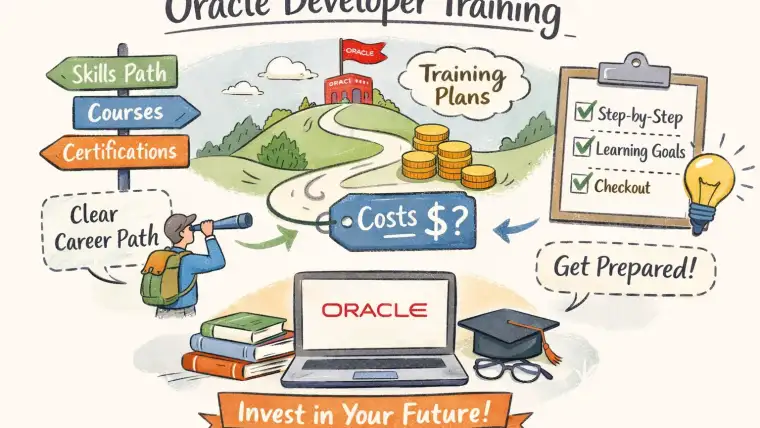
If you’re shopping for oracle fusion financials training the short answer is: for a certification badge fast, use Oracle University’s MyLearn + target exams; for hire-ready implementation skills, choose an instructor-led, project-based course with live Fusion tenants and placement support. For career-changers the fastest route to hire is an intensive, sandbox-driven bootcamp—CloudShine’s 100% practical model is one example that combines live instances, recorded project demos and placement coaching.
Quick answer: Which training path gets you job-ready?
If your priority is a resumeable implementation skillset plus placement help, pick an instructor‑led, hands‑on program that provides live Fusion instances, project deliverables and mock interviews. If you already have deep finance or ERP experience and only need the Oracle badge, Oracle University’s Learning Subscription and targeted exams are the shorter route.
Decision rule: Oracle University for certification; a CloudShine‑style bootcamp for implementation + hire support. If you’re undecided, book a demo lab within 7 days and confirm the vendor provides an actual Fusion tenant (not slides).
7 Best paths for 2026 (pick one based on outcome)
- Oracle University Learning Subscription — official exam alignment and digital labs; fastest for badge-first candidates.
- Oracle University instructor‑led exams package — exam-focused classroom training for candidates targeting a specific certification quickly.
- CloudShine 100% Practical Bootcamp — live Fusion tenants, 60:24 instructor/lab balance, placement cell; designed for fast hiring.
- Third‑party intensive bootcamps (Triotech, Mindmajix Oracle Fusion Financials training, GoLogica Oracle Fusion Financials course equivalents) — project work and flexible schedules for working professionals.
- Self‑paced video + Oracle MyLearn labs — low cost, best for experienced practitioners who only need brushing up (examples: GangBoard Oracle Fusion Financials training).
- Corporate upskilling / Recruit‑Train‑Deliver programs — for enterprises needing coordinated team readiness.
- Project apprenticeship / internship + community labs — gain implementation hours by working on small client projects or simulated migrations.
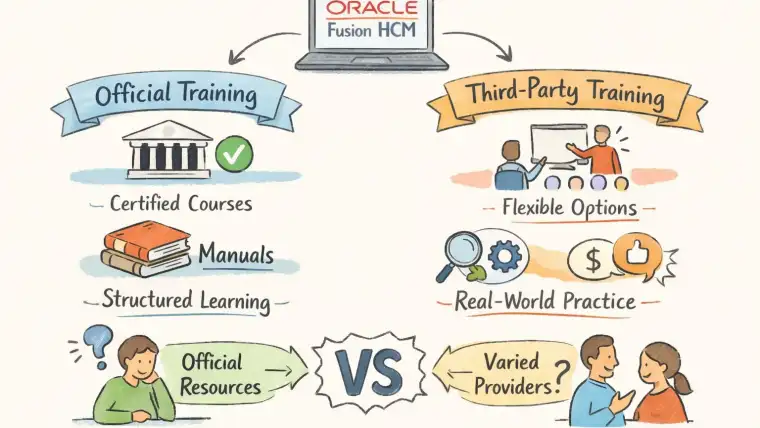
Official Oracle vs third‑party — what each path delivers
Oracle University (official)
What you get: role-based learning paths, official exam blueprints, MyLearn labs and product docs. Pros: authoritative materials and direct mapping to Oracle exam objectives. Cons: higher price, less personalized mentorship, and limited placement support.
Third‑party providers (CloudShine, Triotech, Mindmajix, GoLogica)
What to look for: authentic live‑tenant access, project deliverables, trainer implementation experience (15+ years ideal), and an active placement cell. For guidance on vendor selection see our notes on what to consider when hiring an Oracle consultant firm. Pros: practical labs, portfolio-ready projects, mock interviews and flexible schedules. Cons: variable quality—vet trainers and confirm tenant authenticity before you pay.
Compact checklist to choose fast: lab access (real tenant vs simulated); trainer pedigree (implementation years); placement support (mock interviews + employer connections); certification alignment (does the syllabus map to Oracle exam objectives?).
Certification map: exams, codes, prerequisites and realistic costs
Typical progression: Foundation → General Ledger → Payables/Receivables → Accounting Hub/Revenue Management. Codes are updated annually—always verify on Oracle’s exam pages.
| Module | Example Exam Code (illustrative) | Typical Prep Time |
|---|---|---|
| General Ledger | 1Z0‑1054‑26 (or current variant) — see the official 1Z0-1054-26 exam page | 3–8 weeks |
| Payables | 1Z0‑1055‑25/26 | 3–6 weeks |
| Receivables | 1Z0‑1056‑26 — see the official 1Z0-1056-26 exam page | 3–6 weeks |
| Accounting Hub | 1Z0‑1060‑26 | 4–8 weeks |
Costs: Oracle exam fees vary by region—expect roughly $200–$400 per exam; Oracle Learning Subscriptions bundle labs and prep for an annual fee. Training providers range from low‑cost self‑paced ($50–$500) to premium bootcamps ($1,000–$3,000+). Plan 3–8 weeks prep per exam depending on prior experience. For real exam experiences and study notes see a community write-up of real exam experience notes for 1Z0-1056-26.
Where to get real hands‑on practice — labs, sandboxes and projects
Start with Oracle MyLearn and Oracle’s product docs for guided labs and step‑by‑step configuration. The Oracle docs site also covers administrative tasks like activating your Oracle Fusion Intelligence subscription and cloud admin topics such as accessing instance settings.
Complement that with vendor demos and official tutorial videos (for example an Oracle Fusion Financials demo video and a Fusion GL configuration walkthrough) and community scripts on GitHub for sample data loads.
For true implementation practice you need access to a Fusion tenant. Confirm your vendor offers a live instance and how many lab hours are included. At CloudShine we follow a 60:24 model—60 instructor hours plus 24+ hours of dedicated lab time on live Fusion instances so students complete real configurations. If you want alternative vendor courses to compare, review offerings such as Apps2Fusion Oracle Fusion Financials Cloud v1.1 course or course roundups like OracleERPGuide’s Oracle Fusion Financials training.
Six short labs you should complete and record as portfolio pieces: configure a Chart of Accounts and run a trial balance; process AP from invoice through payment run; complete AR billing, receipts and cash application for a monthly cycle; perform a bank reconciliation and day‑to‑day cash management; create a fixed asset, run depreciation and record a disposal; execute a month‑end close including reclassifications and reconciliations. For each lab record a 5‑7 minute screencast and a one‑page “What I configured and why” summary. For examples of common pitfalls, review Common Errors in Oracle Fusion Cost Accounting.
A practical learning plan: 3 sample timelines
Choose a timeline by budget and baseline experience.
Beginner (part‑time): 9–12 months
Months 1–2: finance fundamentals + Fusion basics. Months 3–6: core modules (GL, AP, AR, FA). Months 7–9: project labs, mock implementations, resume and interview prep.
Intermediate (finance/ERP background): 4–6 months
8–12 weeks module training + 4–8 weeks intensive labs + 2–4 weeks certification push and interviews.
Experienced (EBS/ERP pro): 1–3 months
Targeted module skilling, delta exam prep and recorded project demos for hiring conversations.
12‑week bootcamp (working pro schedule): Weeks 1–2 foundation + GL; Weeks 3–6 AP/AR/Cash; Weeks 7–9 Assets + reporting; Weeks 10–11 project labs + mock interviews; Week 12 certification prep and applications. For additional commercial courses and comparison, see other vendor trainings such as CloudShine Oracle Fusion Finance training or marketplace options like GangBoard.
Pick the right course: 12‑point checklist, price ranges and CloudShine next steps
- Do you provide a live Oracle Fusion tenant?
- How many instructor-led hours and how many lab hours per student?
- Trainer experience: years and implementation background?
- Are materials mapped to Oracle exam objectives?
- Placement support: resume, mock interviews, employer introductions?
- Batch schedule flexibility and recordings access?
- Student-to-trainer ratio in labs?
- Real project deliverables and templates included?
- Refunds or trial/demo classes?
- Salary placement assistance and employer connections?
- Cost, payment plans and EMI?
- Post‑training mentoring window and instance access?
Ballpark prices: self‑paced video courses $50–$500; instructor‑led short courses $400–$1,200; intensive bootcamps with live tenants + placement support $1,000–$3,000+. Verify lab hours and placement commitments before you enroll.
Why consider CloudShine: we emphasize implementation mastery—not just slides. Our model includes live Oracle Fusion instances, a 60:24 instructor-to-lab balance, trainers with 15+ years’ implementation experience, and a dedicated placement cell that runs mock interviews and resume coaching. We’ve trained 500+ consultants and partner with 50+ organizations across the USA, India and UAE. If you want to read about the typical skills employers expect for remote Fusion functional roles, review this summary of key skills and qualifications for Work-From-Home Oracle Fusion Financial Functional Consultant.
Next steps: shortlist two vendors, book a demo lab, confirm tenant access and ask the 12 checklist questions. Enroll within 14 days to maintain momentum.
FAQs
How long to become a Fusion Financials functional consultant? Realistic ranges: 1–3 months for experienced ERP pros, 4–6 months for finance/ERP backgrounds, and 9–12 months for beginners on a part‑time schedule.
Do I need a finance/accounting background? Strongly recommended. Understanding GL, AP and AR processes shortens the learning curve significantly, but motivated non‑finance learners can progress with practical labs and mentorship. For role clarity and task expectations see Oracle Fusion Finance Important Roles.
Are Oracle certifications necessary to get hired? They help signal competence, but employers prioritize hands‑on implementation experience and portfolio projects over certificates alone.
Can third‑party courses qualify me to sit Oracle exams? Yes—anyone can register for Oracle exams. Choose courses that explicitly map to Oracle exam objectives for best results. For certification pathway reading, this Oracle Fusion Financials certification guide is a useful primer.
Summary and action
If you need a badge fast, pick Oracle University; if you need to be hire‑ready, choose a project‑based bootcamp with live tenants and placement support. Shortlist two providers, book demo labs within a week, and start the 12‑week practical plan if you want measurable outcomes in under three months.
Ready to test a live tenant? Book a 15‑minute training needs call or request a free demo lab with CloudShine to confirm lab access and trainer pedigree before you sign up. For supplier and procurement-related configuration topics you may also find our notes on the Oracle Fusion Supplier Portal and Oracle Fusion Supplier Qualification Management helpful when mapping end-to-end procure-to-pay processes.