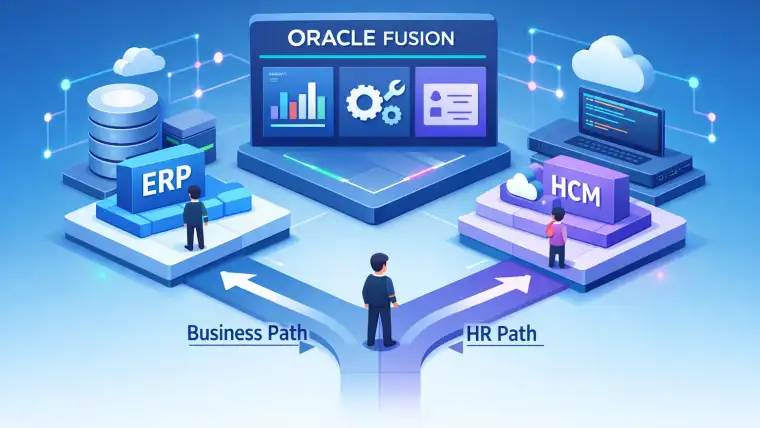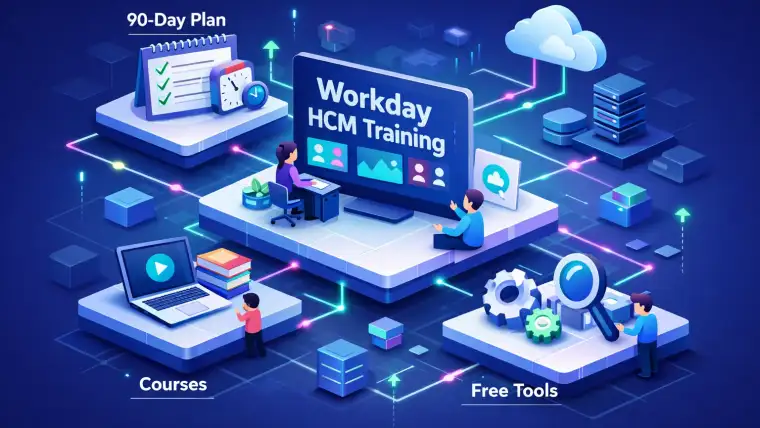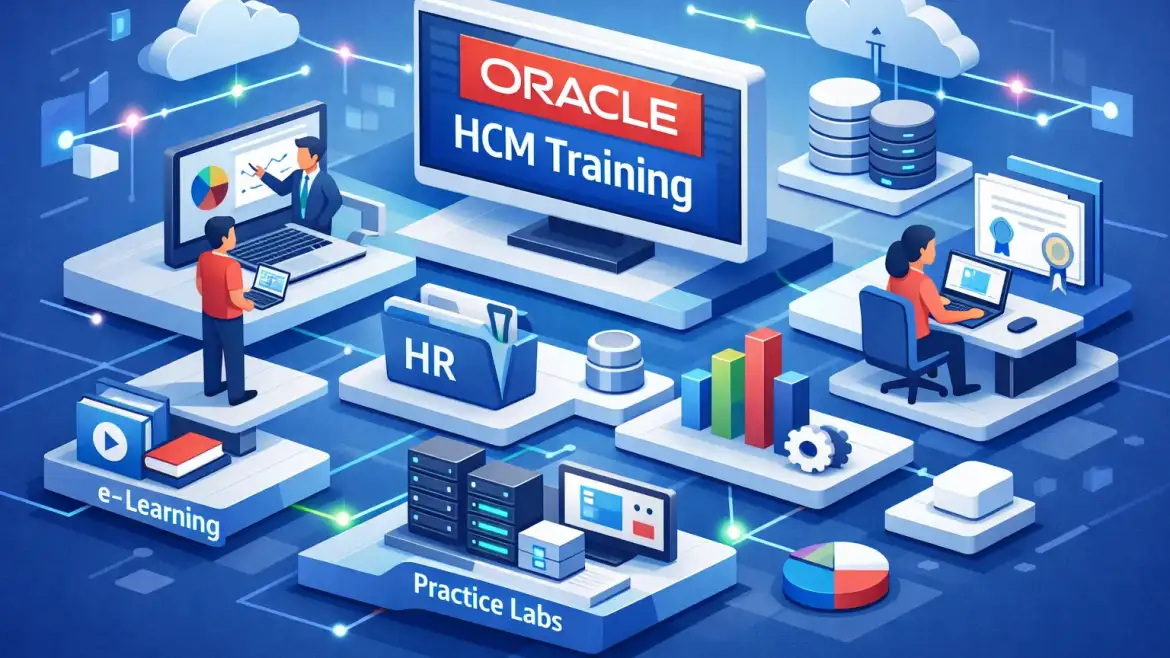
If you need job-ready Oracle Fusion HCM skills, choose a program that bundles instructor‑led lessons with private labs and placement support; if you only need a certification, Oracle University is the straightest route. For anyone comparing oracle fusion hcm online training options, this guide cuts the noise and gives practical course picks plus a 30–90 day action plan so you can enroll and start practicing immediately. CloudShine’s 100% practical model (live Fusion instances, 60:24 training-to-lab rule, placement cell) is one of the clearest options for learners who want to move into HCM roles fast — I’ll flag where CloudShine is the practical pick.
How to choose the right Oracle Fusion Cloud HCM course (level & budget)
Direct answer: Match the course format to your objective — certification, hands‑on employability, or fast conceptual learning. Your budget and available time decide the tradeoff.
Courses fall into four formats: self‑paced video, vendor bootcamp, Oracle University role paths, or intensive practical providers (CloudShine-style). Pick by outcome: certification only (Oracle University), quick orientation (Udemy/LinkedIn), or job-readiness (practical provider with private instances and placement support).
Decision priorities (short checklist)
- Private sandbox access for repeated hands‑on cycles
- Instructor experience (real-world consultants, 10–15+ years)
- Alignment with current Oracle exam codes and role paths
- Placement/mock-interview support and resume help
- Curriculum currency (covers last Cloud updates)
- Schedule flexibility for working professionals
Quick picks by persona: Aspirant (limited budget, needs placement) — CloudShine or a low-cost course plus CloudShine labs for a capstone; Pivoter (mid-budget, wants cert) — Oracle University for the exam track plus a practical bootcamp for projects; Enterprise teams — CloudShine’s Recruit‑Train‑Deliver corporate program or Oracle University role-based training for compliance and standardization. For guidance on structuring corporate programs, see How to Choose Oracle Cloud Training Institute for Corporate Training, CloudShine.
Actionable takeaway: before you pay, ask vendors three direct questions — Do I get private sandbox access? Is the syllabus aligned to current Oracle exam codes? Is mock interview/resume assistance included? Also review vendor selection advice such as What To Consider When Hiring An Oracle Consultant Firm, CloudShine when evaluating partners.
Top providers compared: what you actually get
Direct answer: Not all “Oracle Fusion HCM” courses are equal — the real value comes from private lab hours and placement support. Price alone is a poor proxy for employability.
Oracle University — Official, role-based learning and exam paths; best for formal certification. Labs and subscription bundles exist but pricing and lab access vary by region. Official role training is available via Oracle University HCM training.
CloudShine — 100% practical curriculum with private live Fusion instances, the 60:24 instructor-to-lab model, mentors with 15+ years and a dedicated placement cell; best for job‑readiness and interview evidence.
TrioTech — Promoted long-format programs (90+ hours) with private cloud claims; verify sandbox access and placement outcomes before committing.
Henry Harvin — Marketed as comprehensive (India-focused); check whether private instance access and placement guarantees are included.
Udemy / LinkedIn Learning — Cheap orientation and concept coverage; no guaranteed labs or recruitment support; useful for initial familiarization only.
| Provider | Best for | Labs Included | Cert Prep | Duration | Price Bracket | Placement Support | Who should avoid it |
|---|---|---|---|---|---|---|---|
| Oracle University | Certification & official paths | Varies (Oracle labs) | Yes | Self‑paced / role paths | Premium | Limited | Job‑seekers needing private sandboxes |
| CloudShine | Job‑readiness, placement | Private live Fusion instances | Yes (practical prep) | Instructor‑led + labs (60:24) | Mid / Value | Strong (placement cell) | Only certification seekers |
| TrioTech | Hands‑on long bootcamp | Private (claim) | Some | 90+ hours (claimed) | Mid | Varies | Those needing verified placements |
| Henry Harvin | Comprehensive India-focused | Varies (confirm) | Some | Varies | Mid | Varies | Those who need guaranteed labs |
| Udemy / LinkedIn | Quick orientation | None guaranteed | No | Few hours | Low | None | Anyone needing live practice |
Actionable takeaway: prioritize providers that include private lab time and real-case exercises — those are the items hiring managers can verify in interviews. If you need cross-skilling into finance modules, consider the relevant CloudShine finance training track such as Oracle Fusion Finance Training in India | Order to Cash Drop Shipment Flow | CloudShine as an add-on to HCM practice.
Certification roadmap: exams, codes, costs and realistic prep
Direct answer: Oracle certs are module-based (Core HR, Time & Labor, Payroll). Pair Oracle University learning paths with hands-on practice to maximize your pass probability.
Key examples include Oracle Global Human Resources Cloud Implementation Professional (example code 1D0-1046-24-D) and Time & Labor Cloud (1Z0-1048-24). Exam registration runs through Oracle Learn (mylearn.oracle.com) or Pearson VUE; tests are proctored. Exam prices vary by region — confirm current fees on Oracle University (some implementation exams list ~$245 as a typical price point). For a practical certification overview see this Oracle Fusion HCM certification guide, and for the specific implementation exam see the official Oracle exam 1Z0-1046-26 page.
Realistic prep — Oracle recommends practical exposure (many implementer roles assume ~6 months of hands‑on configuration). If you have less time, simulate project cycles intensively in a private instance and only book the exam after repeated lab cycles.
4‑week sample study map
Week 1: Core HR and org model — build company, legal employers, jobs, positions; run two lab cycles for org setup. Week 2: Hire-to-onboard and Absence/Time — complete hire transactions and absence plans. Week 3: Payroll basics plus Talent modules — run a sample payroll and configure performance cycles. Week 4: Capstone: stitch cycles together, take practice tests and timed re‑runs.
Exam prep tips (Practical Pro): maintain a config playbook of every screen you touched, keep HDL CSV exports for data migration examples, document troubleshooting notes and error IDs, and do timed practice runs that mimic exam tasks. Actionable takeaway: only register for the official exam after you’ve completed at least three full lab cycles (org → hire → payroll → talent) in a private instance.
Hands‑on practice: sandboxes, labs, and five real exercises that prove you can do the job
Direct answer: employers hire demonstrable work — a short portfolio of five configured business cycles beats 100 hours of theory.
Where to get lab access: CloudShine offers private live Fusion instances and post‑course access under its practical model; Oracle University provides lab environments (subscription dependent); some bootcamps and vendors (e.g., TrioTech) claim private cloud access — always verify access duration and private instance retention.
Exercise 1 — Organizational model & position hierarchy
Goal: Map a multinational org with legal employers, departments and positions. Steps: create legal entities, business units, jobs and position hierarchies, and link reporting lines. Expected output: a working Org chart and position budget view. Common pitfalls: inconsistent effective dates and missing grade/job relationships; document your decisions.
Exercise 2 — Hire & onboarding flow
Goal: Complete a hire transaction and an employee self‑service onboarding. Steps: create person/worker records, run hire, configure onboarding tasks. Expected output: hire transaction audit trail, completed onboarding checklist. Pitfalls: incomplete offer templates and missing notification templates — capture screenshots of the hire flow.
Exercise 3 — Absence management & Time & Labor
Goal: Configure absence plans, balances and an approval flow. Steps: set eligibility, absence types, accruals and simulate requests. Expected output: balanced absence ledger and approval audit. Pitfalls: incorrect entitlement calculations and locale/time zone settings; save unit test data.
Exercise 4 — Payroll run for a sample employee
Goal: Configure a simple payroll and produce a payslip. Steps: set payroll elements, run a test payroll, reconcile payslip lines. Expected output: finalized payslip, pay run logs and recon report. Pitfalls: incorrect tax element mapping and pay element assignment; keep HDL snapshots.
Exercise 5 — Talent/performance review cycle
Goal: Create a goals and performance review cycle and report results. Steps: configure review template, enroll employees, run rating aggregation and produce an OTBI report. Expected output: completed reviews and an OTBI dashboard showing distributions. Pitfalls: audience misconfiguration and report joins; archive report definitions.
How to document lab work: include screenshots with timestamps, HDL CSV exports, a short configuration checklist (what you changed and why) and OTBI report images — bundle these as a 2–3 page capstone you can present in interviews. Low-cost alternatives: practice with HDL sample files and Oracle Learning Library labs, but private instance practice remains superior.
Actionable takeaway: convert one capstone into a concise case study — that’s your interview proof.
Costs, timelines, prerequisites and expected career outcomes
Direct answer: expect 1–3 months of focused instructor-led training plus lab cycles to be job-ready for junior HCM roles; certification-focused paths and official exam readiness take longer and may assume 6+ months of hands-on exposure.
Prereqs by level: Entry — no strict prereq (HR understanding helps). Intermediate — bachelor’s degree and familiarity with HR processes and data loaders. Advanced — consulting experience, integrations and BI/OTBI knowledge.
Typical duration buckets (guide): self‑paced (10–50 hours, low cost); vendor bootcamps (40–120 hours, mid cost with lab claims); Oracle University (premium, role-based subscriptions and official exam attempts); CloudShine (practical-heavy, 60:24 instructor-to-lab balance with placement focus).
Career outcomes and rough salary ranges: US average HCM consultant roles typically sit around $112k–$150k annually; senior/architect positions rise above that. India mid-level consultants commonly fall in the 20–30 LPA range. Roles include Functional Consultant, HCM Admin and Implementation Specialist. For current market salary context, review Oracle HCM Cloud salary data.
ROI checklist (quick): lab‑hours per dollar, placement support scope, trainer experience (years), curriculum currency and alumni hiring feedback. Actionable takeaway: if target employers pay >$100k in your market, invest in a practical program that guarantees private lab time and placement coaching.
Your 30–90 day action plan, checklist and FAQs
Direct answer: enroll, complete five lab cycles, finish a module capstone, then move into mock interviews and placement outreach.
- 0–7 days: choose provider, confirm private sandbox access and retention, set a fixed weekly schedule; register accounts (Oracle Learn, vendor portal).
- 8–30 days: complete Core HR modules and run two end-to-end lab cycles; document configuration and export HDL samples.
- 31–60 days: finish Time & Labor, Payroll and Talent labs; run a full capstone (hire → payroll → talent) and take practice exams.
- 61–90 days: finalize capstone as a 2–3 page case study, schedule the official exam if ready, and complete 8–12 mock interviews (resume and LinkedIn polish with placement support). See interview prep templates such as Workday Finance Interview Questions, CloudShine for mock interview formats and question structure you can adapt to HCM roles.
Enrollment checklist: laptop with modern browser, stable internet, sample HR data (10–50 employees), HDL template and basic OTBI familiarity. Pick a concrete deliverable by day 30 — for example, a configured payroll run with screenshots — and use that as your interview demo.
FAQs
Do I need HR experience to learn Fusion HCM?
No — basic HR concepts make learning faster, but the platform and processes are taught in labs so motivated beginners can progress quickly.
How much do Oracle Fusion HCM certification exams cost?
Costs vary by exam and region; some implementation exams list around $245. Always confirm current fees on Oracle University or Pearson VUE before budgeting.
Can I practice without a paid sandbox?
Limited practice is possible with Oracle Learning Library and sample HDL files, but interview‑facing employers expect private instance experience — invest in private lab hours where possible.
Which exam should I take first?
Start with the Global Human Resources/Core HR implementation professional exam — it forms the implementation base for other modules.
How long until I can get a job?
With focused instructor‑led training, private labs and placement help, many learners move into junior roles in 1–3 months. Timelines vary by prior experience and market demand.
Key resources: Oracle Learn (mylearn.oracle.com), Pearson VUE (home.pearsonvue.com/oracle), Oracle Learning Library (oracle.com/learning-library) and HDL documentation on Oracle Docs. For additional module-specific reading, see CloudShine’s overview of supplier roles at Oracle Fusion Supplier Qualification Management Important Roles | Oracle Fusion application Cloud Service | CloudShine.
Conclusion — Choose the route that guarantees private lab time and live projects; that’s the fastest path from learning to billable work. If you want a practical, mentor‑led option with placement focus, compare providers’ lab‑hours and outcomes — CloudShine’s Fusion HCM offerings are designed specifically for that outcome, so compare lab‑hours before you commit.