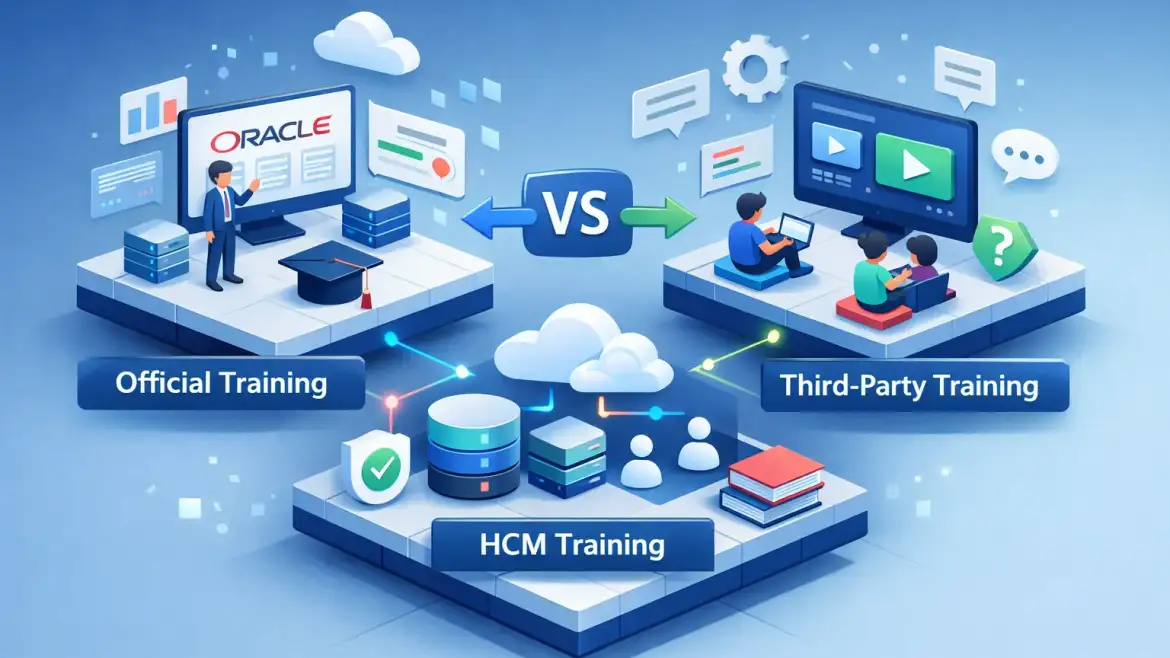
If your primary goal is official certification and exhaustive module depth, go with Oracle University; if you need a faster, lower‑cost route to hands‑on skills, a reputable third‑party course will do; and if you want live‑instance practice plus placement support, CloudShine is the practical middle ground. This guide compares curriculum, certification mapping, lab access, costs, delivery formats and who each option fits best so you can enroll with confidence in your Oracle Fusion Cloud HCM course choice.
Quick snapshot: Oracle University vs Third‑Party vs CloudShine
Oracle University — Best for certification-aligned, end-to-end learning. Curriculum: full HCM suite (Global HR, Workforce Management, Payroll, Talent, Absence/Time). Labs: role-based Oracle-hosted environments are available in official paths. Certification path: direct alignment to Oracle implementation professional exams. Typical duration & cost tier: longer paths and subscription pricing; higher cost but includes official exam mapping and curated learning plans.
Third‑party providers — Best for budget and speed. Curriculum: concentrated on Core HR, Payroll and Talent to match hiring demand. Labs: varied — some include sandboxes, many rely on guided demos. Certification path: useful for interview prep but not always aligned to Oracle exam blueprints. Typical duration & cost tier: 25–45 hours is common; prices range from low-cost self-paced packages to premium instructor-led options.
CloudShine — Best for job-readiness and placement focus. Curriculum: practical Core HR, Payroll, Talent plus integrations, reporting and scenario-based projects. Labs: live Oracle instances, extended mentor support and a dedicated placement cell. Certification path: prepares you for both job tasks and Oracle certification if you want it. Typical duration & cost tier: structured 60:24 model (60 hours instructor-led + 24 lab hours), tiered pricing with placement assistance and mock interviews.
Practical takeaway: Want a cert-first career as an implementer? Oracle University. Need faster employability on a budget? Choose a focused third‑party provider. Need both live-instance practice and placement support? CloudShine is the pragmatic middle path.
Curriculum reality check — what modules hiring managers actually expect
Recruiters hiring for Fusion HCM roles routinely look for Core HR, Payroll, Recruiting/Onboarding, Talent Management (performance/comp), Absence, Time & Labor, Security/roles, Integrations (A2A and file-based), and OTBI/BI reporting. If your course skips several of these, you’ll be less competitive for implementation roles. For further context, see our article on Benefits of Oracle Fusion Human Capital Management, CloudShine.
Oracle University covers the full suite and specialized workforce management topics; it’s the only route that consistently includes Absence, Time & Labor, and deep payroll localization. Third‑party courses typically focus on Core HR, Payroll and Talent because these areas produce hires faster. CloudShine emphasizes hands‑on Core HR, Payroll, Talent, plus integrations and end‑to-end project scenarios you can put on a resume.
What you must be able to do (job‑readiness checklist)
- Configure a hire‑to‑retire process: create positions, hire employees, manage transfers and terminations.
- Define payroll elements, run a payroll cycle and post payroll adjustments.
- Create an absence plan and process an absence/time scenario end‑to‑end.
- Set security roles and test role‑based access to HR screens and data.
- Build a basic OTBI report that extracts employee and payroll data.
- Run a simple data load (HCM Data Loader or spreadsheet import) and validate transactions.
For reporting practice that bridges HCM reporting concepts with real analytics workflows, see our piece on Oracle Analytics Cloud In Finance Applications | Oracle Analytics Cloud, CloudShine.
Actionable tip: before you enroll, map the provider’s syllabus against this checklist. If more than two items are missing, expect to supplement training with labs or projects.
Hands‑on labs and sandbox access — how much is enough, and how to verify it
Practical confidence comes from repetition. Target at least 24 structured lab hours for basic job readiness and 40+ hours for implementer-level confidence. Labs teach debugging, data integrity checks, and how configuration choices propagate through pay and reporting — things slides can’t convey.
In practice, a 24‑hour plan focuses on core cycles and troubleshooting; a 40‑hour plan adds integrations, payroll corner cases and a mini end‑to‑end implementation project. For concrete, lab-focused training examples see providers that publish hands-on lab content such as Apps2Fusion’s Oracle HCM lab training.
Sample lab schedule in prose: a 24‑hour plan dedicates 8 hours to Core HR (employee lifecycle + data loads), 8 hours to Payroll (elements, run, adjustments) and 8 hours to Talent/OTBI and role testing. A 40‑hour plan expands each area and includes a two‑day integration workshop (HCM → Payroll or ATS) plus a portfolio-ready project.
Provider verification checklist — questions to ask before you pay
- Is the sandbox Oracle‑hosted and a real Fusion instance or just a simulated UI?
- How long will each student keep access after the course ends?
- Are student accounts full‑admin or role‑limited for safe practice?
- Are lab tasks documented and graded so I can track progress?
- Can I export screenshots, config notes or a project artifact for my portfolio?
- What is the support SLA for lab help (response time, mentor access)?
CloudShine note: our 60:24 model pairs 60 instructor‑led hours with 24 dedicated lab hours, live instance access and extended mentor support — designed for learners who need both practice and placement assistance.
Price, delivery formats and guarantees — what you’ll actually pay for
Delivery formats: self‑paced is cheapest but offers little mentor feedback; instructor‑led gives real-time Q&A and is best for learning complex flows; bootcamps are fast and intense; blended formats are the most practical for working professionals. Choose delivery mode to match your schedule and learning style, not just price.
Pricing reality: Oracle University uses subscription/exam bundles and typically costs more upfront but maps directly to certification. Third‑party vendors are priced for affordability and speed — expect a wide range depending on hours and lab access. CloudShine provides tiered pricing with placement assistance, mock interviews and resume help; check eligibility and terms for placement guarantees.
Before you buy, read the fine print: clear refund windows, explicit placement guarantee terms (eligibility, timelines, exclusions), and lab‑extension policies matter more than glossy marketing. Judge ROI by how quickly a course can get you interview‑ready for the specific job listings you’re targeting and whether the provider helps you create a verifiable project artifact.
How to choose — a practical checklist by career stage
Answer three questions: Do you need a vendor‑recognized certification? Are you switching careers and need placement support? Are you hiring or upskilling a team? Your answers map to the recommended route.
Recommended match by persona: Aspirants (fresh grads) — choose a focused third‑party course with labs or CloudShine if you want placement support. Pivoters (EBS/legacy ERP pros) — CloudShine or Oracle University depending on whether you need certified proof or job‑ready projects. Implementers/consultants — Oracle University for deep module coverage, supplemented with extra lab time from a third‑party or CloudShine for real projects. Corporates — look for a “Recruit‑Train‑Deliver” model and custom batch timing that aligns to your go‑live. For corporate buyers, our guide on How to Choose Oracle Cloud Training Institute for Corporate Training, CloudShine covers what to negotiate and pilot options.
Red flags: no lab access; trainers with no real-world implementation experience; vague placement guarantees; a syllabus that omits payroll or core HR tasks. When buying at scale, negotiate: ask for corporate pricing, a pilot batch, custom labs that match your configuration, and a short evaluation window for trainee performance.
Enrollment roadmap, a sample 6‑week prep plan and FAQs
Enrollment roadmap in short: pick your primary goal (cert, job, fast upskill), vet providers with the verification checklist above, request a demo lab, compare actual lab access and guarantees, then enroll and follow a structured study + lab schedule.
Sample 6‑week plan (milestones)
- Weeks 1–2: Core HR and data model — hire‑to‑retire flows and HCM Data Loader exercises.
- Week 3: Payroll basics — define elements, run a test payroll, reconcile results.
- Week 4: Talent & Recruiting + build a simple OTBI report that supports a business question.
- Week 5: Integration and security labs — basic file integration and role testing.
- Week 6: Mock interviews, create a 3‑page project artifact with screenshots and business context, and polish your resume.
FAQs
Do I need prior experience to take a Fusion HCM course?
No formal prior Fusion experience is required for entry‑level courses, but familiarity with HR concepts, basic Excel and understanding of business processes will speed learning. For implementer tracks, prior ERP or HRIS exposure is helpful.
Which route is fastest to a job in HCM?
A focused third‑party course or a placement‑focused program like CloudShine with live instance practice and interview coaching is typically the fastest path to an entry role.
Are Oracle University certifications necessary to get hired?
Certs help, especially for consultancy and implementer roles, but employers increasingly value verifiable hands‑on projects and live‑instance experience. If you can do both — cert + portfolio — you’ll stand out.
How many lab hours make me job‑ready?
Target 24 structured lab hours for basic job readiness; 40+ hours to feel confident as an implementer. Quality of labs (real instance + mentor feedback) matters more than raw hours.
What should I ask about placement guarantees?
Ask for eligibility criteria, timeline for placements, refund or repeat training clauses if placements don’t materialize, and any caps on interview introductions. Vague language is a red flag.
For cross-functional examples showing how HR workstreams interact with finance processes, you may find our walkthrough of an Order to Cash Drop Shipment Flow | CloudShine useful as a template for documenting end-to-end artefacts.
If you are comparing Oracle to other HCM systems before choosing a training path, our Workday HCM Tutorial, CloudShine provides a concise primer to help map skills across systems.
Final action: pick based on your goal — certification, rapid hire, or employer‑ready implementation skills. If you want the balanced option (official-level rigor plus real instances and a placement cell), request a demo from CloudShine’s Oracle Fusion HCM course and compare it against an Oracle University demo and a reputable third‑party provider such as MindMajix Oracle Fusion HCM training to see which lab access and guarantees match your needs.