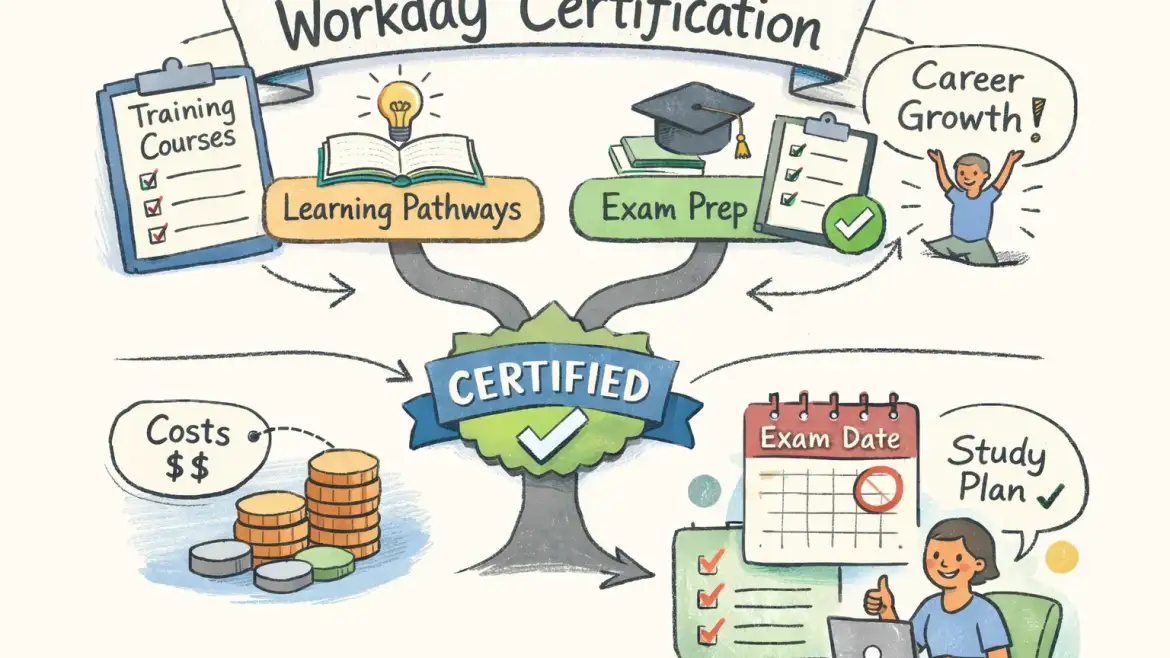
If you’re an HR, finance, or integrations professional, a Workday training certification can accelerate hiring and salary momentum — but official Workday courses are often restricted and expensive. This guide maps the common certification tracks, gives realistic costs and timelines, and lays out a practical 4–8 week exam plan, including how CloudShine’s hands‑on bootcamps help unaffiliated learners get job‑ready.
What you’ll get: a quick decision map, training tradeoffs (official vs third‑party), three sample budgets, a concrete study timeline, registration steps, and interview‑ready next actions.
Quick verdict: Is a Workday certification the right next step for you?
Short answer: Yes if you need employer recognition or deep product skills; choose third‑party bootcamps if you’re unaffiliated and need hands‑on practice quickly. Official badges matter to employers; practical tenant experience gets you interviews.
Pivoter (experienced IT/ERP or finance pros)
If you’re moving from legacy ERP to cloud ERP, certification plus real tenant hours shortens the hiring curve. You should target a functional cert aligned to your background (Financials for finance, Integrations for middleware engineers).
Aspirant (recent grads or career starters)
If you need job‑ready artifacts and interview practice, prioritize hands‑on bootcamps and a portfolio project over chasing official partner-only badges you can’t access.
Enterprise (internal upskilling)
If your employer will sponsor training and exams, the official Workday Academy route is often the fastest path to internal roles and promoted pay bands.
Quick checklist to decide now:
- Employer‑sponsored? Go official.
- Need tenant/Lab access and placement help? Choose a reputable bootcamp (CloudShine included).
- Only need basic end‑user skills? Start with self‑paced content.
Actionable takeaway: If your company will pay, ask HR/Training to enroll you. If not, skip waiting — read section 3 to evaluate bootcamps that include live instance practice and placement help.
Which Workday certification fits your role?
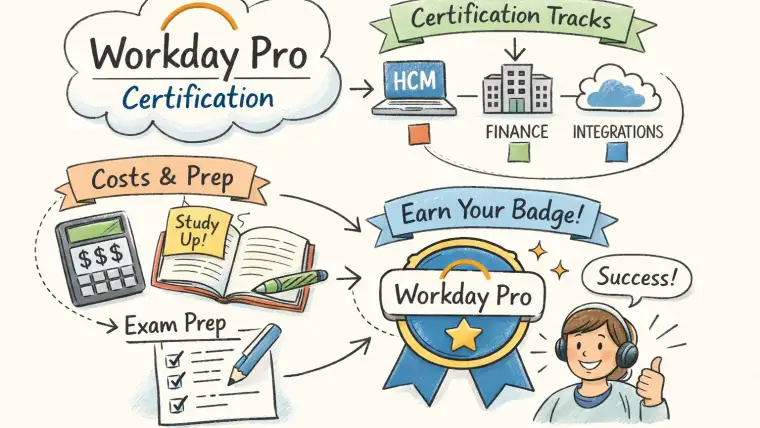
Direct answer: Pick the certification by the job you want, not by what sounds trendy — HCM for HR, Financials for finance, Integrations for technical roles, Platform Admin for system admins, and Workday Pro for broad operational mastery.
Workday Pro: Broad operational mastery aimed at customers and service teams; good for administrators who manage security, tenant updates and business processes.
HCM (Core/Payroll/Recruiting): Covers hire‑to‑retire configuration, payroll, recruiting workflows — ideal for HR practitioners and implementers.
Financials: Focuses on GL, AR/AP, reporting and period close — choose this if you’re a finance or accounting professional moving into ERP roles.
Integrations: Workday Studio, connectors and APIs for middleware and technical consultants who build system-to-system flows.
Platform Admin: Tenant management, configuration testing and release control — aimed at system administrators keeping the instance healthy.
Prism/Adaptive: Treat analytics and planning (Prism, Adaptive Planning) as complementary skills; they increase hireability but often aren’t the primary cert employers ask for.
Time & exam expectations (ballpark): HCM / Financials — 4–8 weeks of study with course/lab time; Integrations — 6–10 weeks; Platform Admin — 2–6 weeks depending on prior platform exposure. Exams are typically proctored and require hands‑on familiarity more than pure theory.
Actionable takeaway: Choose one primary cert and one complementary skill (for example HCM + Integrations). Write a 3‑month goal with weekly milestones: training, 20–40 tenant hours, two mock exams, portfolio artifacts.
For a quick overview of popular certification tracks, see this list of top Workday certification courses.
Training routes: Official Workday Academy vs self‑study vs bootcamps — and where CloudShine helps
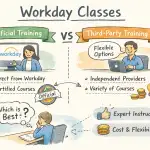
Direct answer: Official Workday training is authoritative but often restricted and costly; self‑study is economical for end users; third‑party bootcamps give unaffiliated learners practical tenant access and interview readiness.
The official Workday Academy provides the definitive curriculum and is required for some partner roles. It’s recognized by employers but access is usually limited to Workday employees, partners or paying customers and units are expensive (see next section). For enrollment details, refer to the Workday enrollment job aid.
Self‑paced options (Workday Learning, Coursera integrations) are low cost and useful to learn concepts. They rarely include a live tenant or mentor guidance, so they’re fine for end users but insufficient for consultant‑level interviews.
Third‑party bootcamps combine live labs, scenario projects and mentor coaching. They’re unofficial but highly practical: students finish with configuration hours, problem logs and interview artifacts employers value.
At CloudShine we replicate implementation realities: live cloud instance access, scenario‑based projects that mirror hire‑to‑retire and procure‑to‑pay cycles (see related posts on Oracle Fusion Self Service Procurement Important Roles | CloudShine and Oracle Fusion Inventory Management Important Roles | CloudShine), expert mentors with 15+ years of experience, and a placement cell that provides resume reviews and mock interviews. Our 100% practical model (60 instructor hours + 24+ lab hours) is designed to bridge the “no‑employer” gap.
If your employer pays, go official. If you need hands‑on practice and hiring support, pick a bootcamp with live tenant access. If your goal is basic user knowledge, start self‑paced content and add labs later.
Actionable takeaway: Decide your delivery method this week and book your first slot — an official course, a CloudShine bootcamp intake, or a start date for self‑study.
Costs, time and budgeting — realistic numbers you can rely on
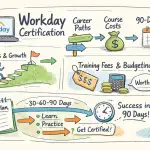
Direct answer: Expect an $800 exam fee plus official training units at roughly $800 per unit; total investment usually falls between $1,500 and $3,500 depending on route and experience.
Official route: Workday commonly charges about $800 per exam attempt. Instructor‑led courses are often priced by training units at ~$800/unit; typical courses run 1–5 units, so a multi‑day course can be $800–$3,200 on top of the exam fee.
Third‑party bootcamps: Prices vary widely, from roughly $300 on the low end up to $2,000 for full bootcamps that include labs and placement support. Expect to pay more for guaranteed placement or extended mentorship.
Extras to factor: retake fees (another $800), paid practice exams, travel for proctored tests (if required), and the opportunity cost of study hours.
Sample budgets:
Employer‑sponsored: Employer pays training units and exam; your out‑of‑pocket is typically zero—just schedule time (2–8 weeks).
Independent bootcamp: Bootcamp $700–$1,500 + exam $800 = $1,500–$2,300 outlay; plan for 6–8 weeks of part‑time study.
Career pivoter (official + prep): Official course(s) $1,600–$3,200 + exam(s) $800 + mock/interview prep $200–$500 → $2,600–$3,500 total and 8–12 weeks to build a hireable portfolio.
Actionable takeaway: Pick the sample scenario closest to you and write one line: “Total $ / Weeks to commit / Who pays.” Add an $800 buffer for a possible retake.
Exam format, passing score, retake policy and a practical 4–8 week study plan
Direct answer: Most Workday exams are proctored, closed‑book, roughly 50 questions in 120 minutes with a passing threshold commonly around 80%; the effective study mix is course content + tenant practice + timed mocks.
Exam structure: Expect multiple‑choice and multi‑select scenario questions. Results are typically pass/fail; confirm exact rules for your target exam. Retake rules and wait periods can vary — a short waiting window (several days) is common.
Study components to prioritize: official course materials, 20–40 hours in a live tenant practicing configuration and business processes, two to three timed mock exams, and focused flashcards for multi‑select logic.
Practical plan templates:
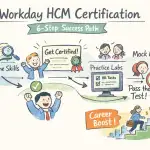
- 4‑week fast track (experienced): 6–10 hours/week. Week 1: review fundamentals + 8 tenant hours. Weeks 2–3: deep config labs. Week 4: two timed mocks and weak‑spot remediation.
- 6‑week standard (novice): 8–12 hours/week. Weeks 1–2 fundamentals and concepts; Weeks 3–4 practical builds and test cases; Week 5 one full mock + fixes; Week 6 final revision + exam.
- 8+ week deep dive (career pivot): 6–8 hours/week spread over structured projects, integration scripts, reporting exercises and a portfolio deliverable for interviews.
Exam‑day checklist:
- Stable internet, quiet room and government ID ready.
- Device with required browser and proctor software installed; run a 10–15 minute pre‑check.
- Have notes/flashcards reviewed and two timed mocks completed in the 48 hours before the exam.
Actionable takeaway: Choose your timeline (4/6/8 weeks), book the exam slot at the end of your calendar, and schedule two mock exams into your plan.
How to register, take the exam, recertify and convert the cert into a job (plus FAQs)
Direct answer: Official exams generally require employer or partner enrollment through Workday channels; unaffiliated candidates should use third‑party programs (CloudShine and similar bootcamps) to gain tenant hours and placement support.
Registration & logistics: If you work for a Workday customer or partner, request enrollment via your learning admin or Workday Education contact. Independent learners should evaluate bootcamps that bundle live tenant access and mock interviews, or contact authorized partners for occasional public seats (see this practical guide on how to get Workday certification for more on pathways).
Recertification and currency: Workday updates frequently; plan on periodic recertification or continuing education (Workday moved to more structured recert cycles recently — verify the latest schedule for your target cert). For recent changes and what they mean for learners, review this overview of Workday certification and training changes. Keep a log of tenant hours and training activities to demonstrate currency to employers.
Turning certification into interviews: Put measurable artifacts on your resume — cert name, tenant hours, and concise project bullets (e.g., “Configured hire‑to‑retire business process in a 5,000‑employee mock tenant”). Build three mini‑stories for interviews: a design tradeoff (e.g., approvals and business process design — see Understanding Fusion Purchasing Approvals Hierachy | CloudShine), a bug triage, and an integration troubleshooting case. Export anonymized screenshots, process maps and test scripts as portfolio appendices (example process flows: Oracle Fusion Sales Order to Shipment Cycle | CloudShine).
CloudShine placement support: Our bootcamps pair live instance practice with resume workshops and mock interviews. We help candidates convert lab work into interview‑ready portfolio items and offer tiered placement‑guarantee tracks for qualified learners.
FAQs
Q: Can I get Workday certified without a partner or customer employer?
A: Official badges are generally restricted; use reputable third‑party bootcamps with live labs to gain practical experience and interview readiness.
Q: How much does certification cost?
A: Expect roughly $800 per exam attempt plus training costs. Official instructor‑led courses are often ~$800 per training unit; total outlay typically ranges $1.5k–$3.5k depending on route.
Q: What’s the exam format and passing score?
A: Most Workday exams are proctored, ~50 questions in 120 minutes, with a pass threshold commonly near 80%; confirm specifics for your chosen track.
Q: How long should I study?
A: Experienced users can prepare in 4 weeks; novices should plan 6–8 weeks with focused tenant practice and mock exams.
Q: Will certification get me a job?
A: Certification helps, but hiring decisions hinge on demonstrable tenant hours, project artifacts, and interview performance. Certifications plus a portfolio and mock‑interview practice are the fastest path to offers.
Summary: If an employer covers it, take the official path; if you’re independent, pick a practical bootcamp with live tenant access and placement support. Commit to one primary cert + one complementary skill (for example SCM — see An Intro to SCM Modules In Oracle Cloud Applications | CloudShine), budget for training + an $800 exam buffer, and follow a 4–8 week, lab‑first study plan.
Ready to get hands‑on? If you’re unaffiliated and want live tenant practice plus resume and interview coaching, CloudShine’s Workday bootcamps are built to convert lab hours into hireable experience—apply for the next intake or request an orientation call to map your 8‑week plan.